Back Country Bulletin
News from the Back Country
Get it on the Apple StoreGet it on the Google Play Store
NewsSportRuralCommunityEat, Drink, Stay
Back Country Bulletin
Law of Ukrainian agricultural exports: What doesn’t kill you makes you stronger

13 February 2025, 1:04 AM

In 2024, Ukrainian agricultural exporters achieved impressive results. They sold goods worth US$24.5 billion. This is the second best result in the entire history of Ukrainian agriculture. The victory was achieved despite many problems and thanks to intensive improvement of agriculture. The war became the main driver of competitiveness for Ukrainian farmers.Victory in spite of all the problemsImage: The Ministry of Agrarian Policy and Food of Ukraine2024 was the best year for Ukrainian agricultural exports since the beginning of the war. According to the Ministry of Agrarian Policy, in 2024, Ukraine exported agricultural products worth US$24.5 billion. Agricultural exports accounted for 59 per cent of total exports. This is the second highest figure in the entire history of Ukraine’s independence. More was exported only in 2021. Then, exports amounted to US$27.7 billion.1 Before the war, Ukraine annually exported agricultural goods worth US$22 billion.In total, in 2024, Ukraine exported 78.3 million tons of agricultural products. Sunflower oil accounts for the largest share of exports – 21 per cent. Almost 6 million tons of this product were exported for US$5.1 billion. Corn is in second place. Corn accounts for 21 per cent of total exports. A total of 29.6 million tons of corn worth US$5 billion were exported. Wheat is in third place – 15 per cent; 20.6 million tons of wheat worth $3.7 billion were exported. Rapeseed is also among the leaders – 7 per cent of total exports. Over the year, 3.8 million tons of rapeseed worth US$1.8 billion were sold at the border. Soybeans accounted for 5 per cent of total exports. This amounted to 3.4 million tons and US$1.3 billion. Oilcakes and residues obtained during the extraction of vegetable fats and oils provided 4 per cent of exports. This amounts to 4.7 million tons worth US$1 billion. The share of meat and edible poultry products was 4 per cent; 447 thousand tons of these products were exported, worth a total of US$958 million. Barley accounted for 2 per cent of exports. A total of 3.3 million tons of barley were sold, worth a total of US$557 million. Sugar also accounted for 2 per cent of exports; 746 thousand tons of sugar were exported, worth US$418 million.The result of 2024 is surprising. Of course, the foundations of Ukrainian agriculture were created in pre-war times. At that time, 17 per cent of the working population worked in Ukrainian agriculture, 70 per cent of agricultural products were exported and the agricultural sector provided 19 per cent of the national GDP.However, the war has greatly weakened Ukrainian agriculture. The total losses of Ukrainian agriculture due to the war with Russia amounted to US$80 billion. Of these, direct losses amount to US$13 billion. Agricultural exports suffered especially badly. This happened due to the cessation of Ukrainian ports. Sea transport was the most effective way to export Ukrainian agricultural goods. The need to attract road and rail transport increased the cost of transporting agricultural exports. The cost of transporting one ton of agricultural products increased from US$30 to US$100 dollars!4But the war and the closure of ports are not the only problem. Ukrainian agriculture had vices that were formed even before the war. One of the main vices is the export of low-processed products. Because of this, the average cost of 1 ton of exported Ukrainian agricultural products is only US$309. But in other countries this price is higher. For example, in Poland the average cost of an exported ton of agricultural products is US$1,560, in Hungary this value is US$1,040, in France US$1,440.5Increased transportation costs, losses due to military actions, low cost of exported products and some other reasons limit the opportunities of Ukrainian farmers. The production of some types of agricultural products is unprofitable. This includes exported grain.This is what the website of the Ministry of Agrarian Policy of Ukraine says about the profitability of crop production: “Based on the results of 2024, a higher level of profitability of crop production is expected compared to the previous forecast. The profitability of sunflower is expected at the level of [US]$45 per ton (-4 USD / t in 2023), soybeans – at the level of [US]$83 per ton (69 USD / t in 2023), rapeseed – at the level of [US]$78 per ton (5 USD / t in 2023). Unfortunately, grain production will remain unprofitable.”6However, despite this difficult situation and many problems, Ukrainian exporters achieved excellent results in 2024. What is the reason for this?The reason for the success is in the complex of measures taken by the Ukrainian government and farmers. The war forced market participants to work effectively. Those who cannot do this will go bankrupt. The secrets of the victory are revealed by the Ministry of Agrarian Policy of Ukraine. Here is what is said about it on the website of the ministry: “Ukraine is actively working on updating its export strategy, taking into account new opportunities and challenges arising from the tougher EU policy towards Ukrainian agricultural products. Therefore, it is now important to strengthen the competitiveness of Ukrainian agricultural products in international markets, agricultural producers need to adapt to EU requirements and standards, it is also important to reorient sales markets, find new ones and expand the geography of exports. In addition, to develop the production of agricultural products with added value, which will help increase income.”In addition, the Ukrainian government is doing a lot of political work. After all, political obstacles are one of the problems for the development of Ukrainian agricultural exports. European farmers have a negative attitude towards the increase in Ukrainian exports. The concerns of European farmers are supported by foreign countries that seek to reduce Ukrainian agricultural exports. In this context, Ukrainian politicians lobby the interests of Ukrainian farmers. The Ukrainian government openly says that increasing exports to the EU is the main goal and this should be supported by European politicians.“If we jointly process products and build logistics routes, the EU will rise from fourth place in terms of export volume to second place. Together we will be even stronger and stronger. The enemy does not like this, so the enemy spreads negative narratives about the Ukrainian agricultural business. Meanwhile, without losing unity and taking into account the interests of our farmers, we continue to confidently move towards the European family,” said Minister of Agrarian Policy and Food Vitaliy Koval.At the same time, attempts are being made to improve Ukrainian agriculture. This is mainly done through various laws. The legislative activity of the Ukrainian government corresponds to the trends of agriculture and wartime.In 2024, Ukrainian officials actively fought against the gray export of agricultural products, including grain. We wrote about this problem in March 2024 in the article “The Ukrainian grain market withstood a coordinated attack from friends and enemies”.Almost a year has passed. But gray export schemes and dumping prices are still relevant. To prevent this, the Ukrainian government made several new laws in 2024. A law on minimum prices for exported agricultural products was created. This law introduces minimum prices for honey, nuts in shells, and nuts without shells, wheat, rye, barley, oats, corn, soybeans, rapeseed, sunflower seeds, soybean oil, sunflower oil, rapeseed oil and oilcake.The Ministry of Agrarian Policy and Food of Ukraine noted in a statement: “The introduction of laws on minimum prices for agricultural exports will create mechanisms to combat the shadow export of grain and oilseeds. And will establish clear rules for all market participants. The Ministry of Agrarian Policy is currently developing appropriate tools for applying these laws. In particular, minimum prices after the laws come into force will be determined on the basis of the developed methods on the 10th of every month”.The Ukrainian government is also tightening controls and restricting the export of agricultural products. For this purpose, a law was created on licensing and quotas for the export of certain types of agricultural products. It is noteworthy that this law actually prohibits the export of salt from Ukraine. The country has a shortage of this product, since Russian troops have captured the largest salt deposit in the Donetsk region. Therefore, the quota for salt exports in 2025 is 0 tons! Similar export quotas have been introduced for other goods.Sugar quota – 107,238.62 tons. A licence is required for export to the EU. Meat and edible offal of poultry: domestic chickens (Gallus domesticus), ducks, geese, guinea fowl quota volume 55,536.17 tons. Turkey meat and edible offal of turkeys quota volume 1,565 tons. A licence is also required for export of these goods to the EU. Licensing is introduced until June 5, 2025.The export of wheat and a mixture of wheat and rye (meslin), corn, rapeseed or colza seeds, sunflower seeds is not subject to quotas. But it is licensed. A licence is required if the country of destination of the goods is the Republic of Bulgaria, Romania, the Slovak Republic, Hungary and the Republic of Poland, regardless of the country of registration of the non-resident counterparty under the foreign trade contract.In addition to setting minimum prices, quotas and licenses, the Ukrainian government has decided to take control of the logistics of agricultural exporters. This includes improving customs declarations and creating open registers of certificates and exporters of agricultural products. This is being done to combat the shadow grain market.13Due to the measures taken, some victories have been achieved, but the situation remains difficult. The Ministry of Agrarian Policy and Food of Ukraine noted in a statement: “To date, as a result of the fight of the Bureau of Economic Security against the shadow turnover of agricultural products, UAH 1.3 billion has already been received by the budget. At the same time, this year more than 5 million tons were exported with signs of risk of non-return of foreign exchange earnings. It is important for us to reduce these risks and create equal conditions for everyone.”In 2025, the improvement of the Ukrainian agricultural market will continue. After all, the situation remains difficult and requires constant improvement of business. Based on forecasts, the coming year will not be easy for Ukrainian farmers.In 2025, the volume of Ukrainian agricultural exports may decrease. Here is the forecast.Grain exports in 2025 may be 40.3 million tons, which is 66.7 per cent of the total supply. Wheat will be exported at 16.2 million tons, barley at 2.9 million tons, corn at 20.5 million tons, and other grain and leguminous crops at about 0.7 million tons.Oilseed exports may be 6.6 million tons. It is planned to export 3.7 million tons of soybeans and 2.9 million tons of rapeseed.In addition, almost all sunflower seeds (99.5 per cent of the total supply) will be processed on the domestic market. The volume of sunflower seeds will be 10.9 million tons. Sunflower oil production may be at the level of 4.9 million tons.14As we can see, after the 2024 record, there may be a slight decline in sales volumes. But this will only be another obstacle for Ukrainian farmers who will accept the test of fate with dignity. After all, Ukrainian farmers have learned the main lesson of the war well and live by the motto “Everything that does not kill us makes us stronger.”This story was contributed by Australian Rural and Regional News
Fire trail upgrades for NSW opal fields

12 February 2025, 10:00 PM

Barwon MP calls for works to continue across NSWNorthwest communities around the Lightning Ridge opal fields are now better protected from bushfires following the Minns Labor Government’s completion of more than $1.35 million in fire trail upgrades and other protection works."Following the recent bushfires in the Lightning Ridge area and the massive effort from firefighters to contain it, this is incredibly welcome news from the NSW Government, and I hope this work continues throughout NSW,” Member for Barwon Roy Butler said.Firefighters rely on a network of roads, trails, and tracks to prevent, manage, and contain bushfires. Maintaining NSW's fire trails by removing excess fuel loads is critical to keeping firefighters safe and helping them reduce the risk and impact of fires on people, property, and the environment.Reducing fuel loads also significantly reduces the severity and impact of bushfires and assists emergency services in controlling and managing them."At Lightning Ridge, a network of 34 fire trails spanning approximately 28 kilometres has been established through upgrades to existing access tracks on a Crown land reserve managed by the Lightning Ridge Area Opal Reserve.A further 6 fire trails at Grawin covering about 6.7 kilometres, and 13 fire trails at Glengarry covering about 17 kilometres upgrades were also undertaken.Work included hazard reduction burns, the removal of excess vegetation, and improving fire trails to meet Rural Fire Service standards. Upgrades involved grading, drainage improvements to prevent erosion, and compacted gravel surfacing of some trails for year-round access. Turning and passing bays were also installed to support firefighting efforts. Separately, Crown Lands and the Rural Fire Service collaborated on a $34,500 project to install and fence a 110,000-litre water supply tank to support firefighting at Grawin and surrounds.These critical upgrades undertaken by Crown Lands, with the support of the Soil Conservation Service, Rural Fire Service, Lightning Ridge Area Opal Reserve land manager, Walgett Shire Council, and community members will improve emergency access and help safeguard residents, businesses, and the local environment from the threat of bushfires.

Mailbag - “I have concerns for the future. We are being asked to carry an unfair burden.”

11 February 2025, 7:00 PM

“Our family has a proud history, building a winemaking business that we believe is a true Australian success story. It has been achieved through hard work, self-sufficiency, determination and vision, built on foundations laid by Vittorio and Giuseppina De Bortoli who carried their dreams of a better life from the alpine foothills of Italy’s north to the fertile Riverina region in New South Wales.From humble beginnings we now have an international business, employing more than 450 Australians and making wine that is enjoyed throughout the world, and in doing so bringing valuable dollars into our nation.But I have concerns for the future and I believe my fellow Australians, especially those in capital cities, need to understand the pressures being applied across the board to those who grow the quality food and beverages, including wine, that you enjoy.We are being asked to carry an unfair burden, not in the name of the environment or sustainability, but merely to appease ill-informed ideology.For example, in the Riverina we need water to grow grapes, rice, fruit, vegetables and a whole range of other produce. That should not be a problem because, in reality, there is enough water available to both grow food and protect our environments.Some people, mainly those living in cities, may argue this is not the case, though we do not often see them in our fertile food growing regions, educating themselves and listening to those with lived experience. They mostly remain within inner-city confines, sipping their latte and glibly expressing their ideologies that impact others, especially those in rural areas.My issue is they generally do not understand what is needed to grow food, and have even less understanding of water management and sensible ways to use this precious resource for productive and environmental benefit.I am writing this letter as an appeal to my fellow Australians. I am passionate about protecting rural communities from unnecessary and often ill-informed environmental ideology.So please think carefully about this, including how you cast your vote at any upcoming election. We need politicians who are prepared to listen, learn and develop policy that not only protects our environment, but also my fellow citizens in rural Australia and the cost of living for all of us. If we do not provide the platform and resources for those who grow our food, ultimately everyone will suffer.I don’t generally get directly involved in elections or political parties, but like so many others across rural and regional Australia I am seeing unprecedented damage to our way of life from illogical policies and their implementation.For the sake of our farming communities, and to ensure we can continue to grow fresh, clean Aussie food, this needs to change.”Darren De Bortoli Managing Director – De Bortoli Wines, Griffith

Five-year study shows glyphosate resistance on the rise

30 January 2025, 10:00 PM

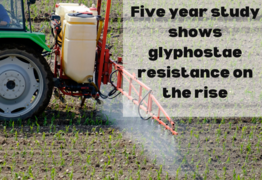
A five-year survey of the entire Australian cropping belt has revealed a sobering picture of growing herbicide resistance in key cropping weeds.Dr John Broster from the Graham Centre for Agricultural Innovation heads up a joint herbicide resistance monitoring project between Charles Sturt University, Queensland Department of Agriculture and Fisheries and the Universities of Adelaide and Western Australia.Dr Broster says if growers lose glyphosate, they’ll have to use more complex, more expensive methods of controlling weeds.“If you use herbicides, you will get resistance,” Dr Broster said.In a 5-year cycle the group visited 3000 randomly selected paddocks and took 2000 samples of the nation’s number one weed, ryegrass, which is followed by wild radish in WA, wild oats in Queensland and NSW, and sow thistle in fourth placeThe most concerning discovery was the increasing resistance to the most important herbicide, glyphosate. Across Australia glyphosate resistance is 5 per cent in the populations of ryegrass, but in a region like the Liverpool Plains in NSW it was in 29 per cent of the populations that were surveyed.By using other methods to control plants that survive herbicide applications and prevent them from setting seed, then growers may be able to slow the development of resistance to enable the use of herbicides for longer.Dr Broster says farmers generally are responsible in their management of weeds.“Even though there are high levels of resistance in the ryegrass to selective herbicide groups, and even glyphosate, at harvest time when researchers collect the weed seeds, most populations are below one plant per square metre,” he said.“So even though it’s more complicated, they’re managing populations quite well using alternative herbicides and other methods than herbicides to control the weed populations.”

Record breaking year for red meat sales in Australia

29 January 2025, 7:00 PM

2024 was a record-breaking year for red meat exports, according to Meat & Livestock Australia (MLA).In 2024, Australia exported 2.24 million tonnes of red meat to 104 countries, representing the largest volume of red meat ever exported.The United States is the largest importer of Australian goat meat, and last year 51,488 tonnes in total were sold. This breaks the previous record of 35,778 tonnes, set in 2014.MLA says 2.55 million goats were slaughtered in the period between January to September 2024, and increase of 23 per cent from the same time in 2023.At the peak, more than 70,000 head were processed each week in 2024.Behind the US. Korea ranked second in terms of the largest buyers of Australian goat meat with China rounding out the top three. The fourth and fifth biggest markets were Canada and Taiwan.The majority of exported goat meat continues to be shipped frozen, either as a whole carcass or a six-way split, with a mix of skin-on and skin-off depending on the market.Beef exports reached 1.34 million tonnes, 22 per cent higher than 2023 exports and four per cent higher than the previous record of 1.29 million tonnes set in 2014.The strongest growth was seen in the United States and Southeast Asia.Australian exports of lamb exports rose to 359,299 tonnes, 10 per cent higher than the previous record set in 2023.Exports to the United Kingdom rose 44 per cent thanks to a new Australian-United Kingdom free trade agreement.More than 255,000 tonnes of mutton was exported last year, which is 22 per cent higher than the previous record set in 2023.Once again, China was the largest market for Australian mutton, followed by Malaysia and the United States.MLA says overall, sheepmeat exports rose 15 per cent from 2023 to 614,396 tonnes, which is the highest sheep meat export figure from any single country on record.

Support for plan to fix Basin issues

25 January 2025, 1:00 AM

A seven-point plan to fix ongoing issues in the Murray-Darling Basin has been endorsed by a leading community group.The Murray Regional Strategy Group, a coalition of farming and community organisations from the NSW Murray Valley, says the plan announced by Independent NSW parliamentarian Helen Dalton should be used as a starting point to repair damage caused by poor policy over the past 15 to 20 years.MRSG Deputy Chair Alan Mathers said it was important to acknowledge the mistakes and learnings since the Basin Plan was legislated in 2012.“We know there are numerous flaws in the Basin Plan, including the indisputable reality that recovered volumes of water cannot be sent from one end of the system to the other. It physically will not fit. It is therefore pointless recovering more water from farmers; instead, we have to focus on localised projects that protect sustainable environments.”Mr Mathers said MRSG also supports the calls from federal Shadow Minister for Water Perin Davey for an end to water buybacks, after the Murray-Darling Basin Authority admitted flow targets in the Basin Plan cannot be achieved.Mrs Dalton’s seven-point plan involves:1. No water buybacks if they hurt communities.2. Returning South Australia’s Lower Lakes to their natural state.3. Increased desalination in order to provide water to South Australia.4. Proper water metering throughout the basin system.5. A renewed focus on water quality.6. A ban on the government flooding of private wetlands.7. An increase in downstream water storage.“These are sensible measures that will build a better Basin Plan for future generations, as it protects the environment but also allows our farmers to grow the food we need for an ever-increasing population,” Mr Mathers said.“It is hard to imagine that any government would deliberately threaten the viability of food production, but that is exactly what we are seeing. Even more bewildering is that it is occurring during a cost of living crisis.”Mr Mathers said the NSW Murray region and Northern Victoria have been unfairly targeted in water recovery, and now the Albanese Government is spending billions of dollars to further decimate the most efficient food bowl in the nation.“Instead of focusing on policies that are backed by ill-informed environmental ideology in the inner-city seats like that of Minister Plibersek, governments at all levels need to consider the future, in particular supporting our farmers so they can grow food in a sustainable way.“The key outcome from the current approach will be ongoing increases to the price of food, to the detriment of farmers and regional communities. Governments are not delivering the balanced, flexible Basin Plan that was promised, and that needs to change. “For this to occur we need political representatives at state and federal level who are prepared to stick with the facts, even when they don’t suit an ideological agenda. We are not seeing this at present, in particular at federal level,” Mr Mathers said.

2024 was a boom year for goat meat - MLA

24 January 2025, 1:00 AM

New goatmeat export records have been reached at 51,488 tonnes shipped weight, according to Meat & Livestock Australia (MLA)Reaching unprecedented heights in 2024, the Australian goatmeat industry has set new benchmarks for production and exports. For the calendar year, exports smashed the previous Australian record (set in 2014) of 35,778 tonnes shipped weight (swt), hitting 51,488 tonnes swt.Globally, Australia represents a fraction of the goatmeat produced. However, with the majority of Australia's production exported, our standing as the number one goatmeat exporter in the world is cemented. Underpinning the record export volumes achieved in 2024 was a mammoth increase in production, which, from January to September (the most recent data available), accounted for 2.55 million goats processed. This marked a 23% increase in slaughter compared to the same period in 2023. The first nine months of 2024 alone were enough to position the year at the highest processed volume, based on a 4% increase in the total number of animals processed for the full 2023 year, which was the previous record.This remarkable growth can be attributed to favourable weather conditions in key goat-producing regions and additionally the reopening and expansion of goat processing plants. As a result, 2024 averaged an impressive weekly processing rate of more than 58,000 head with peaks reaching over 70,000 head. This was a significant jump from the previous high weekly average in 2023 of almost 40,000 head (Source: MLA’s NLRS).This production increase has been witnessed across the board, with all key production states increasing slaughter year-on-year. According to the latest slaughter data (January to September), Victoria remains the largest processing state, accounting for 44% of all Australian goatmeat, followed by Queensland at 27%, and then NSW at 26%. Strong growth was seen in NSW, with an increase in processed volume of more than double.Increased production capacity and strong demand from key international markets created the perfect conditions for a bumper year. Between January and December 2024, 51,488 tonnes swt of goatmeat were exported globally. This was more than a 52% increase on 2023 and 44% more than the previous export record-breaking calendar year, 2014.The US remains Australia’s largest goatmeat export market, comprising 54% of all exports at 27,559 tonnes swt in 2024. This was the highest shipped volume to a single market on record. Korea ranked second, with a five-year continued growth demand seen with a new all-time high of 8,639 tonnes swt. Mainland China continues to be in the top three with a notable 5,161 tonnes swt, demonstrating a sustained demand for Australian goatmeat. The fourth and fifth biggest markets were Canada with 2,632 tonnes swt and Taiwan with 2,008 tonnes swt.The majority of exported goatmeat continues to be frozen, either as a whole carcase or a six-way split, with a mix of skin-on and skin-off depending on the market.The increased processing capacity and plant specialisation set a ‘new normal’ with higher production and export volumes. There continues to be a strong appetite for Australian goatmeat from international markets, demonstrating the ability to absorb the increased supply.If prices and the global trade environment remain stable, the Australian industry is well-placed to leverage the quality of Australian goatmeat to meet customer and consumer needs in the future.Contributed by Emiliano Diaz, MLA Market Insights Analyst

Common sense allows farmers to use ground water during bushfires

22 January 2025, 4:00 AM

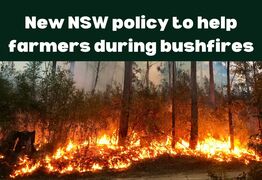
The NSW Government says it is reducing red tape, which has stifled farmers’ ability to fight fires on their own property.Common sense has prevailed in a new policy introduced by the NSW Government.During a fire emergency, a landholder can now take water from surface water and groundwater sources on their land without needing a water licence and water use approval. This includes streams, creeks and rivers within the immediate emergency area. This exemption has been made via recent amendments to the Water Management (General) Regulation 2018. The water can be used by landholders on their property and on adjacent land to fight fires. It can also be used for training and controlled burning when it is carried out by or under the authority of a firefighting agency such as the NSW Rural Fire Service (RFS), and for the testing and maintenance of firefighting equipment. Landholders who wish to prepare for the threat of bushfires can now also lawfully take water and store it in a tank or dam for future firefighting purposes. The maximum volume for each property is 100,000L (0.1 ML) per year. The NSW Government will soon carry out targeted surveys of landholders to better understand how the exemption is being used and to identify the extent and scale of water use. While landholders are not required to submit reports, they are encouraged to log the volume of water they take under the exemption for their own records. “But the fact is, when there is a fire, no one should need to stop and think if they are allowed to access water to keep themselves and their property safe,” New South Wales Acting Minister for Water Jodie Harrison, said.“This is a common-sense decision, and it is great to see these amendments now in place in time for summer. When fire threatens life and property, landholders need fast and easy access to water to protect their properties and themselves. “These changes make it easier and cheaper for farmers and property owners to access water to prepare for and respond to emergency fire situations.” New South Wales Minister for Emergency Services, Jihad Dib, said that when it comes to emergencies, landholders can play an important role in bushfire response, and this change further empowers them to act when their properties are under threat. “The New South Wales Government has been proactive in finding common sense ways to make it easier for landholders to fight fires on their properties, which also includes a trial to make it easier for farmers to keep firefighting vehicles on their properties.”

The history of the Pastoralists' Association of West Darling

20 January 2025, 7:00 PM

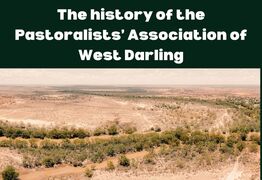
According to their website, the Pastoralists’ Association of West Darling (PAWD) is an agri-political lobby organisation, looking after the special interest of its wool, sheep cattle and goat producing members living in the pastoral regions of the Western Division of New South Wales.Established in 1907, the P.A.W.D. became a Union of Pastoral Employers, and was registered as such under the NSW Industrial Arbitration Act on 5 September 1923 and under the Commonwealth Conciliation and Arbitration Act on October 29, 1926.The Association will be holding its centenary in 2007.The Association had its beginnings on the 29th of November, 1906. A meeting was held at the Australasia Chambers, King William Street, Adelaide. This meeting was presided over by Mr Peter Waite, of what was then “the great Momba Station”, and also in attendance were: Messrs John Lewis (Mundi Mundi Station,) JH Luxmore (Mara Station) TE Barr-Smith (Momba Station) D Waite (Momba Station) R Strachan Dalgety & Co LTD representing Morden and other stations HW Hughes (Kinchega and Balaclava Stations) FW Downer (Solicitor)At this meeting it was resolved: “That the Western District of New South Wales form an association to be called the Pastoralists’ Association of West Darling."Previous to this, pastoralists in the area were members of the Pastoralists’ Union of South Australia, which was formed on September 9, 1890 and at an extraordinary meeting on 13 April 1892 the name was changed to the Pastoralists’ Association of South Australia and West Darling.Delegates at the 32nd Convention of the Graziers' Federal Council of Australia, held in Brisbane, April 1921. Back row (from left): Leslie Smith (Secretary, Pastoralists' Association of Victoria and Pastoralists' Union of Southern Riverina), Major N.W. Kater, M.D., (N.S.W.), A.J. McLachlan (Solicitor), C.S. Wood (Assist. Sec. Pastoralists' Association of West Darling), C.D.E. Francis (Qld), F.M. Ranson (Secretary, United Graziers' Association of Queensland), E.D.H. Virgo (Assistant Secretary, Stockowners' Association of South Australia), I.J. Warnes (South Australia), John Dunne (West Darling), O.E. Friend (N.S.W), L.J. Weatherly (Victoria). Second row: F. Wittenoom (West Australia), A.S. Austin (Southern Riverina), C.R. Murphy, Hon. A.H. Whittingham, M.L.C (Queensland, President of the Convention), A.E. Hamilton (South Australia), John Mackay (N.S.W.), H.M. Turner (Victoria). Front row: J.W. Allen (Secretary, Graziers' Association of N.S.W), P.A. Brown (Minute Secretary, Queensland), W. Muir (Assistant Secretary, Queensland). Mr R.H. Edkins, Queensland, was also a delegate but had to leave before the photo was taken. Image: State Library of South Australia.The P.A.W.D. initiated the first meeting of the Western Division Conference in 1927. This body concerns itself with matters regarding the operation and governing of the Western Division of NSW and is made up of representatives from PAWD, NSW Farmers and Western Division Rural Lands Protection Boards.The Barrier Miner newspaper reported on the 22nd annual meeting of PAWD in the May 17, 1929 edition:"The 22nd annual general meeting of members of the Pastoralists' Association of West Darling was held at the Anchor Chambers on Tuesday, May 14.There were present: Messrs. K. G Brougham, president (Yalcowinna), E. U Langford (K. Tank and Water Hag) A. A. Smith and T. B. Smith (Wilangee), W. L Foulis (Corona), E Andrews (Tandora), N. JJ. Colley (Redan), R B. Ranken (Tolarno), R. M Longmir0 (Boorungie and Glen Lvon), John Parker (Menartee), Alfred crossing (Culpaulin) A. Hindle (Quarry Hills), J. S. Williams (Heydon Downs), Geo. Jefferys (Munka), A. S Crossing (Tongo), J. Lidington (Peak Hill), Joseph Vigar (Charlemont). J. Vigar (Bygerkerno), H. Hughes (Eureka), J. Forth (Nine Mile), Jack Andrews (The Springs). J. JJ. Warren (Whurlie), R. Caskey (Byrnedale). G. A. Crossing. (Topar), W. A. Thomson (Grassmere), Arthur Crossing (Burta and Mount Murchison), R. C. Allison (Kars), S. Reid (Sir Sidney Kidman)."President KG Brougham noted in his report that memberships continued to increase, and he was later returned as the head of the organisation in the annual elections.Mr Brougham also referred to the newly instigated research fund."A most important undertaking instituted during the year was the inauguration of the Australian Pastoral Research Fund, and while it is regretted that the adverse season has mitigated against the complete success of this appeal, I sincerely trust that a return to normal conditions will ensure the successful realisation of the object aimed at, namely, the raising of a funding of £200,000 for "scientific research into the problems affecting the pastoral industry."The meeting also discussed a central Australian government and the sucession of the Western Division as its own state."Mr. Stewart mentioned that he had been in the Western Division over 40 years ago, and taking conditions as they were at the present time there was no denying the fact that successive Governments had failed in their duty towards this portion of the State, which has suffered through Government neglect," the Barrier Miner reported.In 1957 the P.A.W.D. instigated the re-organizing of the Wild Dog Destruction Board in the format that it operates today. The Board that manages the maintenance of the dog proof fence is made up of pastoralists elected from various Western Division areas.From 1960 the PAWD has been a member of the federal body of the Australian Woolgrowers’ and Graziers Association and entitled to one representative on the council. A Past President of the PAWD, Mr K.C. Connors, MBE was elected as Vice-President to that body in 1973.With the Formation of the National Farmers Federation (NFF) in 1979 as a federal umbrella organization for all state rural organizations the PAWD did not have sufficient numbers to have direct representation with the NFF. An association was formed with the newly formed United Farmers and Stockowners of South Australia, now the South Australian Farmers Federation (SAFF) thus giving the PAWD an avenue to the NFF on federal matters. The discussion was made in 2008 that the reason for the association with SAFF no longer existed due to SAFF withdrawing its membership of the NFF hence this association with SAFF was suspended. The Pastoralists’ Association of West Darling has an alliance with the Western Division Council of NSW Farmers Association in relation to the Western Lands Act and Kangaroo Management the two associations have a continuing dialogue on common issues pertaining to the Western Division of NSW.

Caution is key for summer spraying

20 January 2025, 4:00 PM

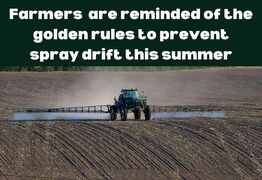
Farmers spraying weeds are reminded of the golden rules to prevent drift and avoid damage to neighbouring properties this summer. As farmers prepare to tackle summer weeds across the state, NSW Farmers' Agricultural Science Committee Chair Alan Brown said farmers should be mindful of several key precautions when planning to spray.“Simple steps such as using the appropriate spray nozzle and spraying as close to the target as possible go a long way when it comes to preventing drift,” Mr Brown said.“Monitoring weather conditions regularly while spraying is also crucial, and while we all want to get the job done, it’s vital that you stop spraying as soon as conditions become unfavourable for the job.“Understanding the impact of new adjuvants and formulations of popular chemicals when selecting your spray mix is also essential to reducing spray drift, and consulting your agronomist will help ensure you have the latest information you need to spray this season.”Off-target spray drift can occur when agricultural chemicals or vapour become airborne and drift outside the intended area when sprayed. This can happen if chemicals are applied at the wrong time of day, or during the wrong weather conditions. As growers look to control weed pressure this summer, Mr Brown said continued vigilance was key to prevent damage to crops when spraying. “Previous seasons saw significant damage as a result of off-target spray drift incidents, so it’s vital that we stay alert and take the relevant precautions to prevent further instances,” Mr Brown said. “Failure to do so can have extensive repercussions, on not just production and profitability but livelihoods, relationships and communities for years to come.”

MRSG “Farmers need water to grow food”

18 January 2025, 4:00 AM

“We’re at our wit's end” Geoff Moar.As we start another critical year in which action is needed to ease the cost of living pressures, a leading community organisation is calling on governments to acknowledge past mistakes and identify future solutions.Murray Regional Strategy Group (MRSG) says food staples are under threat from poor government policy that is hurting the farming sector, yet can be easily rectified.MRSG, a coalition of farming and community organisations in the NSW Murray region, says it is time to identify shortcomings in current water policy and take proactive steps that will help the environment, farmers and Australian families.“Recently released data shows that through numerous programs the water used by farmers in New South Wales and Victoria has declined by about 50 per cent in the past three decades,” said MRSG Chair Geoff Moar.“It has reached the point where we are forced to import more staple foods, and some farmers have stopped growing fruit and vegetables. We need a sensible policy to turn this around, or there will be less clean, green Aussie-grown food at the supermarket, and the prices will continue to rise,” he said.Mr Moar says it is extremely frustrating for farmers and the regional communities that depend on their prosperity because they realise that a change of approach will help the environment, provide more water for food production and consequently ease food price pressures.“Governments seem reluctant to accept the need for change, or listen to those with lived experience who can provide informed advice.“We have significantly reduced the amount of water for food production in the recognised food bowl that covers northern Victoria and southern New South Wales,” Mr Moar said, adding more than 80 per cent of water recovered under the Basin Plan has come from the Southern Basin.“Our group, and others, have highlighted for many years that all the water which has been recovered from this region, with governments insisting there is a lot more to come, will not solve key environmental issues in the Basin, in particular those of the Coorong and Murray Mouth, nor fish kills in the Darling system.“All we are doing is taking water from food production and storing it in dams. That does not solve localised problems. What will have a positive impact are localised projects and complementary measures that address water quality and connect the Darling to the Murray. “Instead, we continue to see cumulative negative impacts of various water reform and policy changes. Yet the solutions fall on deaf ears because the focus remains on achieving political outcomes, rather than environmental and social benefit,” Mr Moar said.Mr Moar said as a nation we have a choice. He said he believes we can continue down the current path, which will not solve key environmental problems in the Basin but will play a role in increasing the cost of food for all Australians. Alternatively, Mr Moar suggests we take a fresh approach and focus on achievable, localised solutions that will benefit the environment, food producers, regional communities and could help ease food prices.“It seems a simple choice, but we’re at our wits end trying to convince governments, especially the Albanese Government, of the best way forward,” Mr Moar said.

Seven-Point plan for Murray Darling Basin

17 January 2025, 10:00 PM

Helen Dalton MP “We must do better”Member for Murray Helen Dalton MP has called on the federal government to adopt her seven-point plan to address what she sees as “real solutions” for the Murray Darling Basin.“The Murray-Darling Basin deserves better than the Federal Government’s “just add water” approach,” Ms Dalton said. “Our communities, environment, and farmers need real solutions.” Dalton says her plan will “fix the system.”She poses an immediate stop to water buybacks, that she says are hurting rural communities. Ms Dalton claims NSW and Victorian irrigators have halved their water use over the past 30 years, reducing diversions below the Murray Darling Basin Plan targets. Her plan would also address the unnatural management of SA’s Lower Lakes and protect the Coorong, see South Australia’s desalination plant used to create its own water supply.Her plan calls for the implementation of consistent, accurate water metering and monitoring and focuses on water quality—tackling pollution, salinity, and invasive carp.Dalton’s plan would see a ban on what she says are “devastating government-created floods on private properties” and expand storage capacity for a more reliable water supply.“This plan prioritises fairness, sustainability, and common sense,” the outspoken independent member said. “It’s time for leadership that protects our way of life. “We demand the change that is necessary to hold the other states accountable and reduce the impact this will have on our community as a whole.“We can—and must—do better.”

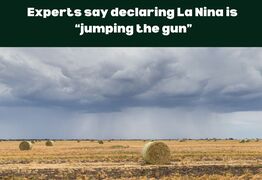
Experts say media reports declaring a La Nina event are “jumping the gun”

16 January 2025, 4:00 AM

Declaring a La Nina event is “jumping the gun” according to experts on climate science and atmospheric science.University of Melbourne’s Andrew King and Kimberley Reid have published an article outlining why unofficial media reports can be harmful.Last week, Sky News Weather Meteorologist Rob Sharpe declared Australia's fourth La Nina in five years is underway, as he warned a major state is bracing for further heavy rain this summer.But King and Reid are wary.“At the moment, some of the indicators used to track the state of the Pacific are just breaching the thresholds used for a La Niña event,” they said. “This has led to discussion in some media outlets that we’re heading into a “rare summer La Niña”.”La Niña events are characterised by below-average temperatures in the central and eastern tropical Pacific Ocean and warmer waters in the west, nearer to Australia. They often, but not always, bring wetter conditions for eastern and northern Australia. Some studies suggest we should expect stronger La Niña events and stronger rainfall responses the planet warms.In contrast, El Niño events usually bring drier weather to most of the continent.Lower sea surface water temperatures in the central Pacific Ocean are leading to speculation about a La Niña event starting to form, raising the risk of wet weather. Image - Bureau of MeteorologyKing and Reid say that would be unusual because La Niña events typically start in winter and get going properly in spring before “decaying” in late summer and autumn, according to the experts.“Given the time of year, it would be hard for a proper La Niña event to get going now,” the report reads. “But the Bureau of Meteorology’s outlook does point to a probable wet end to summer over most areas of Australia.”However, King and Reid say there are numerous challenges in monitoring and predicting El Niño and La Niña events.“Keeping track of how the drivers of Australia’s climate are evolving is tricky. Climate change makes it even more complicated.“The rapid warming of our oceans means the characteristics of La Niña events may well be changing. “Just identifying if we are in a La Niña is trickier than it used to be, so new measures to keep track of the El Niño-Southern Oscillation (ENSO) may become more useful.“It’s worth noting that a criterion for a La Niña event is sustained cooler-than-normal conditions in the central Pacific because there is some week-to-week fluctuation in sea surface temperatures.The Bureau of Meteorology (BoM) has not declared a La Niña and instead notes that the ENSO is currently “neutral” (neither El Niño nor La Niña).“Any unofficial declaration of a La Niña is jumping the gun,” King and Reid’s report says.“The Bureau’s long-range forecasts are the best source of information for Australians wishing to know what weather and climate conditions the next few months may bring.”

Helen Dalton expressed deep concern over the Federal and State governments' water policies

26 December 2024, 4:00 AM

Helen Dalton expressed deep concern over the Federal and State governments' water policies, warning of their potential to devastate our communities.The latest threat to the southern basin comes from the NSW government's announcement of a staggering 184% increase in water charges by 2029. This means the cost of a megalitre of NSW Murray general security water will skyrocket from $14.60 in 2024 to a staggering $41.45 by 2029.Farmers are facing unsustainable costs that threaten our ability to produce food for both Australia and the global market. These exorbitant costs could lead to business closures, job losses, and the destruction of rural communities. In financial terms, an estimated $23 million will be drained annually from the Riverina alone, putting our nation's food security at risk.“In a failed attempt to hide the devastation her water buybacks are causing, Federal Water Minister, Tanya Plibersek, has announcement a paltry one-off $160 million in hush money for Murray–Darling Basin communities. (She calls it compensation, but we all know what this money really is.)” Dalton speaks out. The Murray River Basin contributes $30 billion annually to the Australian economy.Dalton is concerned The Water Minister's proposed water buybacks threaten to destroy this $30 billion industry. “The Minister ignores important issues like water quality.” She states. A staggering 375 million carp infest the Murray-Darling Basin, accounting for 90% of the river's biomass. These invasive fish pose a significant threat to the ecosystem and must be eradicated immediately. “I will continue to fight for our community in 2025 and I am looking forward to continuing to make Murray an even better place to live in the new year, and beyond.” Dalton pleads.

141-160 of 208
Back Country Bulletin
News from the Back Country

Get it on the Apple StoreGet it on the Google Play Store