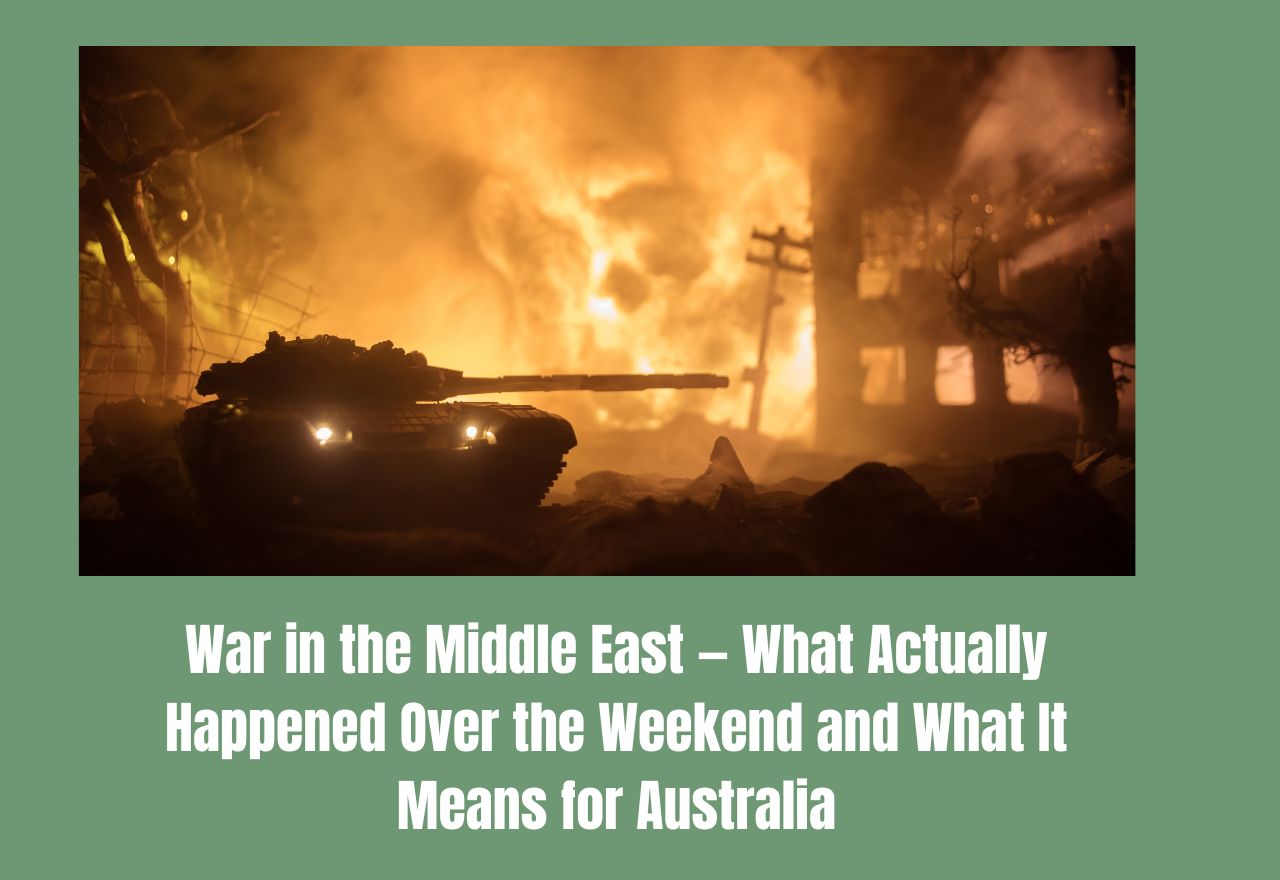
War in the Middle East — What Actually Happened Over the Weekend and What It Means for Australia

Kimberly Grabham
04 March 2026, 7:00 PM
IN SHORT
- Israel and the United States launched a major joint military strike on Iran over the weekend, killing Supreme Leader Ali Khamenei in what is one of the most significant military actions in the Middle East in decades.
- Iran has retaliated by firing missiles and drones at 27 US military bases across the region and at Israeli targets, killing at least three American soldiers and disrupting air travel across the Gulf.
- The Strait of Hormuz, through which a fifth of the world's oil passes, is now at risk of disruption, with global fuel prices already rising in response.
In the early hours of Saturday morning, the Middle East changed dramatically. Israel and the United States launched a large-scale coordinated military strike against targets across Iran in an operation Israeli authorities named Roaring Lion and American officials called Operation Epic Fury. Among those killed was Iran's Supreme Leader, Ali Khamenei, in an assassination that shocked governments around the world.
The strikes targeted military infrastructure, nuclear-related facilities and senior leadership figures across multiple Iranian cities. It was among the most significant military actions the region has seen in decades, and its consequences began unfolding within hours.
Iran responded swiftly and forcefully. The Islamic Revolutionary Guard Corps announced it had launched missiles and drones at 27 United States military bases across the Middle East, as well as at Israeli military installations. The United States Navy's Fifth Fleet headquarters in Bahrain was struck. Qatar, Kuwait and Saudi Arabia all reported impacts from Iranian drones and missiles on their territory. At least three American soldiers have been confirmed killed.
Qatar Airways grounded its entire fleet after Qatar's civil aviation authority suspended all air navigation over the country indefinitely. The Persian Gulf, one of the world's busiest air corridors, is now severely disrupted.
The Strait of Hormuz, the narrow waterway through which roughly a fifth of the world's oil passes, sits at the centre of this crisis. Iran controls its northern coastline and has historically threatened to close the strait in the event of military conflict. Whether it moves to do so in the coming days will be one of the most closely watched developments in global energy markets.
World leaders are calling for restraint. Emergency sessions of the United Nations Security Council are under way. The Australian Government has activated its crisis response protocols and is monitoring the situation around the clock. The Department of Foreign Affairs and Trade has updated its travel advisories for the Middle East region, advising all Australians to avoid the area entirely.
For now, the fighting is confined to the Middle East. But in a globalised world, what happens in the Persian Gulf does not stay in the Persian Gulf. The effects, economic and otherwise, will be felt far beyond the region in the days and weeks ahead.
NEWS

SPORT

RURAL