The Flying Doctors Are Bringing Q Fever Vaccinations to Ivanhoe

Kimberly Grabham
02 March 2026, 7:00 PM
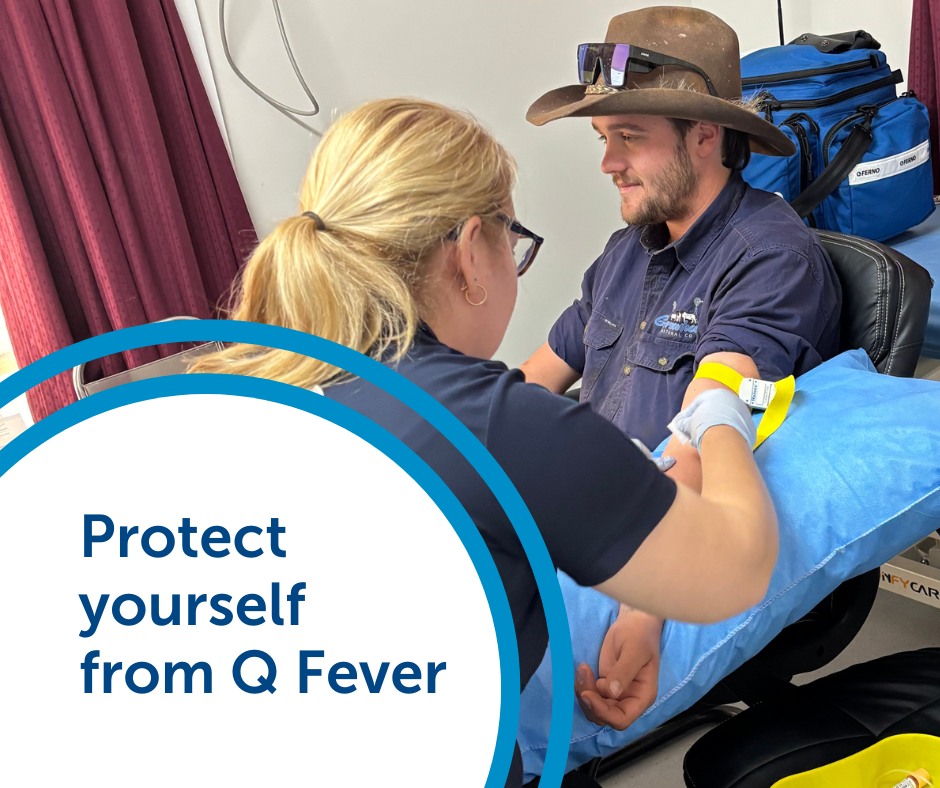 Image: RFDS
Q Fever Vaccinations to Ivanhoe; Here Is Why You Cannot Afford to Ignore It
IN SHORT
- The Royal Flying Doctor Service NSW/ACT is running a Q Fever vaccination clinic in Ivanhoe across two weeks in March and April, with initial skin and blood test appointments available on Monday 23, Tuesday 24 and Wednesday 25 March, followed by results and vaccine appointments on Monday 30 and Tuesday 31 March and Wednesday 1 April.
- The vaccine is available to anyone aged 15 years and over and two appointments one week apart are required to complete the process.
- To register your interest contact Sophie Ogilvie on 0498 189 968.
If you muster cattle, work in a shearing shed, handle goats, run a piggery or spend time around livestock of almost any kind, Q Fever is not a theoretical risk.
It is an occupational hazard that has been ending careers, hospitalising workers and leaving people with chronic illness for decades across rural Australia.
The Royal Flying Doctor Service is bringing the vaccine to Ivanhoe in March, and if you have not been vaccinated, this is an opportunity that deserves to be taken seriously.
Q Fever is caused by the bacterium Coxiella burnetii, which is carried by a wide range of domestic and wild animals including cattle, sheep, goats, kangaroos and feral pigs.
The bacteria are shed in enormous quantities in the birth fluids, placenta, faeces, urine and milk of infected animals. They can survive in soil, dust and on surfaces for extended periods, and critically, they are transmitted through the air.
You do not have to touch an infected animal to contract Q Fever.
In the right conditions, simply being downwind of contaminated dust is enough.
The disease can range from a flu-like illness that puts a person in bed for several weeks to a severe acute infection requiring hospitalisation.
Symptoms typically include a sudden high fever, severe headache, muscle pain, fatigue and in some cases pneumonia or hepatitis.
For most healthy adults the acute form is survivable, though it can be debilitating for weeks and in some cases months.
What makes Q Fever particularly dangerous is its potential to develop into a chronic form, which can affect the heart valves, liver and other organs and in some cases can be life-threatening.
Chronic Q Fever is difficult to treat and can persist for years.
For people working in the agricultural industries that define life across the Hay, Balranald, Carrathool and Central Darling shires, the occupational exposure risk is real and consistent.
Lambing, calving and kidding seasons bring the highest concentrations of the bacteria into the environment.
Shearing, yarding, drafting and handling of livestock stirs up dust that can carry Coxiella burnetii across considerable distances.
Abattoir workers, farm labourers, station hands, veterinarians, livestock transport drivers and anyone else regularly in and around animals should consider themselves at genuine risk if they have not been vaccinated.
Australia is actually one of the few countries in the world where a Q Fever vaccine is commercially available.
The Q-VAX vaccine, developed in Australia, is highly effective but requires a specific two-step process before it can be administered.
This is because vaccinating someone who has already been exposed to Q Fever or who has had the disease previously can cause a severe local reaction.
The pre-vaccination screening, which consists of a skin test and a blood test, determines whether a person has existing immunity or prior exposure.
Only those who return a negative result on both tests are eligible to receive the vaccine.
This is why two separate appointments one week apart are required.
The Royal Flying Doctor Service NSW/ACT clinic in Ivanhoe runs across two weeks in March and April.
Week one covers the skin and blood test appointments on Monday 23, Tuesday 24 and Wednesday 25 March.
Week two covers the results and vaccine appointments on Monday 30 and Tuesday 31 March and Wednesday 1 April.
The vaccine is available to anyone aged 15 years and over.
To register your interest, contact Sophie Ogilvie directly on 0498 189 968.
Given the limited appointment windows and the need for both appointments to be completed within the two-week schedule, registering early is strongly advised.
The Royal Flying Doctor Service has been providing outreach health services to communities across remote and rural Australia for nearly a century.
Vaccination clinics of this kind, brought directly into communities where the nearest specialist health service might be hours away by road, are exactly the kind of preventive health intervention that makes a material difference to the long-term wellbeing of people working the land.
Q Fever vaccination is not glamorous.
It does not get talked about at the pub or mentioned at the saleyards.
But it is one of the most practical investments a person whose livelihood depends on working with livestock can make in their own health and their capacity to keep doing the work they love.
Do not wait until you or someone you work with is sick to think about this one. Call Sophie Ogilvie on 0498 189 968 and register your interest now.
NEWS


SPORT


RURAL