‘Like a bad dream where you want to scream’: Kaitie Nash’s battle with a body that won’t behave

Krista Schade
28 February 2026, 7:00 PM
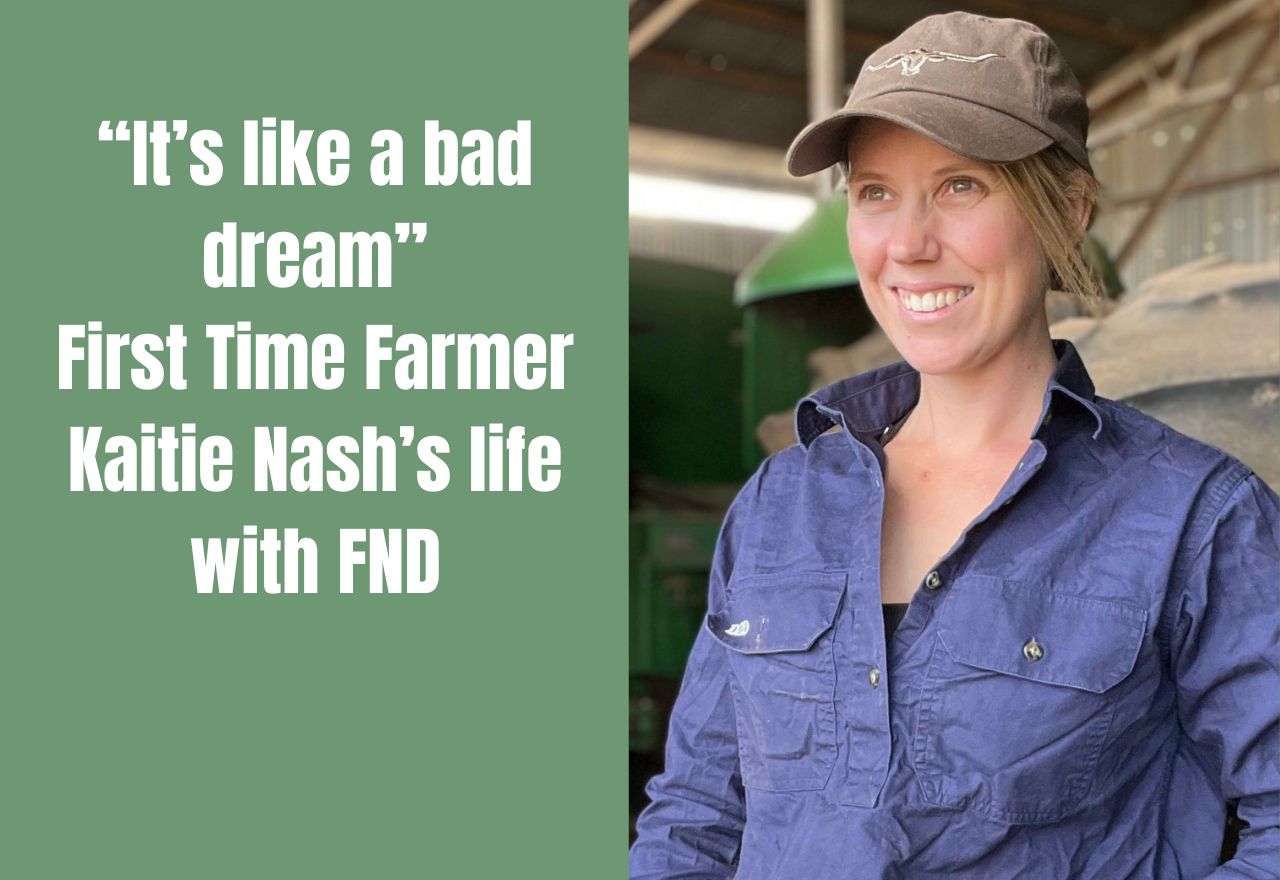 Image: Kaitie Nash
‘My Body Just Shut Down’: The City Girl Turned Farmer Fighting a Medical Mystery
In short:
- The Incident: Local farmer and influencer Kaitie Nash’s life changed instantly when a routine chore led to a terrifying physical collapse and a diagnosis of Functional Neurological Disorder (FND).
- The Challenge: Living in regional NSW complicates recovery, with Kaitie facing hour-long ambulance waits and a lack of specialised neurological care outside major cities.
- The Mission: Despite tremors and fatigue, Kaitie is using her platform to advocate for the 21,500 Australians living with FND, proving that a sense of humor is the best medicine.
For Kaitie Nash, life on a farm near Coonabarabran was a whirlwind of what she describes as “normal mum life” – a mix of cleaning troughs, cooking, and chasing after two lively young boys. She had built a growing online community and was building a following as a farming influencer, a creative outlet she started in late 2023 at the urging of a friend, to share the often-absurd conversations of life in the bush for a city gal.
But in September last year, that normalcy was shattered by a load of wet washing and a sudden, terrifying change.
“I was hanging out a load of washing and I noticed that my hands were blue,” Katie said, speaking from her farm office in the central west region of NSW.
“I had this wave of just a feeling of unwell... I just said to my husband, ‘Oh gosh, I don’t feel very well. Something’s wrong. Something’s wrong’”.
What followed was a frustrating journey to unravel a medical mystery. By the time Nash reached the hospital in Coonabarabran, her breathing was shallow and her limbs felt like lead. While her blood pressure initially plummeted, later episodes left doctors baffled as her vitals appeared perfectly normal on the monitors.
“I had this confusion in my head,” she says, describing a subsequent episode in front of her husband. “He looked at me and he said, ‘Are you okay?’ and then he said, ‘You can’t talk, can you?’ and I kind of said no... But I physically couldn't really do anything... It was the weirdest feeling.”
Kaitie was moved onto the larger hospital at Dubbo was eventually diagnosed with Functional Neurological Disorder (FND), a condition where the brain’s structure is normal, but the messaging sent to the body is disrupted.
She describes the terrifying dissociative events as being “almost like a seizure, but it’s non-epileptic... everything just kind of shuts down”.
The reality of living with a chronic, unpredictable condition in regional Australia adds a layer of complexity that city-dwellers rarely face. When Kaitie again collapsed at home in January, she faced an hour-long wait for an ambulance.
“It is terrifying, especially when you don't know what's going on with your body,” she says. “Time is such a major factor when your health comes into it... I just in my mind was thinking if there's something seriously wrong, what's going to happen? Am I going to be okay? I'm a mum... you need to be okay for your kids”.

The diagnosis has forced a new normal upon the family. Kaitie can no longer drive, suffers from significant fatigue, and experiences visible tremors.
“When I stand up... I can’t talk,” she says of the symptoms that can appear without warning. The hardest part, however, isn't the physical toll, but the stolen moments with her sons.
“It’s not going to be long until they’re like, ‘Go away, mum,’” she says. “I look at this little window that I have and it... that’s the one thing that upsets me because I look at it and go, I can’t go outside and play... my body’s just not coping... it’s almost like their childhood is going to be wasted to this fatigue”.
Despite the challenges, her trademark humour remains intact. She jokes with friends that she now has a doctor-mandated excuse to avoid chores. “I really cannot go near a trough or a weed or a washing basket. I mean, it’s just what the doctor said,” she laughs.
She has also found solace in the Coonabarabran community and the overwhelming support of her online followers. She says she isn’t interested in hiding her condition or feeling embarrassed by her tremors.
“I’m not embarrassed about what I look like or how I talk or anything. It’s just part of it and I’m okay with that,” Kaitie said firmly. “I think if you were to judge someone on that, we’re not the same people and I don’t want to be your friend”.
In Australia, approximately 21,500 people live with FND, and it is the second most common reason for a neurology consultation.
Historically, FND was a "diagnosis of exclusion" (meaning doctors only diagnosed it after ruling everything else out). Today doctors use diagnostic tests that look at leg weaknesses and whether tremors are controlled when the patient follows a specific rhythm using another limb.
Because FND sits at the intersection of neurology and psychiatry, individualised treatment is required. Seeking treatment by physiotherapists, psychologists and occupation therapists experienced in FND is difficult, and even harder to access from regional and rural areas.
Public access to FND clinics can take more than 12 months, and most specialised care is concentrated in major cities.
While some Australians with severe FND do have access to the NDIS, many face hurdles because FND symptoms can fluctuate, making it harder to prove a permanent disability, and ruling them ineligible for care funding and support.
As she navigates a path forward involving psychology, physio, and neurology, Kaitie is determined to use her platform to raise awareness for FND, particularly for those in isolated areas. For this young mum from a farm in the bush, the goal is simple: to keep people laughing, and to show that even when the body shuts down, the spirit doesn't have to.
You can follow Kaities journey on Instagram @kaitie_nash or her website thefirsttimefarmer.com.au
What to look out for
FND symptoms are typically grouped into four main categories:
1. Movement & Motor Symptoms
These are often the most visible signs and can mimic conditions like Parkinson’s or MS.
- Limb Weakness or Paralysis: Often affects one side of the body or a specific limb. A classic sign is "sudden giving way" (e.g., your leg suddenly buckling).
- Tremors and Jerks: Involuntary shaking or sudden twitches (myoclonus) that may change or stop if you are distracted.
- Gait Problems: Unusual walking patterns, such as dragging a leg or walking with a very wide, unsteady stance.
- Dystonia: Painful, fixed muscle contractions, often causing a hand to clench or a foot to turn inward.
2. Functional (Dissociative) Seizures
- These look like epileptic seizures but aren't caused by electrical activity in the brain.
- Warning Signs: You might feel "spaced out," have a racing heart, or experience a "rising" feeling in your stomach beforehand.
- During the Event: Shaking, stiffening, or falling to the ground. Unlike many epileptic seizures, these often last longer (sometimes 10+ minutes) and the person’s eyes are often tightly closed.
- Blackouts/Drop Attacks: Suddenly losing consciousness or falling to the floor without shaking.
3. Sensory & Awareness Symptoms
- Numbness or Tingling: A pins and needles sensation or a loss of feeling that doesn't follow a standard nerve path (e.g., a "glove" of numbness over just the hand).
- Vision & Hearing: Blurred vision, double vision, or even temporary functional blindness or deafness.
- Dissociation: Feeling "there but not there," as if you are disconnected from your body or the world is unreal.
4. Cognitive & Other Symptoms
- Brain Fog: Significant trouble with memory, concentration, or finding the right words.
- Speech Issues: A sudden stutter, slurred speech, or a very quiet, whispering voice (dysphonia).
- Swallowing Problems: The feeling of a lump in the throat (globus) or difficulty swallowing.
- Extreme Fatigue: A crushing tiredness that isn't always helped by sleep.
In Australia, neurologists look for "Positive Signs" rather than just ruling other things out. If you notice these, it's a strong indicator of FND:
- The Distraction Test: Symptoms (like a tremor) improve or stop when you are asked to perform a different task, like counting backwards or tapping a rhythm with your other hand.
- Waxing and Waning: Symptoms may be severe one hour and completely gone the next.
- Inconsistency: Being able to move your legs normally while sitting, but being unable to walk.
COMMUNITY


RURAL