Back Country Bulletin
News from the Back Country
Get it on the Apple StoreGet it on the Google Play Store
NewsSportRuralCommunityEat, Drink, Stay
Back Country Bulletin
Don't Sleep on This: The Importance of Quality Sleep for Overall Health

05 October 2024, 2:00 AM

We all know the feeling – that groggy, sluggish sensation after a restless night's sleep. But sleep deprivation isn't just about feeling a bit out of sorts. It's crucial for our physical and mental well-being, impacting everything from our cognitive function and mood to our immune system and physical health.Why Sleep MattersDuring sleep, our bodies and minds go into repair mode. Here are some key reasons why getting enough quality sleep is essential:Brainpower Boost: Sleep allows the brain to consolidate memories and process information, enhancing learning, focus, and cognitive function.Mood Regulation: Sleep deprivation can disrupt the production of neurotransmitters that regulate mood, leading to increased irritability, anxiety, and even depression.Physical Repair and Restoration: While we sleep, our bodies repair tissues, strengthen muscles, and release hormones essential for growth and development.Immune System Support: Sleep plays a vital role in regulating the immune system, helping us fight off illness and infection.Reduced Risk of Chronic Diseases: Adequate sleep has been linked to a lower risk of chronic conditions like heart disease, stroke, and diabetes.How Much Sleep Do We Really Need?Sleep needs vary throughout life, but most adults require 7-8 hours of quality sleep per night. However, factors like age, health conditions, and lifestyle can influence individual needs.Sleepless in the Back Country? Strategies for a Better Night's RestIf you're struggling to catch those precious Zzz's, here are some tips to improve your sleep quality:Establish a Regular Sleep Schedule: Go to bed and wake up at consistent times, even on weekends. This helps regulate your body's natural sleep-wake cycle (circadian rhythm).Create a Relaxing Bedtime Routine: Develop a calming pre-sleep ritual, such as taking a warm bath, reading a book, or practicing gentle stretches. Avoid screen time for at least an hour before bed.Optimise Your Sleep Environment: Ensure your bedroom is cool, dark, and quiet. Invest in blackout curtains, earplugs, and a comfortable mattress.Limit Caffeine and Alcohol: While caffeine provides a temporary energy boost, it can disrupt sleep later in the day. Similarly, alcohol might make you drowsy initially but disrupts sleep quality throughout the night.Regular Exercise: Engaging in regular physical activity can improve sleep quality, but avoid strenuous workouts close to bedtime.Manage Stress: Chronic stress can wreak havoc on your sleep. Practice relaxation techniques like deep breathing or meditation before bed to unwind and quiet your mind.Seek Professional Help: If sleep problems persist despite lifestyle changes, consult a healthcare professional. They can help identify any underlying sleep disorders and recommend appropriate treatment options.Remember, prioritising quality sleep is an investment in your overall health and well-being. By implementing these tips and utilizing the resources available, you can create a sleep sanctuary and wake up feeling refreshed and ready to take on the day. So, switch off the screens, dim the lights, and prioritize a good night's sleep. Your mind and body will thank you for it.

Before Mad Max Furiosa: Movies filmed in Hay, NSW

04 October 2024, 5:00 AM

Before Hollywood descended on the southern Riverina township of Hay, in NSW, to film part of ‘Mad Max Furiosa’ in 2022 the tiny township already boasted an impressive bio.Australian writer and bush poet Joseph Furphy's lived and worked in Hay when he began writing his 1890's epic Such is Life.The short film called Child Lost on Goolumbulla is based on just one scene in the novel -which depicts the story of a helpless child lost in the bush. Andrew Furphy - a direct descendant of Joseph Furphy, produced the film with actor John Derum, who also acted in the 2013 docu-drama.Filmed on Thelangerin Station, the production boasted a cast of locals, who made the production both possible and engaging.Katie Schiller starred as ‘Mary’ the lost child with her real-life father Brett playing ‘Rory’, the father of her character, and sister Felicity also appearing. The film also saw appearances from Hay’s best horsemen; Ted Circuitt, Barry Nisbet, Ivan Job, Sam Coleman, Laurie Stevens, Richard Cannon and Ray Miller, as well as Bill Ryan, Bob Gaston, Derek McFarland, Fi Gaston in supporting roles.The flat, dry, saltbush landscape of Thelangerin made the haunting story of loss of a child both sorrowful believable; a reality of many early settlers.Below: A gallery of images from the 2013 production ‘Child Lost on Goolumbulla’ (Images: Bush Lit Productions) The wide expanses of the Hay Plains make the location perfect for road trip, coming of age movies, such as 1997s ‘True Love and Chaos.’The movies starred Naveen Andrews, Hugo Weaving, Miranda Otto and Ben Mendelson, amongst a cast of Australian actors, written and directed by Stavros Kazantzidis. The cast stayed in Hay during the stint and mixed with locals at the former Caledonian Hotel one weekend, chatting and shouting drinks. Hugo Weaving had shot to fame in the cult classic Priscilla Queen of the Desert (1994) but was friendly and approachable with the late-night crowds at The Cal.Hay first appears on screen, where Weaving’s character is meant to be dropped off at one of the South Hay services stations. The location then flicks rapidly to another area of NSW – which was confusing for locals! – and Weaving’s character ends up back with the road tripping characters of Andrews, Otto and Mendelson.“True Love and Chaos was filmed at the Caltex and I still have all the autographs from the crew,” Jenni Teusner recalled. “And yes - some of us are actually in the film.”The iconically Australian bar of the Commercial Hotel is the next filming location, popping up in the move some 30 minutes later. Local actor David Shea put in an admirable performance as a pub patrol, as Otto danced to the jukebox and Weaving played pool on the well-worm table of The ‘Merch.The Hay Plains also provided the perfect backdrop for the travelling scenes.True Love and Chaos used several locals as extras in scenes filmed in Hay. Locals remember Hugo Weaving, Noah Taylor and Ben Mendelson as very friendly.The dark comedy series ‘Mr Inbetween’ also took advantage of the Hay Plains as a desolate back drop to a hitman on the run.The Australian series starred Scott Ryan as gun for hire Ray, alongside Brooke Satchwell and Matt Nable, and the episodes filmed in 2021 near Hay were directed by the talented Nash Edgerton.Crighton’s Engineering were tasked with erecting a windmill at a crossroads north of Hay.Cameraman Charlie Whittaker posted on his social media, when filming ‘Mr Inbetween’ near Hay, wrapped in 2021.In 1979 the acclaimed Australian classic ‘My Brillant Career’ was filmed at ‘Kywong’ just north-east of Hay on the Jerilderie Road. The movie was filmed in reverse order and everything at 'Possum Gully', the property which is seen as drought-stricken at the start of the film, was shot on the Hay Plains.‘Possum Gully’ was the fictional home of Sybella Melvyn, played by Judy Davis, who dreams of escape a life of poverty and drought.Sam Neill and Max Cullen also starred in ‘My Brillant Career’ and the film went on to win a slew of awards from the Australian Film Institute (AFI) and British BAFTA awards, including best film, best direction and best actress.Judy Davis starred in the 1979 film ‘My Brilliant Career,’ directed by Gillian Anderson and partially filmed south of Hay. (Image: screenaustralia.gov.au)Released in 2009 ‘Charlie and Boots’ starring Shane Jacobson and Paul Hogan as father and son also filmed in Hay, including a droving scene at the 16 Mile Gums on the Cobb Highway.But it was the Lachlan Street ‘accident’ scene that stole the show. Charlie and Boots narrowly avoided a collision with a carful of lady bowlers, played by locals Lesley Hurst, Anne Hurst, Pat Woods and Bub Hurst. The steely eyed bowlers kept their cool, despite a torrent of abuse from Hogan’s character, and Lesley is named in the film credits as ‘Lady Bowler.’A film grab from ‘Charlie and Boots’ starring Shane Jacobson and Paul Hogan, showing the vastness of the Hay Plains.In the 1980s the wide stretches of straight roads were ideal for car commercials, and Holden produced a television ad for their latest Holden Commodore, featuring the children of form Hay residents Mick and Jenny Robertson.Toyota, Hyundai and Ford Mustang’s have all filmed on the long, flat stretches around Hay and in the late 1970s Paul Hogan flew over the Hay Plains in a stunt plane, around Burrabogie Station, filming a television ad for the all-new Winfield Yellow cigarettes.Aussie rocker Shannon Noll chose Hay to film the film clip to his 2004 hit ‘Drive’. The clip opens with Noll playing a mechanic at the former Walter’s Motors garage in Lachlan Street. He watches as a city couple peels in, arguing loudly, but soon Noll takes off with the couple’s hotted up XB Falcon, and the girlfriend.The shunned boyfriend flags down a truck – belonging to Chris Garner – and gives chase along the Cobb Highway, as Noll sings and drives across the Plains. They fleeing pair stop off town and end up partying at The Commercial Hotel, before Noll returns the car to his disgruntled customer and takes off into the sunset with the woman.The clip was filmed on the wedding day of Jacqui and Brett Hargreaves, from Hay, who still have the autographed serviettes from the day.The mini-movie went on to be named best music video of 2004.When Hollywood rolled into town in March 2022, to film ‘Furiosa’ on the plains near the legendary One Tree Hotel, the town of Hay was swamped with stunt riders, crew and a whole lot of shrouded-in-secrecy vehicles.The Town boomed as accommodation filled and movie folk spilled from every pub, club and coffee shop but there was just one thing missing; no-one spotted the star Chris Hemsworth.Filming was done in top secret but whispers where that the middle Hemsworth brother was not scheduled to film in Hay, much to the disappointment of locals.The fifth Mad Max film ‘Furiosa’ is set to be released in May 2024, with the residents of Hay keen for a premiere screening, and to be part of the sixth film ‘Mad Max: The Wasteland’ which is currently in pre-production.

Leah and Kathy spread the joy of teaching and learning in Vanuatu

28 September 2024, 11:00 PM

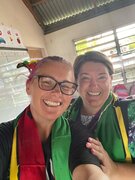
Hang onto your hats, teachers Leah Books and Kathy Duncan went international!The pair flew off to Vanuatu, where they shared their skills, knowledge and teaching to classes of children and teachers. The program was one of many which a Queensland company called Global Teacher delivers.“It was just something which popped up on our Facebook, and we decided to apply,” Leah said. “We had our interviews, explained we would not want to go without the other, and were both accepted.”Leah said some teachers have university degrees in Vanuatu, and some don’t.“The teacher I was paired with was in her mid-50s and had three more years until retirement,” Leah said. “She also had five children living with her. It is a common occurrence, parents heading to Australia to find work, and having to leave their children with family, friends, or people they know.“Something which was quite endearing was the children had not seen white teachers before and they were amazed. They kept on wanting to touch my face, hair, and arms.”Leah has kept in touch with the teacher of the class she taught, corresponding via Facebook Messenger. Leah said the teachers there have passion for their teaching and for their students, they just do not have access to a lot of the training and resources teachers in Australia have.“They are basically sent our curriculum and told to implement,” she said. “A lot of their work is copying from the board, and writing. If I were teaching in Hay about Australian animals, I would bring pictures up on the whiteboards, or videos, and do different activities with the children,” she said.“I didn’t have anything like that available. So the night before I spent all night drawing animals to show the children while I was teaching.“The next day, I came back, and the teacher had photocopied the drawings and got the children to colour them in. It was the first artwork hung in the classroom.“They just do not have the same resources, there were six lead pencils for the 36 children to share. They were so happy with anything they were given, and were happy to wait for their turn. One of the students owned a pencil sharpener, so then the class had one pencil sharpener.”As soon as Leah and Kathy understood what lack of resources the classes faced, they found a store and bought every resource they could think might be needed.“I made chocolate milk with the children, and they were fascinated,” Leah said.“They had never done that before; just milk and chocolate powder. There were no books to read in the class, and no ball. The small ball I bought to do maths exercises with the children was looked at with wonder. So were the books, just small ones I brought with me on the plane.”The journey was Kathy’s first trip overseas.“I had no expectations, and was so happily surprised at how friendly everyone was,” Kathy said. “They wanted us there, wanted to hear our ideas and to learn from us. They valued our opinions and skills.”Kathy had 45 children in her class, and six children sharing one pencil. Most of the children walked many kilometres to school and back, in thongs or no shoes.“Our time there was amazing,” said Leah. “The hardest thing to overcome was the language barrier. The children knew four and five languages, but little English. They were speaking to us in Bislama, which is an English-based Melanesian pidgin, the national language.”The teacher in Kathy’s classroom had been teaching for over 20 years, and had a huge passion for her job.“She had such a great passion for phonics, and could see how the method of learning to read using phonics made sense, instead of reading by memory. She also loved maths.“In that country, they are still stuck with rote learning. It was amazing to be able to show a whole new way of teaching.”Kathy has ordered maths and literacy packs to send back to the children, and people from her school, Ivanhoe Central School, have also donated items.The teacher who Kathy interacted with is hoping to come to Ivanhoe in the Vanuatu school holidays next year, so she can see what Kathy’s classroom and school are like, and observe teaching methods.Leah and Kathy agree they both would do it again, and that it was a highly worthwhile experience.

Father Pat Austin: Enriching lives and bonding cultures

28 September 2024, 2:00 AM

Father Pat Austin, parish priest of Balranald, is a member of the religious order, the Missionary of the Sacred Heart. “It is quite unusual for a member of a religious order to be on their own,” Fr Pat told me. He gets news from the Order all the time, and always knows wherever he ends up in the world, he will be back at the order. Last year, he was invited to go back to the order, but during a journey to visit his brother in Bendigo, fate took a different turn. Father Pat was passing through Balranald on the way to see his brother for his birthday. An Indian priest who came from Hillston told him there was a big shortage of priests in Balranald, and he should come back. “I knew he was right, so after I saw my brother in Bendigo for his birthday, I immediately made plans to return to Balranald, I have a great fondness for, and a happy connection to the town, from my time here before,” Pat said. On his way home from Bendigo, Fr Pat stopped in Balranald and presided over two Mass services. He was back in residence in Balranald in December 2023. Fr Pat was ordained into the Catholic faith in 1968, when he was 28 years old. “My family encouraged me, and I wanted to be like the priests I knew and admired,” Pat said. “I became a parish priest, which is like a doctor of souls. People come to the church where all spiritual things take place, then return to their lives, and live their faith.” The first 10 years of his life as a priest was spent in the Northern Territory. “I was sent first to Melville Island, North Darwin, where there were tribal Aboriginal people,” he said. “One older man, named Bob Curry, sent word he wanted to be baptised.” Father Pat was asked to go to Bob’s camp. Bob was sitting on the ground with his two wives. There were little aluminium pots and pans around, and a little white dog. The trio did not speak much English, but conveyed they wanted to be like the early missionaries. Not speaking the language, Father Pat recited the creed; I believe in God, the Father almighty, Creator of heaven and earth, and in Jesus Christ, his only Son, our Lord, who was conceived by the Holy Spirit, born of the Virgin Mary, suffered under Pontius Pilate, was crucified, died and was buried; he descended into hell; on the third day he rose again from the dead; he ascended into heaven, and is seated at the right hand of God the Father almighty; from there he will come to judge the living and the dead. I believe in the Holy Spirit, the holy catholic Church, the communion of saints, the forgiveness of sins, the resurrection of the body, and life everlasting. “Each phrase I would speak, the man would say in reply, ‘Him right,’ and I felt this was an adequate baptism. “Sometime later, it was late at night and I was driving to the island next door when a man tried to wave me down. “I don’t know how I saw him as this was in the dead of night. “When I got out of the car, he said Bob needed me, and led me over to where Bob was, lying on the ground, his two wives with him. One of the wives was cradling his head in her hand. “I directed them to act fast and we will get the man in the truck and to the first aid post. “I was told, ‘No father, he want baptism, he dying,’ and they repeated this. “I asked them if they had any water with them, and they did. “I was still trying to think, and asked him if I were to baptise him as Bob – his name. “I was told, ‘no no he wants to be baptised James’. “I knelt down and began baptising, and the man died the next day. “He wanted to be like the priests and the Catholic missionaries he saw, I feel it was a good demonstration of the power of example.” The wonder of how Father Pat managed to see the trio in the pitch black of night is something which has stayed with him. “During my time there I was lucky enough to meet Doctor Charles Osborne, who had studied the Tiwi tribe extensively, and taught me the language,” he said. “I invited a doctor who was beautifully versed in the Tiwi language to share my house, so he could teach me about the Tiwi people. “He was there until the cyclone hit in Darwin.” Fr Pat knew the Tiwi had a very deep culture and wanted to find out all he could. Incredibly dedicated to his work, he knew connecting with and understanding the people was the key. He also spent time in a foreign mission in Papua New Guinea, from 1988 to 1998. “I was a bit surprised to be asked,” he said. “I was 48, and knew the challenges, and wanted to go. “I contracted Malaria in the first week there, and was sick for a month. “The beauty of it there was the bishop presiding allowed the different groups on different islands to be in charge of their own religious undertakings. “I loved living in Papua New Guinea. “They were such a happy race. “Women were in charge of everything, and they got things done.“Because the women accepted the church, that’s how it was. “A lot of work has been completed over many years to translate the Bible into many different languages, including their language.” After a time, Father Pat became quite ill. His beloved German Shepherd dog, a girl named Sheba, was four years old, and sadly “I became a parish priest, which is like a doctor of souls. People come to the church where all spiritual things take place, then return to their lives, and live their faith.” had to be left behind. “I was just too sick,” he recalled sadly. “I had no other choice, and really missed her. “I couldn’t wait for the quarantine and governmental protocols. I was distraught.” Fr Pat has also served in Brisbane for a year, and in Victoria for eight years. “There were two parts of my post in Victoria, the parish was one part, and there was also school in the Western District of Hamilton. “They were lovely people, sheep farmers. It was not far from the Grampians, a great part of the world.” Fr Pat went back to Milne Bay in the Southern Province of Papua New Guinea for 10 years, then back to Hamilton, before arriving in Balranald. He first came to Balranald in 2006, was away 2013 to 14, returned in 2015 for a year, and then made Balranald his home once again in December last year. He vastly enjoys life in Balranald, and the people in the town. He gardens every day, believing it is good for the body, mind and soul. He regularly ‘keeps the cafes in business,’ as he calls it, dining out with good friend Andrew Le Cornu, proprietor of a local motel. His beloved Labrador, Sweetheart is always by his side, and even comes to church to sit in on services. Speaking with Fr Pat, it is quite clear he was born for his vocation. He just has a special something which is observable, but like an itch you just can’t scratch – you know its there but can’t quite get it. His serene nature would calm and restore faith to even the most obstinate of doubters. It was such a pleasure to meet Father Pat and Sweetheart, and hear his story


An inspiring modern day  pioneer: Marie Scott
An inspiring modern day pioneer: Marie Scott

25 September 2024, 12:15 AM

Marie Scott is a well-known and respected woman in the Balranald district.She recently spoke at the Hatfield Happening, sharing her story with other women.“Nothing from my previous 20 years of living in town at Balranald could have prepared me for my new married life in the back country,” Marie chuckled.Marie’s father, who was a shearing contractor in the area, predicted Marie would not last more than 12 months. How wrong he was.After 56 years on the land, Marie is going strong. She vastly enjoys life on the land, but conceded it has not been without challenges over time.Some of the hardest times of life on the land were the many droughts and horrific dust storms, especially the 1992 drought, which dragged on for many years.There were many bushfires in the district, and a particularly devastating fire in 1974 which burnt 750,000 acres, thousands of sheep, many kilometres of property fencing, and telephone lines, causing mass evacuations.Marie and her family suffered flood events where sheep were marooned and were only able to be reached by horseback and dragged through water to be saved.“One of my saddest memories was watching my husband having to dispose of sheep during the drought as we could not sell them. They had no commercial value, as the price had fallen both out of the sheep and wool market,” Marie recalled.“All the starving people in the world and this happened; it was very hard to comprehend.”Marie became an unqualified nurse; she had no other choice. Over time, she was the one who dealt with many cuts, bruises and medical dramas. Medical services were what felt like a world away.Over time, living conditions became much easier.Sealed main roads were constructed all the way to Ivanhoe, which was highly valued as Marie and her family got bogged many times in the mud after the rain.There was a mail delivery service implemented and carried out twice a week.The family had mains electricity installed in the house in the mid-80s.“We went from 32-volt generator with very few appliances available,” Marie recalled. “It cost us $30,000 to get power connected, which was a huge amount of money in those times.”Refrigeration progressed from kerosene, to gas and then electric.Other roles Marie filled over time were shearer’s cook, animal caretaker, ICPA Branch member and President, involvement in the school’s Country Area Program, involvement in the Rural Counselling Service, Clare Sports Club Secretary, part of the Clare Christmas Tree Committee, Hatfield Ladies Committee, Volunteer to Balranald Arts and Crafts and St Vincent de Paul, President of Ivanhoe CWA and current Secretary of Ivanhoe CWA.She credits her husband as being very patient, except for when in the sheep yards.One quite difficult time to get through for Marie was motherhood. While a proud and devoted mother, she told the crowd at Hatfield Happening after raising her first child, the other four seemed a breeze, although a blur.“I suffered what I now understand was undiagnosed Post Natal Depression after the birth of my third child,” Marie said.“Support services were not available at the time, so I had to suck it up and get on with life. I thank my lucky stars for a very supportive husband and Sister Dawn Greenham, who was a child healthcare nurse and conducted home visits.”Marie giggles when she looks back on the antics of her sons.“I think we all sighed with relief when automatic phones replaced party lines.“My children would love to pick up the party line, have a talk and then leave the phone dangling off the hook, which made us quite popular,” Marie laughed. “Nobody could make a call.”If she didn’t already have enough to do with running a farm, her many roles and raising five children, Marie was an instrumental force in getting the Hatfield and Clare School established.She battled tirelessly for this important cause, lobbying with politicians and NSW Education hierarchy to get the needed school for the education of increasing numbers.Forty years later Marie’s grandchild attends the school, like his father before him. Prior to establishment of the school, two families operated a subsidised school at their properties with governesses.After primary school Marie’s sons attended Assumption College for most of their secondary education.“We spent most likely the cost of another property with school fees and the thousands of kilometres travelled over the years,” Marie said. “We still keep in touch with some of the teachers they had over time.”Declining community population was also a great loss, causing the closure of Hatfield School, and the loss of community events. Improvements in technology have changed life on the farm and the way they do business.Internet from satellite to homestead allows their business to run instantly, resulting in being able to keep connected to business contacts, buy and sell stock, book keep, monitor bores, checking watering points, all without travelling great distances.“We can now sit in our lounge room and watch our grandsons playing football in Adelaide,” Marie said happily. “Television via dish as well. Mobile phones work at the homestead but there are many black spots out in the paddocks.”Her five sons have always been considered by Marie as her greatest asset, although they were rather mischievous.“They are Scott fifth generation farmers, and have enabled us in various ways in continuing to build up our farming enterprise, Merino sheep,” she said.“The ‘boss man’ wouldn’t have it any other way, but the descendants are working on him to change breeds.“They have also produced 13 grandchildren, some of whom we hope will continue their grandfather’s dream to continue life like this on the land where we have made so many special memories.“It has been so hard to put all these years into a condensed writing, not being able to tell all the wonderful, weird and amazing things I have seen and enjoyed in my time in the back country.“I implore people to put up their hand and fight for their community; nothing is too hard to accomplish, don’t let anyone say something can’t be done.”

Indescribably inspiring: Connie Mallet

17 September 2024, 11:21 PM

Connie Mallet is a true rural wonder. Very well liked in her community and district, more proverbial pies on her plate than fingers, and impeccably styled to boot, she is an incredible asset on so many levels. Topping it all off, she is lovely and it is clear she cares. Like so many people we see all the time that we don’t know and cannot begin to understand the many things someone has gone through in life to get them to the place and calibre of the person they are today. Connie spoke recently at Hatfield Happening, and had the packed hall enthralled. All of the sayings were true; you could hear a pin drop, not a dry eye in the house. Connie’s story is one which will stick with me for a long time, and was all I could think about for days. “Some insights I will share with you today are confronting for me, but if it will help to inspire just one of you here today, then it will be all worthwhile,” Connie said bravely, choosing to share her hardships for the sake of helping others. When Connie came to Australia at the age of seven, she couldn’t speak a word of English. Living in a very rough and violent neighbourhood while trying to communicate and understand this new country, Connie started to become insecure and withdrawn. It is the most insidious, vile creatures in society who see and seek out the vulnerable for their own evil gain. Tragically, between the ages of 11 – 15, I was repeatedly sexually abused by a senior member of the church I belonged to. This also happened to be her dad’s closest friend, who had gained the trust of the church and Connie’s parents. “Suffice to say that the abuse I endured during this time was dreadful but being withdrawn and insecure I told no one because I thought no one would believe me and that it was all my fault,” Connie told the audience. Connie’s insecurities only grew as she grew into adulthood. They were further compounded by a horrific rape she endured in a Melbourne carpark one evening coming back from a business meeting in the city. At that time, she was establishing a career in the corporate world. “By the time I tried to get through this ordeal I was a very broken person even though I didn’t know that at the time or maybe I didn’t want to know,” she said. “I was crying out for love and affection and my insecurities put me into a very damaging marriage with a controlling and physically and verbally abusive husband.” A very wealthy man and well-known entrepreneur in Melbourne, under his control she was not allowed to work, buy clothes, or anything. “After a time, I couldn’t even think for myself as he totally controlled all aspects of my life including contact with my family,” Connie shared. “I was living in this large mansion in Toorak, caged in with no freedom, money or will of my own.” After one too many beatings that sent her to hospital, Connie reached breaking point. Desperately needing help, she knew of a wonderful place in Warburton that could help broken people. She remained there for many months, with minimal contact with her family. “As I confronted my demons head on with heavy counselling each day, I was consumed with anger and very dark thoughts of revenge, until it completely overwhelmed me and destroyed my sense of value and self-worth,” Connie said.“At night I would have these dreadful nightmares where I would be standing at the edge of a cliff and will myself over and then wake up screaming as I fell. “In reality I was at that precipice of self harm to ease this overwhelming, all-consuming pain. “They moved me from room to room as I kept destroying each room I was in with my anger and pain.” Somewhere deep inside, there was a little voice trying to reach out to Connie. Remembering an employer saying to her, “If you look good, you feel good and if you feel good you do good”. Drawing strength from the saying, Connie began attending her daily counselling sessions wearing makeup, wearing clothes which made her feel good. “My counsellor said to me, “Connie you will be ok, there is something within you that wants to fight this”. “He gave me a visual example that I still use today. “He said there are two types of people in the world; you go to a gallery and there is this large beautiful painting on the wall. “You stand back, admire the picture. Suddenly you see a speck of dirt on the painting and you start concentrating on that speck until you see nothing of the beauty of the picture, just the dirt. “The other type of person sees the speck, but stands back and sees the picture in its beautiful entirety; the speck doesn’t ruin the beauty of the picture for them.” It was a pivotal moment for Connie. She realised regardless of who hurt her and how badly they hurt her, no amount of anger or focusing on dark thoughts of revenge would fix and make her better. “The only weapon that could heal my immense pain was living within me; only I could make things better for myself, no one else, the power was within me,” she said. During the day while at Warburton, she would go to a quiet place in the garden. Instead of thinking dark thoughts, she began thinking about herself, and reaching within herself for the solutions. “I consciously started to visualise myself growing wings when at the precipice so when the nightmares came instead of throwing myself over, I would grow wings and fly high above all the pain,’ she said. After her time at Warburton, Connie returned to Toorak with a new sense of self value and self-belief. She contacted a business associate of her husband who knew of her dreadful home life and empathised with the situation. She asked him to secretly give her work to do at home which was writing marketing plans for his clients and he would pay Connie in cash. Once she built up enough money, Connie rented a furnished apartment, booked a taxi and ran away with only a handful of clothes. She left all her designer clothes, jewellery, cars and all the materialistic things behind. “All those things meant nothing to me,” she said. “The only thing of value I took with me was my new and empowered inner self.” From there she completely rebuilt her life. Reconnecting with family, within a year she had an amazing job, her own apartment, furniture, car and clothes. Most importantly, she had a greater sense and appreciation of herself and what really mattered in life. At that time, Connie remembered what her dad used to say to her as a child about kindness; if you are kind to others not only will it enrich their lives, but it will also enrich your own soul, as your sense of self value grows the more you will rely on your inner self to conquer any obstacle. So, this started Connie’s journey of being part of many charitable organisations in Melbourne. In 2000, she began a private network called Connie’s Angels with the mantra, empathy equals hope. It started with forming a local group of women who have been through terrible challenges in their lives and had conquered. “When I would hear of someone who was going through a particular challenge, I would match them with one of my Angels who had gone through a similar challenge to be an empathetic ear and shoulder, someone who had walked in their shoes,” Connie said. This network of angels grew, and through word-of-mouth, networks began in other communities. These days through her Facebook page and the work behind the page, she has a private network of Connie’s Angels around the world. “What I’ve come to understand is that going through some of the dreadful life experiences and reaching into myself for solutions has given me a deep sense of empathy for others and their challenges,” she said. “Practising kindness and empathy is a very powerful thing. The more you seek to understand others, the more you understand yourself, your value and purpose in this sometimes-challenging world. “It gives you a sense of worth, and a deep belief in yourself; somehow no matter what you may go through, you have that inner superhero weapon that is greater than any obstacle.” Connie’s touching story truly epitomises what life is about. Brave, strong people baring the depths of their soul, their pain and trauma and the story of the path back to a positive life. The ability to rise above and completely bounce back and thrive in the incredibly inspiring way Connie has, just cannot be adequately described in words.

Shearer's cook - an Australian institution

17 September 2024, 1:34 AM

Sheep shearing is probably the most iconic activity in rural Australia. A back-breaking profession, there are few other industries where people burn more calories, and work up incredible appetites. These workers no doubt rely heavily on the hard working and talented shearer’s cooks to fill their bellies and provide fuel to keep them going, and satisfied. Aileen Clarke (pictured above) is a well-known district local. For many years, she has been a shearer’s cook in the region. She vastly enjoys her work, even though the days are long. “We get up at 5 am, sometimes earlier,” she said. “I will immediately begin preparing breakfast, often sausages, spaghetti, bacon and eggs, for 15 people. “Sometimes I have cooked for as many as 27 people. “Shearing is an intense job, so they eat every two hours. “Morning tea will be mini quiches, or toasted sandwiches, or sausage rolls. “Lunchtime can be a range of meals including chicken or lasagne with salad. Afternoon tea will be sandwiches, watermelon, oranges, and homemade slices, cakes or biscuits. “Dinner will be pork or mutton with vegetables.” Aileen’s working day concludes at 8pm. She tries to work right through a shearing run, with one day off. “It is great work, and I love what I do,” she said. “It can be tiring, and when I get home there will be days where I will sleep all day, and just rest.” She has been a shearer’s cook for more than 20 years, and also does roustabout work. Aileen is currently into her sixth week of a shearing run. She works for various shearing companies, and has travelled to places such as Tilpa and Louth. Sometimes shearing runs can last for up to two months. “I love doing what I do; you meet so many different, and lovely people, and see places I might otherwise never see,” Aileen said. An experienced cook such as Aileen doesn’t need to make meal plans or follow recipes. She mixes up the meals day to day to ensure variety, and has good preparations and items in the freezer to grab and go. “I like to keep it interesting, and changing it up so it doesn’t get boring,” she said. She loves the lifestyle, and says she will still be in this line of work for a long time to come. “Wherever there’s work, I will be there,” she said with a smile. When she is at home, Aileen loves relaxing, looking after her grandchildren and enjoying life. Friendly, happy and well-known about the district, many shearing teams and farm operations would just not be the same without institutions like Aileen.

Backbones of a small town: Jan and Ray Longfellow

15 September 2024, 2:48 AM

By Kimberly Grabham. Ray and Jan Longfellow share what life is like at the helm of the Ivanhoe Post Office, and their fondest community event, the Claypan Boogie. Ray and Jan Longfellow are the friendly, helpful, capable husband and wife team who greet you when you go into the post office. They are so much more, however. People such as Ray and Jan Longfellow are the backbones of Ivanhoe. Incredibly modest, Ray does not mention in his interview he was the unopposed mayor of Central Darling Shire for many years. The Longfellows have been in Ivanhoe for many decades. Coming to the area from Western Australia on the edge of the Nullarbor, they decided to move to the area for work. The couple lived and worked on various properties for a time. Adept in his role as an overseer, Ray and Jan decided to try their hand at something new. A café in Ivanhoe became vacant and the pair decided to enter the food and hospitality industry. For 10 years, they ran the café. “We enjoyed our time there, but it was a lot of work,” she said. “We operated from 6am to midnight. “We would make over 100 lunches a day, for lunch orders at the school. In those times they had some 200 children in attendance at the school. “They would bring the lunch orders over in the morning, we would make them, pack them in boxes and send them back over. “We would also put 80 pies in a big wood fire oven we had for half-time of the movies. “The movies were run at the Ivanhoe Community Hall, and all the people who went would come down for something to eat at intermission. We would sell out of pies every time.” The licence came up for the post office, so the couple applied for it, not thinking that they would be successful. However, they ended up at the post office helm, and are still there at Ivanhoe Post Office 30 years later. After 10 years in a busy café, they enjoyed the change of pace and learning something new. However, there was a lot to learn, and courses to complete. The couple took over the post office close to Christmas, which is hands down the busiest time of year for any post office. “The postmaster wasn't very pleased when we came, because he had to teach us at the same time as handling the Christmas post,” he laughed. Over the years, the couple find Christmas still is the busiest time of the year, but for evolving reasons. One of the biggest changes they have witnessed in the postal sector is the big drop off in mail letters, and increase in parcels. “It's a different kettle of fish now, because everything's eBay, and that’s more common in Ivanhoe now more than ever because we haven't got any shops,” Jan said. “Once, people could shop at the supermarket, the other cafe and Wendy’s, and, you know, different ones over time. “But now there's nothing else here which makes it awfully hard for people. “Christmas will still be busy, but all in all there are a lot of parcels at any time of the year. “So much business is lost in Ivanhoe, there is a call for so much here, someone could be operating businesses here to meet the need, instead of the many parcels we get through here every week.” “We didn't have any of this computerisation when we came in here. “Money orders have more or less priced themselves out. We hardly sell any money orders now. And cheques are gradually phasing out.” They initially found it a difficult transition when the postal systems went from completely handwritten to computerised, but have learnt how to operate and navigate the systems. “It’s funny though, they only just upgraded this system once we got used to the old system,” he said. “Someone from Australia Post came down, set it all up and showed us how to use it.” They say having things computerised does make it easier, once they understand how it works. The supermarket was sorely missed in Ivanhoe when it closed. They credit Wendy Aves as being such a big part of the town and keeping it running, and people can buy many things at her store. But largely, people have to travel out of town and long distances to get anything they need. “It just makes life hard when say you break your shoes or something you can’t immediately replace,” they said. When asked if there were any significant local happenings they have propelled or been a part of, they instantly come back with the Claypan Boogie. What is the Claypan Boogie you may ask? The Outback Claypan Boogie was held in Ivanhoe on Saturday October 12, 2002 as a fundraising effort for the Royal Flying Doctor Service. It was a fantastic community event, with live musical entertainment, catered three course meal, and the opportunity to come together as a community. You can read more about the Claypan Boogie in a Blast from the Past in the near future. “Jenny Farrar did everything for the event, she had a lot of connections in Adelaide which helped tremendously,” Ray recalled. “Oh, buses come from everywhere. “We had a big marquee, and we had tables and chairs with serviettes. Every chair had a great big bow. “And it was a three-course meal, soup and sweets. A catering crew cooked the meal, and all the roasts. “That was Jenny's job, and she did it really well.” Ray was president of the Ivanhoe Services Club for many years, and the couple were awarded Life Membership. Their great granddaughter, Rilie McMaster works at Wendy Aves’ store, helping out. One of their daughters works at the hospital, and has for many years now. They have grandchildren who have established themselves in Wagga, purchased homes and made great careers for themselves. They are immensely proud of all their children, grandchildren and great grandchildren. Rilie’s mother, Tammy is also indispensable and a great treasure to the couple. “We are really lucky, we personally don't do without some things, but a lot of people in the area haven't got cars or a vehicle to transport them. “They're doing it hard I would imagine.” The couple are very appreciative of nearby resources they and the town have to source items for residents in the town, such as Hay’s supermarkets, the taxi truck service, amongst others. The bus which operates throughout the region is very useful. Jan noted she has travelled on the bus a couple of times when she has needed to see the doctor. “For $20 or so to get somewhere, is good for a lot of people here without their own transport, and that is a lot less than what you would pay in fuel to get yourself somewhere,” she said. The couple plan on selling their post office, and enjoy retirement in the house they own next door to the post office. After renovating the house to their satisfaction, particularly the kitchen and bathroom, they will be happy. Ray and Jan Longfellow are the heart and soul of a place like Ivanhoe. Modest, unassuming and friendly, it was a pleasure to hear their story, and know a beautiful community event such as the Claypan Boogie had such a positive impact on so many, and is a fond memory decades later.

Placid and stoic: Win Linnett of Ivanhoe

11 September 2024, 2:13 AM

When I called in at the post office and asked the lovely lady behind the counter where Win (short for Winifred) Linnett’s address would lead me, part of the direction was that she would be on the porch, on the couch. It’s heartening to know that everyone knows everyone in the charming town of Ivanhoe. Win’s maiden name was Storm, making her Win Storm. She was named after her aunt. Her husband was named Albert, whose family had a farm outside of Ivanhoe, and long ties to the area. Albert was one of 10 children, with the family having a total of seven boys and three girls. “Albert’s family became my family, and we all got along well,” she said. Win originally came to the Ivanhoe area in 1956, as a governess for the Danson boys. They live close by her to this day, and she still has a strong fondness for them. Win originated from the Condobolin area, where her parents had property. She was very close to her parents. She was born on the land, and has had the land in her blood her entire life. “I was always used to outside work, and I enjoyed it,” she said. “When Albert and I were married, we practically lived out in the paddock, working on his parent’s property. "When I was a governess for the Danson boys, I met Albert through their parents, my employers.” They were not located far from Ivanhoe, but didn’t come into town a lot, as there was no need. When Win noticed that I write with my left hand, she recalls Albert was left-handed too. “He had a travelling teacher, who tried to make him write with his right hand, but that didn’t work,” she said. Win attended boarding school, at St Mary’s Star of the Sea. She enjoyed school, and learning. One thing she never enjoyed about school was that there was too much religion, and you were rarely allowed to speak, let alone say what you wanted. The food was also pretty poor, and Win especially hated one regular dish, tripe. She would slip the tripe under her cousin’s chair when nobody was looking. “I was always pleased when the holidays came around,” she said. “Every three months, we would be able to go and stay with my grandparents, who lived in Sydney. "It was only a short trip from the school, in Wollongong, over to Sydney. “One night, some of the girls at the school snuck out to meet boys. “They snuck out by crawling up a drain pipe, and met the boys. I didn’t say anything, but they still got caught. “Those girls were dismissed as they called it, expelled.” Win and Albert married in 1957, Wyn being 20 years younger than her husband. The age difference never bothered the couple, however. “We went to a lot of balls back in the day,” she said. “We really enjoyed the balls, and both loved dancing. “The balls were held in the community hall.” Abert and Win had so much in common, especially their affinity for the outback life. “I loved always being in the paddocks. We always had horses; my mother got around by sulky. “I really enjoyed mustering, although as I grew up, I would miss a lot as I was away at school. “We would do a bit of everything, and everything the men did,” she said. “We would walk behind the sheep, until the days when using motorbikes to muster came. "I never learnt how to ride a motorbike.” Living on their farm in the earlier years was interesting. The road to Wilcannia was not finished at the time. “As we were located close by, we used to have a lot of people turn up for meals, they would often get bogged due to the road, it made things quite busy. “There was also an exchange running in the kitchen, which my mother-in-law operated, so that made life extra busy, with us all juggling visitors, the phones and other things.” When Win and Albert started their own family, she was determined that none of her children would be heading to boarding school, reflecting on her time away with many rules and strict nuns. Albert bought a house in Ivanhoe town, where she still resides today, so that the children could attend school in town. He also bought the block next door, to the right. The family moved into town, Albert travelling out to the family property every day, to undertake his role as property manager. “This house used to be the old club managers' residence, in the days where you had to be 21 to get in to the club,” Win recalled. Having two daughters and a son, Wyn is very proud of her children. One daughter had a long career in the correctional service in the area, and when that closed, she became involved in the mining industry. Her other daughter works at Murdi Paaki Regional Housing Corporation in Broken Hill. Her son is a boss on the roads. “They are all close by, and have good jobs and lives,” Win said. “They all keep an eye on me, and are always here if anything goes wrong. “My nephew Clive is also really good.” Win’s husband Albert was great friends with Wendy Aves’ father. “They would be the last to come home from the pub at night, they were good mates.” When Win’s parents retired, they moved away, opening a boarding home in their home. They would serve dinner at night, and had about seven people living there. Win has seen some big changes in Ivanhoe over the years. “There were more shops in earlier years,” she commented. “A lot of shops have shut. “There used to be a big shop on one of the corners, and that shop sold everything. “My brother-in-law worked there for a while, before it eventually closed down. “When they took the railway away, things changed a lot.” After a time, Win came to work at Ivanhoe Public School, and truly enjoyed her time there. Heather McGinty started work there the same day, and still works there as a teacher’s aide. “I enjoyed working at the school,” Win recalled. “The classes were smaller, and that meant that you could show each child more attention. They still have a great school there, and still have the school bus, which is good.” Win stopped working at the school when attendance numbers dropped. Sadly, Win lost her sister Clare to cancer. “Her name was spelled Clare, my mother always said she didn’t want a chair in her name,” Win chuckled. “Clare used to come and visit me often on the A Train when we were younger. “She was my younger sister, and was bright and happy, always getting the giggles.” Her older sister, Marjorie, lives in Lismore, and was a radiographer. “I remember when we were little, Marjorie would get into bed and shine the light up against the white sheets, so she could look at her veins,” she said. “Things like that, medical things, always fascinated her.” Her brothers, Tom and John are also located in Lismore. Win loves to sit on the front porch with her Jack Russell, enjoy the weather and watch the world go by. She is an avid newspaper reader, and loves completing find a word puzzles. Wyn used to knit a lot, until her hands began to ache too much. It was such an honour to talk to Win. She is the epitome of Ivanhoe and its people. Friendly, happy and strong, Win is one of Ivanhoe’s inspiring people

Riding an eBike around Australia to promote renewables in the bush

09 September 2024, 6:13 AM

When I sat down with Gregory Andrews (pictured above) in the cool of the New Crown Hotel in Hay’s main street, it was following an incredibly blustery trek of 170 kilometres across the Hay Plains. On the day he arrived in Hay, the strong September winds and a flat tyre had delayed his arrival from Balranald by several hours, which he admitted was thirsty work.Travelling solo, on an eBike, Mr Andrews spoke passionately about his trip around Australia and the reasons behind it.“I started because I wanted to promote renewable energy and de-politicise it,” Mr Andrews told me.“The fossil fuel industry and some politicians like to trick us but what is good for the weather is good for the wallet.“Of course we have a way to go, in the bigger four-wheel drives, but in my own home, we charge our EVs (electric vehicles) from our solar system. So it’s not woke, or right-wing or left-wing, it’s just good economics.”“I want to promote that concept in the bush. We need to shift to renewable energy for a safe future for our kids.”Mr Andrews left Cottesloe Beach on August 8, and had covered more than 3,900 kilometres by the time he arrived in Hay on September 6. After planning to travel 100 kilometres a day and take seven weeks to finish, he has sometimes covered up to 200 kilometres and should arrive in Bondi Beach around the 14th or 15th of September.Mr Andrews was keen to explain that renewable energy can have lasting economic benefits to individuals and will help stabilise the energy market, at a time when cost-of-living pressures are forefront in the minds of most families.“There are benefits for energy security and independence because we aren’t going to be affected by price spikes from wars in the Middle East, because the sun shines and the wind blows – it doesn’t care what’s happening in the rest of the world,” he explained.He has been overwhelmed with the kindness of people on the roads. Grey nomads and people in the bush have helped him along the way.“I was in the outback, and there was a couple trying out their new-to-them small caravan, and they said ‘would you like to use our power?’ Then they offered me a bacon and egg sandwich and a coffee, so I have really enjoyed connecting with people.”A flat tyre just en route to Hay delayed Gregory Andrews arrival in town. Mr Andrews described the districts roads as "the worst by far' after travelling more than 3,900 km. Image: Lyrebird Dreaming.When he left Hay the next morning, Mr Andrews chose the back roads to Narrandera, rather than taking the most direct route along the highway, preferring a more circular yet connected journey.Mr Andrews is a passionate advocate for the environment. He was Australia’s very first threatened species commissioner when he led the development of this country’s first threatened species strategy. He visited the Hay region frequently as part of his work around the protection of the tiny Plains-Wanderer bird, the protection of which has become synonymous with the region.Mr Andrews also worked as an ambassador to West Africa and represented Australia at the United Nations climate change negotiations from 2010 to 2013 as the deputy chief negotiator.Mr Andrews’ unique action on climate change is well-known. In 2023 he underwent a hunger strike for climate action out the front of Parliament House.You can follow Gregory’s journey by visiting his website www.lyrebirddreaming.com, and checking out his socials.#eBike4Australia

The gentle Alec Pack

16 August 2024, 1:47 AM

Alec PackAs we dig into the Blast from the Past archives, little treasures fall out.One such treasure is the following article about Mr Alec Pack. Fondly remembered by all who knew him, he was a kind and gentle soul.Alec Pack was the youngest of eighteen children of Ah and Margaret Pack and was born on the same block where he now lives in Macauley Street.He tragically lost both parents before he turned six.His mother died shortly after giving birth to his brother Eric, and his father passed not long after.Alec was raised by his family, and remembers the loving time of being part of a large family unit.Alec’s parents, Ah and Margaret Pack were some of the earliest settlers in the Hay districtAh was a gardener at Til Til, situated between Balranald and Ivanhoe. He used to travel into Hay, hawking kis vegetables.Alec attended Hay Public School, but as was common in those times, he finished his schooling at age 13, after gaining employment as a groom with John Rees at Daisy Plains.“It was like living at home,” Alec recalled. “One of my older sisters, Kathleen also worked there.”It was at Daisy Plains that Alec first had experience shearing.“Mr Rees needed a couple of rams shorn before joining, so I had a go with the blades,” Alec said.“I cut them ragged, so I made the decision then and there that shearing was not my go. Mr Rees agreed.”However, it did not deter him from getting into the ‘game’, and he went shearing in 1945. He started of with contractor O.J. Smith before joining up with Ray Congdon’s team a year later.“We worked some pretty big sheds. Tupra was as big as anything around in those days, plain and basic, with as many as sixteen shearers on the go. It was a huge shed, with plenty of work.’He remained in the shearing industry until 1955, before he had, as he described, burnt himself out, and intended to give it away.He returned to Daisy plains, and stayed there another 15 years.“I had no intention of going back shearing again, but around 1970 I felt I had come good again, and was talked into going back.“I freelanced, and had plenty of work. I used to average about 160 to 170 a day. The best I shore a day was 228, and that was using narrow gear. About 20 years later, I shore the same number at Kooba Station using the wide combs.The Pack Family is a large, well known family in town, with descendants still residents of Hay today. Image: The Riverine Grazier.“I never understood the opposition to the wider combs, they made shearing a lot easier. You know, I was always a union man. The union made the job a lot safer and more comfortable for shearers. When I first started out, we were given two chaff bags, which we had to fill with straw to use for mattresses. It is a lot different now. The hard work and sacrifices for conditions that have been made by shearers, even before my time, have paved the way for better conditions the current shearers now enjoy.”Alec said he enjoyed shearing, and the fact that he enjoyed the work made it easy for him to stay in the industry for so long.“I never tried to chase the shearer I knew I could not beat,” he said.” I just poked along at my own pace, and it wasn’t too hard. I remember working one time with the late Pat Kelly, and he told me a fellow shearer a fellow shearer, by the name of Gordon Nash, had expressed concern to Pat that I was taking him on, ad then Pat would drop back, and I wouldn’t try to beat on, and beat him. I always aimed at shearing my average.”He said he wouldn't like to be in the game now.“Too much weekend work,” Alec said. “In my time you could earn enough working Monday to Friday. The cost of combs and cutters these days makes it a pretty expensive trade. I remember buying two dozen cutters for eight quid. Nowadays, I believe they are about six or seven dollars each. And a comb costs $35.”Alec estimates that he has shorn almost 200,000 sheep in his expansive career. He retired in 1987, after the death of his son Andrew, and now spends his time at home, enjoying the company of his wife Isabelle, their family and grandchildren.Alec has a well earned reputation for being a good, hard working shearer, a team man who always pulled his weight.He is a credit to the shearing industry, and a credit to his strong work ethic.

A true bush battler: Bree Wakefield

14 August 2024, 12:52 AM

Bree Wakefield was on the panel of speakers who appeared at the recent event, Hatfield Happening.Her story is one of varied hardships, and the beauty of overcoming these hardships and elevating yourself.Bree lives on a sheep and wheat property over an hour west of Hatfield, and 50 minutes north east of Mildura, with her husband Ryan and her three children Angus, 17, Harry, 14 and Alice, 12.She runs her own farming business, an old hand at this work as she grew up on a farm herself.“There is nothing like being yelled at in the sheep yards by your father to instil resilience as a child,” Bree laughingly recollected during her speech at Hatfield Happenings.Bree recalled her high school boarding years as being some of the best years of her life.“Nothing promotes independence more than essentially moving out of home at the age of 12,” she said. “I loved being in an environment which was like a permanent school camp.”The school nurtured Bree’s confidence and resilience, instilling in her the importance of being a strong and independent woman capable of anything. Some of Bree’s favourite sayings are ‘Everything is meant to be,’ and ‘life is what happens when you are busy making other plans’.A fortnight before her last university examination, Bree discovered she was pregnant. “A baby, while not on my five-year plan, was definitely on the list somewhere, and he pushed himself to the top of the list,” she laughed.Bree went full steam ahead, forging her nursing career. She and her husband welcomed their child, Angus, and Bree went back to work when her son was eight months old. The couple felt they wanted to give Angus a brother or sister, so after a time, Bree fell pregnant again. Devastatingly, life took an unexpected turn. At Bree’s 20-week scan, it was discovered the baby has a major heart defect, and would require open heart surgery to survive.“This was a pivotal moment,” Bree said. “Life to this point had been relatively easy, and the journey we went through with Harry was challenging in every way.”Thankfully, Harry’s story had a positive outcome. He had open heart surgery at 11 days old, and spent the first three weeks of his life in hospital. He and the family hasn’t looked back since.They counted themselves very lucky Harry’s health condition was identified before his birth. If he had been born in the local hospital, his outcome would have been vastly different.The experience made a lasting impact on Bree and husband Ryan’s perspective on what was important to them in life.“Going through the life changing experience of having a sick child who nearly died made us realise we didn’t want our children growing up in childcare,” Bree said. “We wanted them to grow up in the bush. We decided to make the move back to my parent’s place.”In the first three months of moving onto Bree’s parents’ property, they had purchased their own property, and discovered they were expecting another child, their daughter, Alice. So, there they were, the family living a happy life on the land.Cut to when Bree was 25. She was diagnosed with having the BRCA2 gene. This meant she would have a very high chance of developing breast cancer in her thirties. “There is a long history of the disease in my father’s side of the family,” she said. “We lost my grandmother to breast cancer two weeks before I was born. My great aunt passed from breast cancer two weeks before my grandmother, and my aunt was diagnosed with the disease in her thirties. I didn’t have to wait for a cancer diagnosis, and was able to avoid having the same horrible fate as other members of my family.”Bree made the courageous choice to undergo a prophylactic double mastectomy and reconstruction when she was 31.She decided to be brave and share her journey at the time, continuing to encourage women to check their breasts and be proactive.Over the years, women have told Bree her monthly reminders have kept them checking, resulting in finding a lump in their breast they have had checked.“Knowledge is power,” Bree said.Another quote Bree lives by is ‘change is uncomfortable but that is where growth happens.One day, while lost in the ground hog days of life with three small children, she received a phone call. Someone asked her if she was interested in organising a three-day conference for a local organisation.“I was just a nurse, mother and farmer; what did I know about event planning,” she laughed.“I was told oh it’s not that hard, you just need to book a few things and organise people. I soon learnt this was a total lie!”Bree decided to step up and give it a go, in spite of it being something she had never done before and the prospect made her quite uncomfortable.“The growth I made from that moment was huge,” Bree said. “I have since gone on to organise three successful Mongo youth project conferences for Indigenous and non-Indigenous school children from around Australia. Hosting 300 people in a paddock for three days with no running water or power is no small feat, but I discovered I can do it, and do it well.”Another quote Bree favours is fake it till you make it. The initial conference led to additional management work, which she says gives her an outlet from farm life, allowed her to contribute financially and expand her skill set.Grow by serving was the motto at Bree’s boarding school. She finds this motto incredibly relevant in her adult years.Highly passionate about community involvement, she has held many positions on committees and has been involved in many organisations over the years.“There is a huge sense of satisfaction from giving back to your local community,” she said. “Local events such as Hatfield Happenings just don’t happen, there is always a team of local men and women who bring their skills, knowledge and time to make it happen.“Not only does being on a local committee contribute to your area, but you will grow personally, learn new skills, make new friends and ease the feeling of isolation which is so familiar to people on the land.”In 202o, the COVID pandemic hit Australia, and this had a huge effect on families with children who boarded away at school, and interstate.Angus had started school in Year 7 in Adelaide, like his mother before him. His boarding journey did not go the way it was anticipated.“Angus had to quarantine for two weeks at a time just to get back to school from our isolated property,” Bree said.“The first time was at his boarding house, which I likened to solitary confinement. The second time was with me in a townhouse in Adelaide with no backyard.“This was a harrowing experience for so many families and we scrambled to get authorities to listen to our pleas.”Isolated Children and Parents Association (ICPA) NSW came on board to support families and advocate to their contacts within the government. Bree became a part of the ICPA state council, on the COVID committee, and the Health and Wellbeing portfolio holder. “I don’t know how I became a part of such a highly regarded organisation, but Claire Butler and her encouraging words had a lot to do with it,” she said. “Once again I was brave, I embraced the uncomfortable and faked it until I made it.”An eternal optimist, Bree credited the sole positive to come out of COVID for her as being the ICPA.She counts the four years of her tenure on NSW ICPA State Council as a huge time of growth.“Being involved with such a professional and passionate organisation was a life changing experience,” Bree said. “I have spoken to ministers in parliament, travelled all around NSW, met people from all over Australia who are also passionate about advocating for rural and remote education and developed close friendships that will last a lifetime.”“I recommend everyone be brave, embrace the change, and the uncomfortable,” she said. “Look for the positive, break the mould, fake it till you make it.“Join the committee, apply for the job, help organise an event, you won’t regret it.”

The Hatfield  Bushrangers
The Hatfield Bushrangers

13 August 2024, 5:58 AM

    97km from Balranald on the Balranald/Ivanhoe Road is the tiny village of Hatfield. Every year the Hatfield Recreation Hall comes alive with various community events. Each year the Balranald Isolated Children's Parents’ Association stage an event called the Hatfield Happening in the Hatfield Recreation Hall. It is a High Tea event for the ladies, though men are welcomed, with funds raised going towards a particular charity or cause.The team from The Riverine Grazier and Back Country Bulletin made the journey to Hatfield Happening, and were floored by the amazing time everyone had.Inspirational speakers, such as Bree Wakefield from the area, regaled the crowd with their stories of adversity and living on the land. You can read Bree’s story in the Community section in the Back Country Bulletin app.The old pub, once a thriving hotel and coach stop, is now abandoned. It’s isolated out there, with roads not often travelled, heat unforgiving in the summer. The place is a true example of the simultaneous harshness and beauty of the Australian outback.Looking up and down the road, it sparks one’s imagination. You can almost see a group of Bushrangers galloping along the flat terrain on their horses, evading the authorities.In 1879, a gang of four young men, called the Hatfield Bushrangers had been on the spree at a roadside inn, on the Wilcannia Road. The information of their antics was discovered in an article from The Telegraph, from Tue 4 Mar 1879.The Balranald bailiff had been serving summonses for the district court was pulled up at this inn, the Hatfield hotel, on his way home.Once he got off his horse, he was ordered by two of the gang to bail up, and surrender his horses.The bailiff thought the men were joking, especially as he was slightly acquainted with one of them. They soon proved him serious by levelling their revolvers at his head.He then gave them the reins of the horses, at the same time remarking that they would not be much use to them, as they were quite exhausted already from a long journey.One of the men replied, “Never mind, we must have them to start with.”The bailiff discovered the pub was held up by two other members of the gang.The patrons of the pub were confined in a room with the bailiff, and Mr. Grainger, store owner and publican.Two of the gang then went back to Grainger's store, taking firearms and ammunition. They searched the house for money, but got very little.The gang taunted Mrs. Grainger, telling her they stole her fowls some time before and would take whatever else they wanted.They then helped themselves to clothes, and other items. The gang returned to the hotel, and made Mr Grainger shout round for everyone in the establishment.Here they stayed, chatting with their prisoners until evening, when they mounted their horses, and rode off in the direction of Till Till station.As soon as they had gone, the bailiff obtained a horse.Galloping all night, he reached Balranald early on Sunday morning, and reported the happenings to authorities.As for the gang, they had headed towards Til Til station.They came across a member of the Hartshorne family, and demanded his horse.When he refused and hurtled off on his steed, the marauders opened fire; one shot connecting with his saddle but Hartshorne and his horse were uninjured.Authorities were alerted.First-class Constable Beresford, Constable Power, and Special Constable Day, were police officers from Moulamein who were on duty at Balranald.The trio headed out on Sunday morning, and overtook the bushrangers after riding 180 miles, over a day and a half ride.Enlisting the assistance of First Nations trackers from Clare, they followed their tracks to Kilfera station, where the manager, Mr Casey provided the best horses on the station.Mr Casey rode with the police. The group found the gang camped, preparing supper near two small trees.First-class Constable Beresford, Special Constable Day and Constable Power, on an engraving artwork titled The captors of the Hatfield Bushrangers: Constables Beresford and Power and Mr. Day, by unknown artist.“Bail up!” The Bushrangers yelled at the posse.“Surrender in the Queen’s name!” The police countered.The gang fired twice at the police without effect.Police promptly returned the fire, when Constable Power's horse became scared and broke away.The Constable jumped on Mr Casey's horse, and rejoining the troopers, again covered the bushrangers, who were now trying to escape.Several shots were then exchanged before police surrounded the gang.The bushrangers threw up their arms and surrendered.Capture of the Hatfield Gang of Bushrangers, an engraving artwork by Arthur Collingridge de Tourcey.Police took their weapons, handcuffed the criminals, and took them to Kilfera station. Their career as bushrangers lasted a mere four days.The gang were taken to Balranald Gaol.“We have been expecting the Kellys here for some time, so that, what with the local bushrangers and the prospects of a visit from the Mansfield desperadoes, there is great excitement in the district,” the article concluded.Amongst the charges the gang faced was a capital charge of wounding with intent to murder.At their court hearing, the jury heard the gang were impersonating the Kelly gang during their antics around the district, and had threatened to take lives of many of their victims.The jury, after retiring for three minutes, returned a verdict of guilty against all the bushrangers, and recommended Hobbs to mercy, as he was a ‘cripple’. Thomas Gorman, born in 1858, a stockman and the believed ring leader, was sentenced to 21 years hard labour. Gorman had lamented at the trial his only regret when taking aim at Constable Powers was that his shot was not fatal.According to the historical sign erected to remember the Hatfield Bushrangers in Ivanhoe, the gang were all condemned to death.Mr Casey was awarded a six-barrel revolver in recognition of his actions leading to the criminals’ arrests.

281-299 of 299
Back Country Bulletin
News from the Back Country

Get it on the Apple StoreGet it on the Google Play Store