When the heat gets inside your head: How 45-degree days affect your mental health

Kimberly Grabham
30 January 2026, 7:00 PM
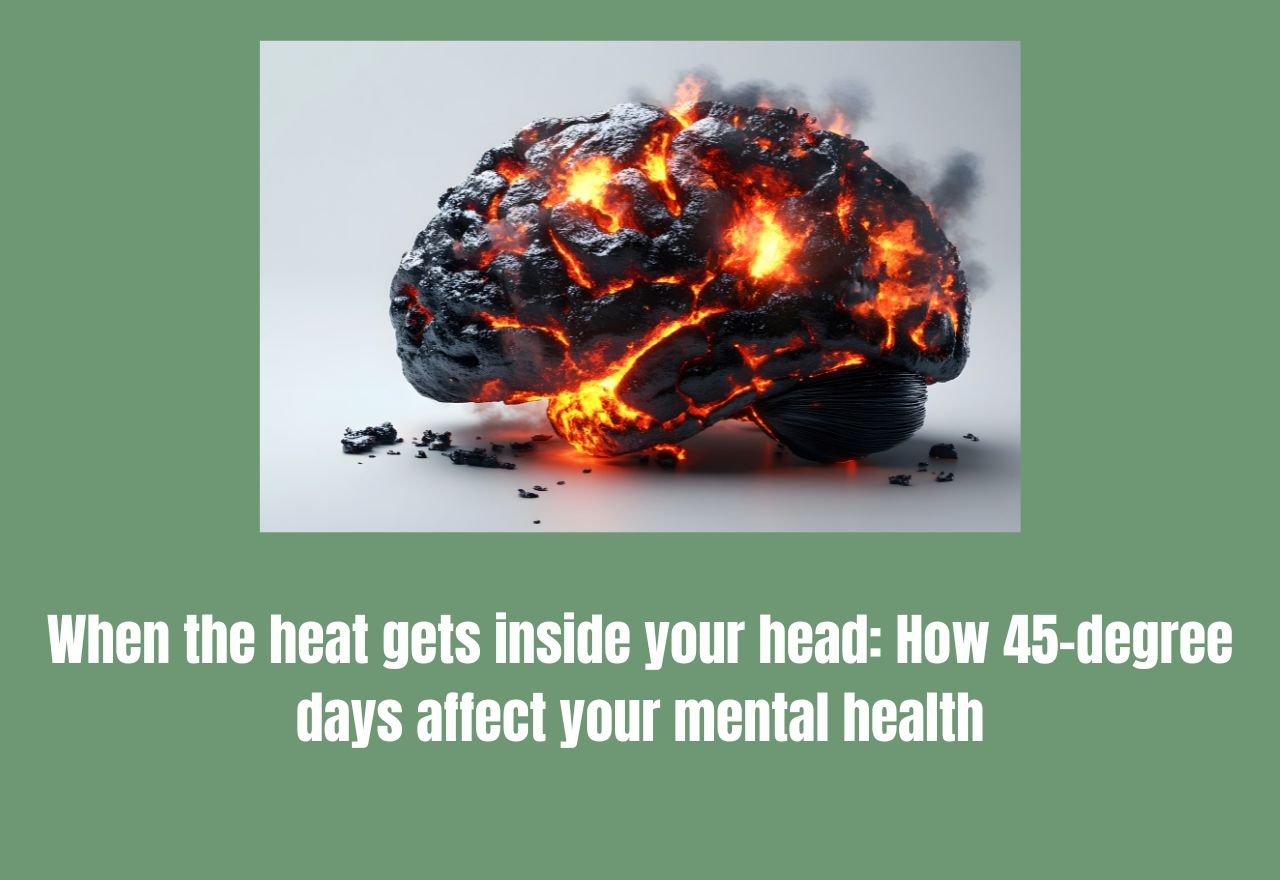
Extreme Heat and Depression: What's Really Happening
In Short:
- Research shows for every 1°C above optimal temperature, mental health deaths rise 2.2% and illness by 0.9%, with young Australians aged 15-44 most affected
- Extreme heat impacts mental health through sleep disruption, dehydration, elevated stress hormones and social isolation, with hospitalisation for mood disorders increasing 40% during heatwaves
- Staying hydrated, prioritising sleep in cool spaces, maintaining social connection and being gentle with yourself are essential strategies for protecting mental health during extreme heat
There's something about a week of 45-degree days that does more than make you sweat. It creeps under your skin, settles in your chest, makes everything feel harder than it should. You're irritable. You can't sleep. The smallest things set you off. You feel flat, disconnected, like you're moving through thick air. And you wonder if you're imagining it, if you're just being weak, if everyone else is coping better than you are.
You're not imagining it. The heat is getting inside your head, quite literally affecting your mental health, and the science is increasingly clear about just how significant that impact can be.
As parts of New South Wales face extreme heat with temperatures climbing past 45 degrees Celsius, it's worth understanding what's actually happening to our brains and bodies during these relentless heatwaves. Because while we talk a lot about the physical dangers of extreme heat, the mental health impacts are just as real and far more common than most people realise.
Research from Australian universities has found that for every one degree Celsius rise above a region's optimal temperature, mental health related deaths rise by 2.2 per cent and illness by 0.9 per cent. That's not a small number when you're talking about sustained heatwaves pushing temperatures 10, 15, even 20 degrees above what's comfortable.
The connection between heat and mental health isn't new, but it's becoming impossible to ignore. High temperatures contributed to an annual loss of 8,458 disability adjusted life years in Australia, representing 1.8 per cent of total mental and behavioural disorder burden. Young Australians aged 15 to 44 are particularly affected, with most losses linked to living with poor mental health during hot periods.
So what's actually happening when the mercury climbs into the mid-forties and stays there for days on end?
The mechanisms are both physiological and psychological. Your body is working overtime to maintain a stable internal temperature, and that constant physical stress triggers a cascade of effects. The underlying mechanisms may include disrupted sleep, dehydration, elevated stress hormones and increased social isolation during heat events, all of which can worsen conditions like anxiety, depression, substance use and psychotic disorders.
Think about your last truly hot night. You couldn't sleep, tossing and turning, sheets sticking to your skin, mind racing at three in the morning. Sleep disruption alone is a significant trigger for mental health issues, and during heatwaves, quality sleep becomes nearly impossible without air conditioning. Night after night of poor sleep compounds, leaving you exhausted, foggy, emotionally fragile.
Dehydration affects cognitive function and mood regulation. Your brain is roughly 75 per cent water, and when you're dehydrated, everything from concentration to emotional stability suffers. During extreme heat, you're losing fluids faster than you might realise, and that physical depletion translates directly into mental and emotional depletion.
The stress hormones are real too. For those predisposed to acute or chronic mental problems, failure to gain relief from the heat for extended periods of time may trigger irritability and episodic psychological distress, accompanied by risk behaviours such as excess alcohol consumption, violence and aggression.
It's not just people with pre-existing mental health conditions who are affected, though they're certainly more vulnerable. Research shows that the likelihood of hospitalisation for mood disorders like depression and mania increased by approximately 40 per cent during periods of high heat. Hospital admissions for mental and behavioural disorders spike during heatwaves, and the pattern is consistent across different cities, different countries, different climates.
There's also a deeply human element to how heat affects mental health that the statistics don't fully capture. During extreme heat, people withdraw. You stay inside, curtains drawn, trying to escape the worst of it. Social isolation increases. You cancel plans because it's too hot to go out. You skip exercise because moving feels impossible. All the normal coping mechanisms that help maintain mental health, the walk, the coffee with a friend, the trip to the park, become harder or impossible.
For people in regional areas without air conditioning, or with limited access to cool spaces, the impact is even more severe. You can't escape it. You're just enduring it, day after day, night after night, and that relentless exposure wears you down in ways that are hard to articulate but impossible to ignore.
The research also shows concerning links between extreme heat and suicide. Suicide rates rose by one per cent for each one degree Celsius increase in average monthly temperature. Young people are particularly at risk, with emergency presentations for suicidal thoughts and behaviours demonstrably linked to hot weather.
This isn't about being melodramatic or weak. This is about understanding that extreme heat is a genuine stressor on the human system, and mental health is part of that system. Your brain doesn't exist separately from your body. When your body is under sustained environmental stress, your mental state suffers.
The effects aren't uniform either. Some people are more susceptible than others. Those with pre-existing mental health conditions, older adults, people living alone, those without access to cooling, people on certain medications, all face heightened risk. But even people with no history of mental health issues can experience mood changes, increased irritability, difficulty concentrating, and feelings of hopelessness during prolonged heat exposure.
The effects of sustained heat and humidity, accompanied by drought, water restrictions, bushfires and power outages, are likely to have marked effects on the mental health of both rural and urban communities, with possible increases in the incidence of episodic or chronic stress. And that's exactly what we're seeing play out across NSW right now.
So what do you do about it? How do you protect your mental health during a week of 45-degree days?
The basics matter more than you might think. Hydration isn't just about physical health, it directly affects your mood and cognitive function. Drink water even when you don't feel thirsty. More than you think you need.
Sleep becomes crucial, which means doing whatever you can to keep your sleeping space cool. Damp sheets, fans, cold showers before bed, whatever works. Poor sleep compounds every other mental health challenge, so prioritising it during heatwaves isn't indulgent, it's essential.
Stay connected, even when you don't feel like it. Text a friend. Call someone. Even brief social contact can help counter the isolation that heat imposes. If you're struggling, tell someone. The heat makes everything feel worse, including the reluctance to reach out for help.
Limit alcohol. It's tempting to reach for a cold beer when you're hot and stressed, but alcohol disrupts sleep, causes dehydration, and can worsen mood. It's one of those risk behaviours that feels like relief in the moment but compounds the problem.
If you have air conditioning, use it. This isn't about comfort, it's about health. If you don't have air conditioning, find spaces that do. Libraries, shopping centres, community centres. Don't just endure it at home if you have other options.
Be gentle with yourself. If you're feeling flat, irritable, unmotivated, disconnected during extreme heat, you're not failing. You're experiencing a normal human response to abnormal environmental conditions. The heat will break eventually. Your mood will lift. But in the meantime, adjust your expectations. You don't have to be productive or positive or coping perfectly. You just have to get through it.
For people with existing mental health conditions, talk to your healthcare provider about heat management strategies. Some medications can interfere with your body's ability to regulate temperature, increasing vulnerability to heat-related illness. Understanding your specific risks can help you prepare better.
The broader reality is that extreme heat events are becoming more frequent and more severe. What we're experiencing now isn't an anomaly, it's increasingly the new normal. That means we need to start thinking about heat as a mental health issue, not just a physical comfort issue.
Communities need cooling centres. Healthcare systems need to prepare for increased mental health presentations during heatwaves. Employers need to understand that productivity will drop when temperatures soar, and that's not laziness, it's biology. Urban planning needs to incorporate green spaces and cooling strategies. These aren't luxuries, they're public health necessities.
On a personal level, it means recognising that mental health fluctuates with environmental conditions, and that's okay. It means being more compassionate with yourself and others during heat extremes. It means understanding that someone who's usually coping well might struggle during a heatwave, and that's not weakness, it's human.
The next time you're five days into 45-degree heat and everything feels impossible, remember that it's not just you. The research is clear. The heat is real. The impact on your mental health is measurable and significant. You're not imagining it, you're not overreacting, and you're definitely not alone.
Take care of yourself the way you would if you had the flu. Rest more. Lower your expectations. Reach out for support. Use whatever resources you have access to. And know that when the temperature drops, you'll feel more like yourself again.
Because extreme heat doesn't just make you uncomfortable. It gets inside your head, affects your mood, disrupts your sleep, elevates your stress, and challenges your mental health in ways that are as real as the physical dangers we talk about more readily.
Understanding that connection isn't about being alarmist. It's about being informed, being prepared, and being kinder to ourselves and each other when the mercury climbs past 45 and stays there for days on end.
The heat will break. Until then, survival counts as success.
COMMUNITY


NEWS


RURAL