The Good Old Days - Bob Biggs

Tertia Butcher
26 December 2025, 1:00 AM
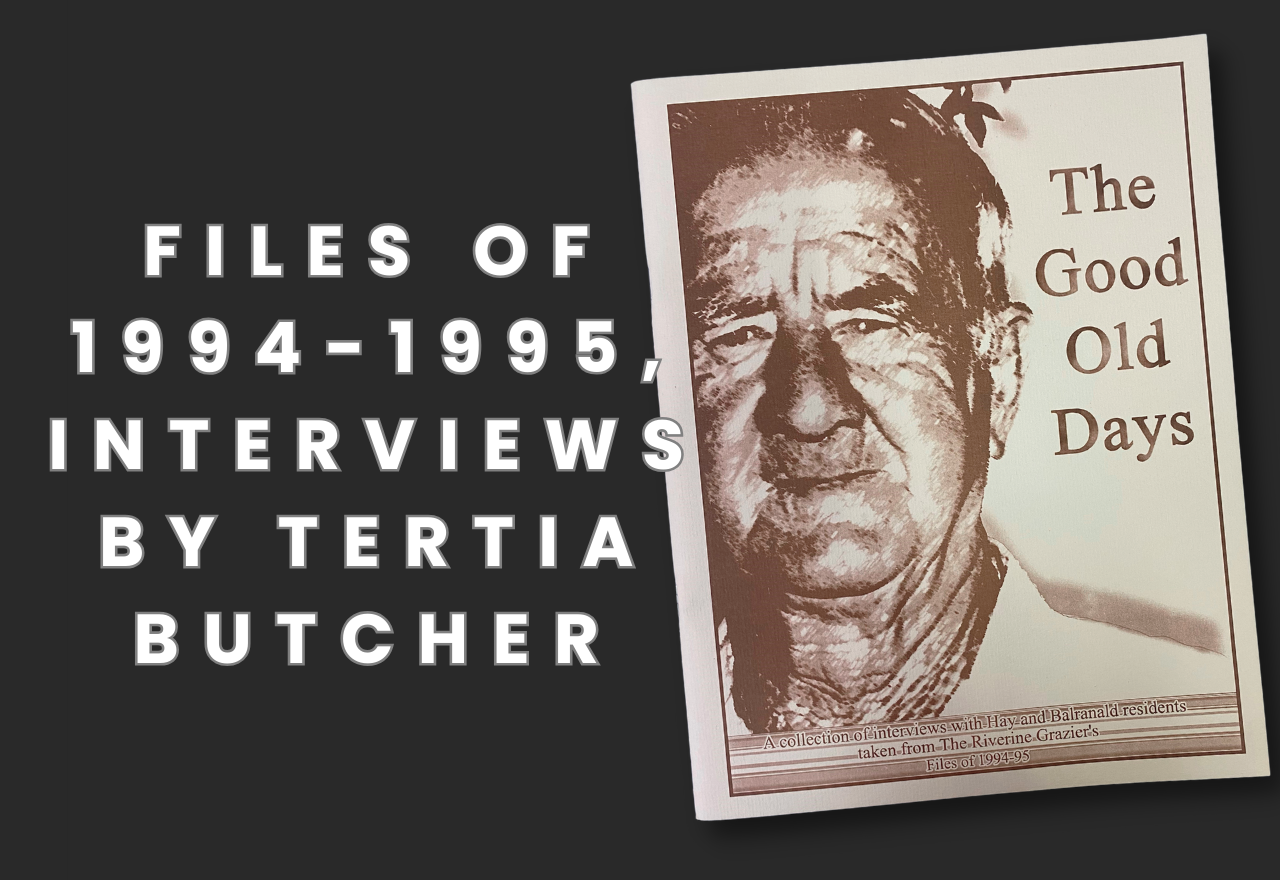
They come from one of Hay's success stories - Bob Biggs senior who started off delivering newspapers and ended up the proprietor of the Ampol complex in Macauley Street (now Caltex) and a school bus company before retiring to the NSW north coast in 1979.
But it was a long road to success. Long hard work, and little pay.
Bob was born in Church Street, East Hay on September 1, 1915.
“My first job - I was a little bloke then - was as a paper boy for A.O. Best Newsagents.
“When I was nine, I progressed to delivering milk for Fred Tapscott after school. I left school when I was 13. I was ready to go to high school but my mother couldn’t afford the clothes.
“So I went to Yeadon Station and worked there for around ten months earning seventeen shillings and sixpence a week. It was the depression years and work became very scarce. My brother Jack and I were forced to "go on the dole.
“My mother was laundress at the hospital for 24 years and a very proud woman. She didn’t want anyone in town to know her sons were getting the dole, so Jack and I took our push bikes and swags and headed for Griffith where we went on the dole. Every Thursday we would go to the Police Station and be given three tickets with a total value of six shillings and eight pence. They were for the baker, butcher, and grocer. We managed by cutting bindis and raking up the yard for the baker in exchange for yesterday’s cakes. And the butcher never refused us an extra sausage for a bit" "of cleaning up.”"
Bob was away for a year when he decided to return to Hay.
The first few nights he got out of bed to sleep on the floor, not being used to sleeping in a bed. He then worked for the Naughton family at ‘Booligal’ Station for a while and later at ‘Freshwater’.
“I then returned to Booligal where I helped dipping sheep and learned to drive a one-ton Chevrolet truck. That was my first taste of trucking, and something which I loved for the rest of my life.
“There was a Mounted Police officer stationed at Booligal, Constable Beach. One of my jobs was to dress a sheep and take it into the Police station to hang in the meathouse. One day the Constable asked me how old I was.
“When I told him I was 16, he said ‘You’d better be 17. Come in and I’ll give you your driving licence’. That is how I got my licence!
“I also used to drive A Model Ford utility for Arch Hennessy, a store keeper from Booligal, going to Hay three times each week to get bread from Beissel’s Bakery in Alma street. These were kept in three chaff bags.
"The bread was red-hot and the bags had to sit on special racks so the bread didn’t get squashed.”
Bob was witness to the de-licensing of the One Tree Hotel, some sixty years ago.
“Frank McQuade senior was the licensee.
“His clients had to use the wagon as a toilet, and when the inspector came around one day and told himto build proper toilets, ‘Stick it’. Frank lost his license."
Bob also worked with O J Smith, the well-known shearing contractor; with Jim Calderwood’s horse team forming the Balranald road and with Jim White and his son ‘Sharper’ on building the Mulwala Canal at Berrigan.
“We used a three-quarter yard scoop behind eight horses abreast,” he remembers.
“At Christmas we all came home and I got a job at Ashley’s Motors as a grease boy. I loved it but earned only £1-10-0 a week while I was getting £1-10-0 at the canal. My father tried to talk me into staying where the bigger money was, but I wanted to go into motors. So he told me I could stay at home, provided I paid my mother £1 per week, leaving me with 10/-.
“ Through his work at the garage, Bob came to work with Col Greaves who operated a transport business, carting wool to Melbourne.
“They were short of a driver one day and borrowed me. I loved it and never went back into the garage. I stayed on the trucks.”"
When Bob married Mavis Pocock in 1937, he was working at ‘Boonoke’ with Col Greaves, carting fodder to ‘Moonbria’ for the late Mac Falkiner.
“I went to Mr. Mac and told him I loved my work but wanted to be with my family in Hay. He told me that he couldn’t build another home on the property as he had just built one for Col. In the end, he told me he could quite understand my situation. He wished me luck and gave me a cheque for £100 - a lot of money in those days. He was a good man to work for, but my home was in Hay.”
Bob was set up for business when he returned to Hay with his £100 cheque. He had also been given an old semi-trailer by Mr. Mac as well as an old prime mover by Col Greaves.
“Over the years I missed quite a few dinners, but never booked anything up,” he said.
“We built a small house where Caltex stands today, and gradually added to the complex. When the aerodrome was pulled down in West Hay and the hangar was shifted to Lachlan street to become the Memorial Hall, I got hold of the two bearers and used them to make my own wool dump.
“The bearers and decking for the drum shed were part of the police horse stables. And when the Memorial Hall burnt down, I bought the remains for £5.
“With the help of my father, it took a bit of cleaning, but we were able to use the outside stairs and some of the iron.
“The water tanks I sold for £15 each.
“My dump held all the wool we carted as well as anything that came up from Melbourne. I loved life as a truckie.”
A big break came Bob’s way when Alf Ashley senior wanted petrol carted from Melbourne. He helped Bob buy a new Fargo truck, to which was added a tray.
When sheep were carted, Bob hired a wooden crate from Hay Motor Company.
“I got a lot of help, mainly from station people and we were doing quite well until petrol rationing came in. I was told I was limited to 44 gallons each month (had been going through 500 a month) and that I must fix a charcoal burner to my truck as well. They were terribly dirty things and I wouldn’t fit one on my new truck.
“So I decided to enlist in the Army. That was 1941 and Arthur Squires was my recruiting officer. So myself and several others went down to Sydney to enlist. We all passed medical except Harry Cox and Snow Marr. I had one month’s leave to wind up my business.”
Bob became an Army driving instructor, teaching others to drive heavy vehicles and machinery at West Maitland.
"The next three years were spent in Western Australia waiting for the Japanese to land.
“They didn’t. So we were brought back in 1945. When I returned home, I got the truck out and started my transport all over again. Over time, we added to our complex and finished building it up to what it is today. In 1954 I became an agent for Ampol.”
Bob’s trucks were also used to transport foot- ball teams and groups of people such as the Hay Band.
“I will never forget the day we took the Band to the Narrandera Band Sunday, all the local players and 38 instruments. Mr. Constantine was the Band Master. He was music-mad and he used to live at Bishop’s Lodge. On this day Hay won the competition outright and Finley came second. There were bands from everywhere.
“On the way back, it started to rain. It rained two inches and there was no bitumen between Hay and Narrandera. It was a mud track all the way. We had chains on the back wheels and at Darlington Point we stopped in front of the hotel and slept on the verandah. Some slept under the bridge.
“I gave old Mr. Constantine my bed in the truck.
“The next day we were given a bucket of tea and some toast by the publican.
“That was all the food they had as many others had camped there the night too.
“In return, the band got out their instruments and played some music on the verandah of the hotel. I can remember Ronnie Wall playing the cornet.
“Darlington Point had never seen anything like it. It was wonderful.”
Bob sold his Ampol business to Michael Bradley in June 1973 who subsequently sold it to Reg O’Brien.
His house and school bus business was sold to the Derrig family.
“When we decided to leave town we had a send-off every night for two weeks.
“I still return to Hay to visit my son Bob and family.
“This is where I worked hard to enjoy a good retirement.
“But home today is Forster, where I still have the Cup won for kicking the most goals (35) in the Wednesday afternoon half-holiday com-petition."
"Work bloody hard and lay off the grog and drugs. Those are the words of wisdom for today’s youth who want to make a success of their lives."
NEWS

SPORT
RURAL
COMMUNITY





VISIT OUTBACK NSW
VISIT BALRANALD