Why Your True Crime Obsession Isn't Weird: The Legitimate Benefits Behind the Guilty Pleasure

Kimberly Grabham
01 February 2026, 9:40 PM
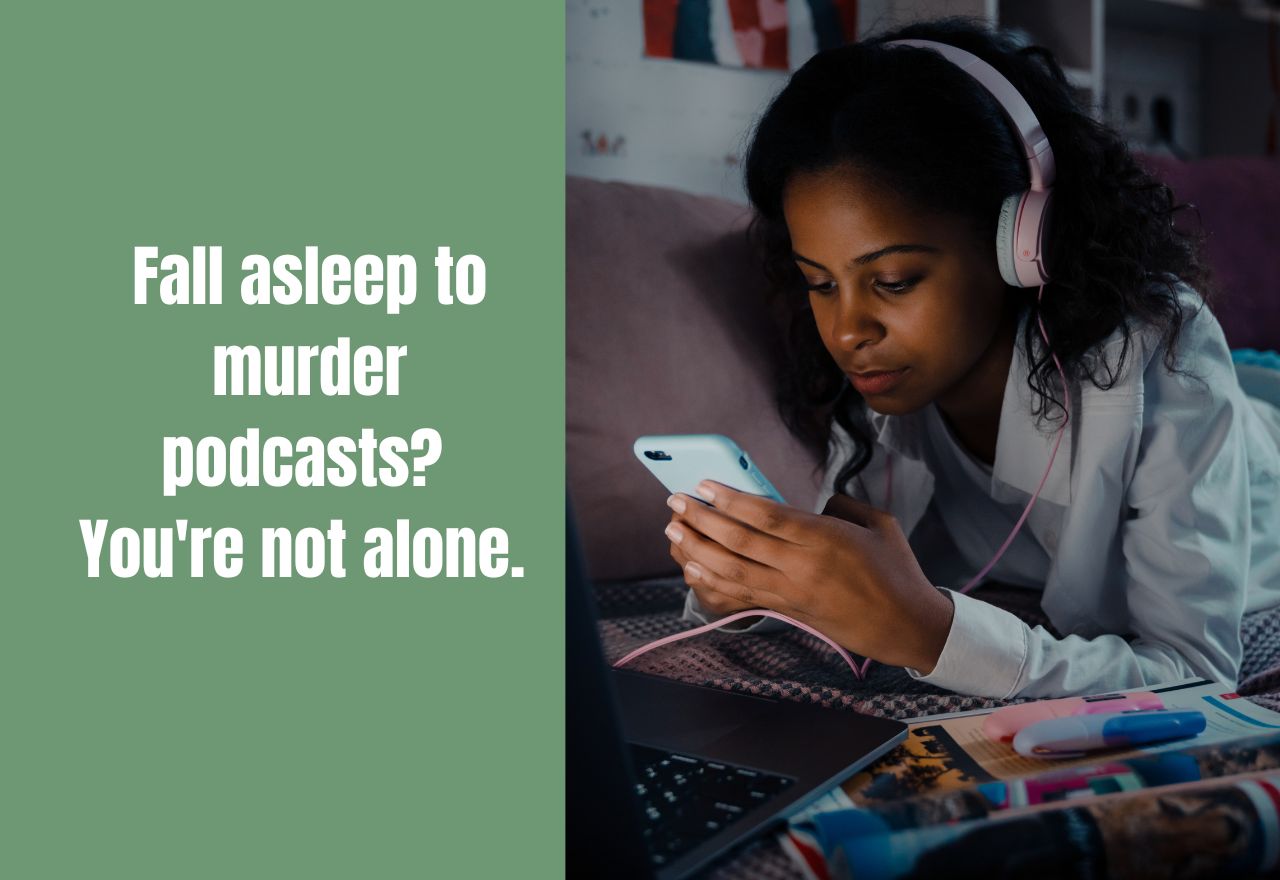
Fall asleep to murder podcasts? You're not alone.
In Short:
• Women make up 70% of true crime consumers and 85% of podcast audiences, using the content to learn survival techniques, identify red flags in behaviour, and mentally rehearse responses to dangerous situations
• True crime serves legitimate psychological functions including emotion regulation, threat awareness education, and social connection, with research showing it helps people feel more informed and prepared rather than more fearful
• While benefits include safety education and victim advocacy, healthy consumption requires moderation and choosing ethical content that centres victims rather than sensationalising violence for entertainment
You're loading the dishwasher while listening to a detailed account of a serial killer's capture. You're walking the dog with a podcast host describing a crime scene in your ear. You fall asleep to episodes of a murder documentary. And somewhere in the back of your mind, you wonder if there's something wrong with you.
There isn't. And the reasons why true crime resonates with millions of people, particularly women, are actually far more logical and beneficial than you might think.
True crime has exploded into one of the most enduring entertainment trends of the past decade. Podcasts like Crime Junkie, My Favorite Murder, and Morbid attract massive audiences. Documentaries like Making a Murderer and series like Monster dominate streaming platforms. According to research, women are responsible for 70 per cent of Amazon reviews for true crime books. The audience for the podcast Wine and Crime is 85 per cent female. Even though men commit 80 per cent of violent crimes, women are significantly more drawn to true crime stories.
It seems counterintuitive. Why would anyone, particularly women who are statistically more likely to be victims of violent crime, voluntarily consume content about murder, assault, and abduction? Why would graphic descriptions of crime scenes be relaxing? Why would anyone fall asleep to stories about serial killers?
The answer isn't that something's wrong with you. The answer is that true crime serves genuine psychological and practical functions that we're only beginning to understand and appreciate.
The most straightforward benefit is safety education. True crime content teaches survival techniques, helps identify red flags in behaviour, and provides practical knowledge about how crimes occur and how they can be prevented. For women in particular, true crime stories can educate about how to cope with scary situations and distant threats. They can teach practical tips that might prevent victimisation.
Think about it pragmatically. Through true crime content, women can learn how they could be vulnerable to predators and what they can do about it. They can learn to recognise warning signs in relationships that might escalate to violence. They can understand manipulation tactics used by abusers. They can hear survival stories from people who escaped dangerous situations and learn from their strategies.
One listener explained it perfectly when defending true crime consumption against criticism: "I've never been attacked by any kind of animal, nor do I know anyone who has. However, I do live in the forest and I have learned how to react if I ever encounter a cougar or bear by listening to other people recount their own sometimes horrible experiences. I like true crime and survival stories because I want to be a more aware person."
There's a difference between hypervigilance, which can be a symptom of trauma, and choosing to be vigilant as a safety strategy. True crime consumption, for many people, falls into the latter category. It's intentional education about potential threats, not compulsive worry about them.
Psychotherapist Helen Villiers points out that one of the most difficult things about being a woman is never knowing where an attack might come from. Being able to predict patterns of behaviour is seen as a way to keep safe. There's a deep sense of protection and security in the belief that you would be able to recognise danger and protect yourself. By explaining how crimes occurred and how perpetrators operated, true crime content provides a sense, even if somewhat false, that you'll be able to spot predators and keep yourself safe.
The field of evolutionary psychology explains that we're wired to try to make sense of threats in our environment. We want to understand what would make people do things that would be unthinkable to us. Beyond just a natural drive to make sense of threats, studying the details of violent crime cases may make us feel like we'd have a better idea of what to do if we were ever in that situation. Following these cases gives our brains a rehearsal for the possibility of being a victim of crime. It's mental simulation of low-probability but personally relevant high-impact risks.
Oddly enough, learning about crimes can actually make people feel safer, not more frightened. Dissecting what went wrong helps listeners feel more informed and more prepared. It's the difference between generalised anxiety about unknown dangers and specific knowledge about identifiable risks. The former is paralysing. The latter is empowering.
True crime also serves important emotion regulation functions. The content delivers strong emotions like fear, anger, and outrage within a structured narrative arc, helping consumers manage those feelings productively. It's similar to how horror films function as a safe space to experience fear. You're processing genuine emotions, but you're doing it in a controlled environment where you can pause, stop, or step away at any time.
For some people, particularly those who've experienced trauma, true crime content provides a way to re-experience traumatic situations in a safe environment where they have more control. This isn't necessarily unhealthy. Processing trauma through parallel narratives can be therapeutic, though obviously this depends heavily on the individual and their specific circumstances.
The social connection aspect of true crime consumption is also significant. Listeners often describe podcast hosts as friends. These parasocial relationships, while one-sided, still fulfil social needs and foster trust. Online communities around true crime create spaces for discussion, analysis, and shared interest. Platforms like Reddit are filled with amateur sleuths who analyse cold cases and form global justice communities. For many people, these fandoms foster belonging and shared identity.
There's also an element of justice-seeking and victim advocacy. Many true crime consumers are motivated by a desire to see justice served, to ensure victims aren't forgotten, to keep public attention on unsolved cases. Podcasts like True Crime with Kendall Rae explicitly focus on bringing awareness to victims and their families, including links to GoFundMe accounts, police tip lines, and donation pages in every episode description. This turns consumption into a form of activism, however small.
The format matters as much as the story. Modern true crime media offers intimacy and immersion that older formats never could. Listening to a podcast creates an almost companionable experience, a voice in your ear that feels personal and present. You can consume it while doing other things, fitting it seamlessly into multitasking lives. These aren't just stories, they're shared emotional experiences, a blend of entertainment, education, and empathy.
Now, this doesn't mean true crime consumption is without potential downsides. Cognitive biases and repeated exposure to emotionally intense narratives can lead to beliefs that the world is more dangerous than it actually is. This can result in overestimating personal risk, reduced trust in strangers or institutions, and chronic hypervigilance or anxiety. Even in the face of declining crime rates, true crime content can create perceptions of increased threat.
Being aware of these risks is important. If you find yourself dwelling on cases hours after consuming them, if you're compulsively checking for updates, if you're fearful of going out or being home alone, if you're experiencing regular anxiety symptoms like rapid heartbeat, trouble sleeping, or constant tension, these could be signs that your true crime consumption is negatively affecting your mental health. Like any form of media, moderation matters.
There's also legitimate ethical concerns about the true crime genre. The line between storytelling and sensationalism can blur. Some content is heavily dramatised and stylised, making it difficult to distinguish fact from fiction. This can desensitise audiences to real-life atrocities, shifting focus from justice and truth to entertainment value. In the pursuit of gripping narratives, respect and empathy for victims can get lost.
Choosing ethical true crime content matters. Look for creators who centre victims and their families, who are transparent about their sources, who avoid gratuitous detail for shock value, who use their platform to advocate for justice rather than simply exploit tragedy for profit.
But acknowledging potential downsides doesn't invalidate the legitimate benefits. For many people, particularly women, true crime consumption is a rational response to living in a world where violence is a genuine threat. It's education disguised as entertainment. It's emotional processing wrapped in narrative structure. It's community building around shared interest and shared concern.
The next time someone asks why you're relaxing with a murder podcast, or raises an eyebrow at your true crime documentary queue, you can explain that you're not being morbid. You're being informed. You're learning to recognise manipulation tactics, understand predatory behaviour, and mentally rehearse responses to dangerous situations. You're processing fear in a controlled environment. You're connecting with a community of people who share your interests. You're advocating for victims and justice.
Your true crime consumption isn't weird. It's a sophisticated psychological strategy for managing threat awareness, emotion regulation, and social connection. It's education about human behaviour at its worst, which helps you recognise and respond to warning signs in your own life. It's a way of feeling more prepared in a world where preparation matters.
And if it helps you fall asleep at night knowing that you'd recognise the red flags, that you'd trust your instincts, that you'd know what to do if you ever found yourself in danger, then it's serving exactly the purpose it needs to serve.
Just maybe skip the most graphic episodes right before bed. Even beneficial content doesn't need to fuel nightmares.
COMMUNITY
RURAL


SPORT