Butler and Dalton Join Forces to Overhaul ‘Secret’ Water Register

Krista Schade
17 February 2026, 7:00 PM
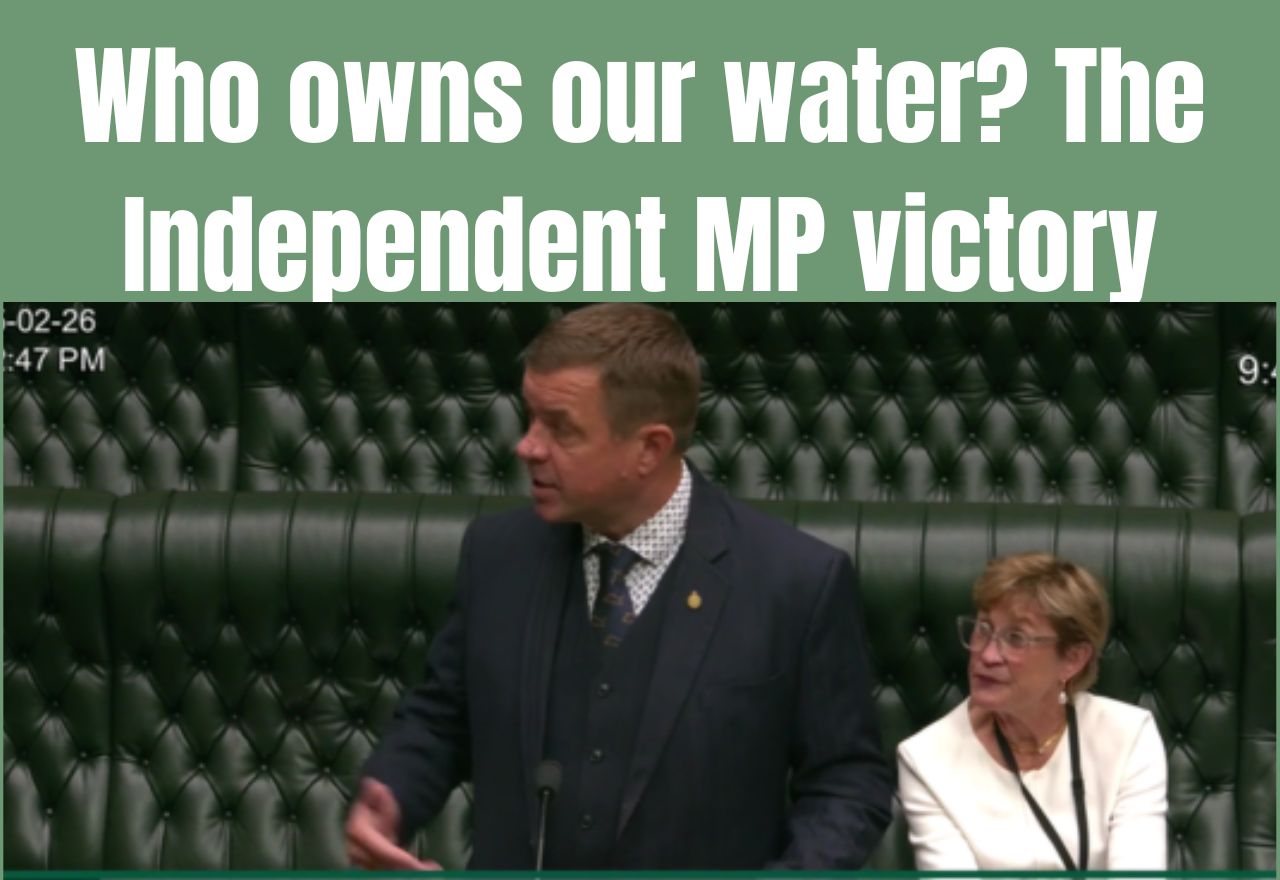
Butler and Dalton Strike Blow Against ‘Secret’ Water Register: What the New Laws Mean for You
In Short
- End of Secrecy: The new law creates a simplified, searchable register to reveal who owns NSW water, stripping away complex corporate veils.
- Politician Accountability: For the first time, MPs must publicly disclose their water interests—and those of their spouses—on the Pecuniary Interests Register.
- Independent Power: Barwon MP Roy Butler and Murray MP Helen Dalton formed a rare regional alliance to push the bill through, bypassing traditional party-line politics.
Member for Barwon Roy Butler and Member for Murray Helen Dalton have joined forces in the NSW Parliament to demand an end to what they describe as the "shroud of secrecy" surrounding water ownership in the state.
Both Ms Dalton and Mr Butler are independent members, representing the vast Back Country electorates of Murray and Barwon respectively.
During the first sitting week of February, Mr. Butler rose in the Legislative Assembly to throw his weight behind Mrs. Dalton’s Water Management Amendment (Water Access Licence Register Reform) Bill.
“I rose to speak in favour of a bill by parliamentary colleague Helen Dalton, Member for Murray, asking for a simpler, more accessible register of State and Commonwealth water access licences.”
The Problem: A "Distrustful" System
For years, landholders and community members have complained that the current NSW Water Register is a maze of technical data that makes it almost impossible for the average person to see exactly who holds what licences.
"Finding information about water assets in NSW is extraordinarily difficult," Mr. Butler told his constituents this week. "When information is hard to find, it can sow the seeds of distrust."
The core argument driving this Bill is one of public ownership: because water is a public asset, Dalton and Butler say the public has a right to see who is using it and where it is going. They argue that the current lack of transparency creates an uneven playing field where large-scale players can navigate the system, while family farmers are left in the dark.
"Applying for a water licence is currently easier than opening a bank account,” Ms Dalton said. “People can hide behind a corporate veil, so the general public don't know they're the actual purchaser. I am here to end the secrecy surrounding water ownership in NSW."
The Bill: What is Changing?
The Bill, introduced by Helen Dalton and backed by Butler, aims to shine a light on the murky corners of water trading. If passed, the reform would introduce several key changes:
A Simplified Register: The creation of a more accessible, search-friendly database of State and Commonwealth water access licences.
Unique Identifiers: A system to track water owners more clearly, preventing interests from being hidden behind complex corporate structures.
Foreign Ownership Reporting: New requirements for reporting foreign beneficiaries of trusts that hold interests in NSW water.
MP Accountability: Perhaps most controversially, the bill seeks to require Members of Parliament to publicly disclose any water interests they or their spouses hold, putting water on the same level as property or shares in the Pecuniary Interests Register.
"When I was elected, I was shocked to learn I didn't have to declare my water entitlements in the conflict of interest form they make politicians sign,” Ms Dalton said. “We have to declare land, property, jobs, and shares. But not water. The first step in fixing our water problems is to find out who owns it."
The Timeline: A Persistent Fight
While Roy Butler rose to support the reform in the first sitting week of February, the journey began much earlier for Helen Dalton. She first introduced the Water Management Amendment (Water Access Licence Register Reform) Bill in the Legislative Assembly on August 8, 2024.
This wasn’t her first attempt; Dalton had been introducing versions of this "Water Register" bill since 2020. However, the 2024 version finally gained enough momentum to pass both houses and was assented into law on October 23, 2024
"Assented into law" is the final hurdle a Bill must clear to become an enforceable Act of Parliament.
Once passed, the Bill is sent to the Governor of NSW, who represents the King. The Governor signs the Bill on behalf of the monarch.
When Roy Butler spoke in favour of the Bill in February, it was still a proposed law. Once it was assented, it shifted from being a political idea to a legal requirement.
In Australia’s constitutional monarchy, a Bill (a proposed law) does not become a law the moment politicians finish voting on it. It requires a formal seal of approval from the Crown.
A Powerful Independent Alliance
The partnership between Butler and Dalton seems to be creating a powerful push-for-the-bush in NSW Parliament. While they represent different electorates, their shared background as independents from regional areas allows them to bypass party-line politics.
"Everyone should follow the same rules," Mr. Butler said. "Public assets belong to the people, not to governments."
NEWS


SPORT


RURAL