The life and history of scabs in Menindee and beyond

Kimberly Grabham
07 December 2025, 7:00 PM
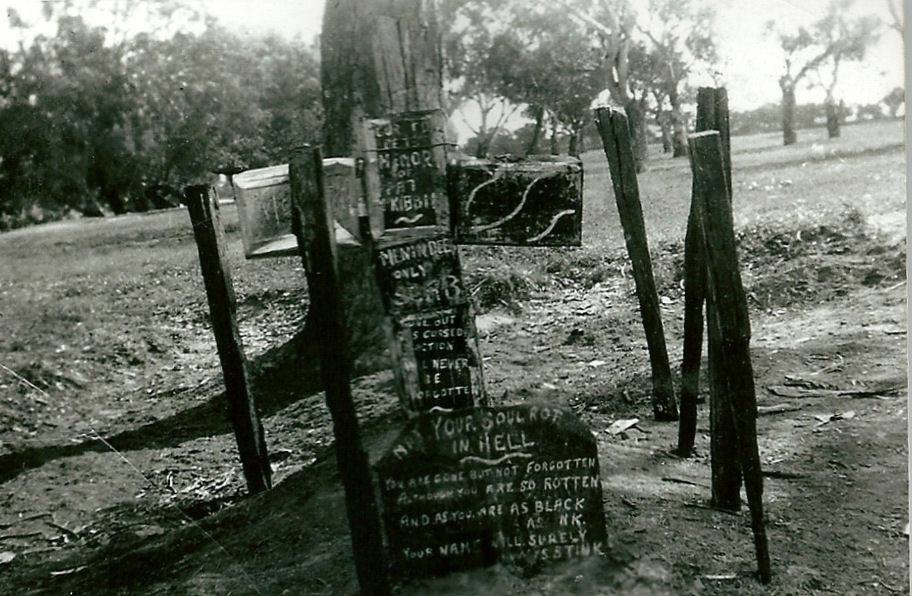 Image: Dianne Coffey, Menindee Wilcannia & Western NSW History page on Facebook.
An old photograph from Crick Park in Menindee tells a story that many Australians have never heard. Dating back to 1938 or 1939, during a rail strike, the image shows a grave marked with the word "SCAB", a stark reminder of the bitter industrial conflicts that once tore through rural Australia.
The grave belonged to a man believed to have refused to strike with his fellow workers, and while the details of his story remain elusive, the photograph opens a window into one of the most violent chapters of Australia's labour movement.
The term "scab" has long been used as a derogatory label for strikebreakers, those workers who crossed picket lines or refused to join their colleagues in industrial action. In the late 19th century, this word carried such weight that it could destroy reputations, fracture communities, and in some cases, spark violence that would echo through generations.
The most dramatic example of this conflict occurred in the early hours of 27 August 1894, when around 150 masked shearers boarded the paddle steamer Rodney as it lay moored in a remote lagoon on the Darling River, 37 kilometres from Pooncarie in New South Wales. What happened next would become one of the most infamous incidents in Australian industrial history.
The Rodney was no ordinary vessel. Operating primarily from Echuca Wharf, then the third largest port in Australia with 240 paddleboat river traders, it used barges to transport tonnes of wool along the Murray and Darling river systems. But on this fateful voyage, it carried a far more controversial cargo: 45 non-union shearers destined for Tolarno Station near Menindee.
The journey of these strikebreakers had begun at Echuca, where they arrived by rail under police protection. The choice of these men to break the strike was not taken lightly by the unionised shearers who had been fighting for fair working conditions and decent pay. When the Rodney departed Echuca Wharf, it did so with only minutes to spare as over 100 union shearers raided the wharf, resorting to throwing stones at the departing vessel in a desperate attempt to stop it.
But the union men didn't give up. They pursued the paddle steamer along the river network, gaining support and numbers along the way. By 1894, their camps had become highly organised, with more than 300 armed shearers taking control of the movement of riverboats and trade along the Murray and Darling Rivers. They were fighting what many saw as a class war between the privileged station owners and the workers they considered second-class citizens.
The conflict had its roots in the early 1890s, a time when Australia was on the eve of a crippling depression and enduring a scorching drought. Wool prices were plummeting, and the country's wool growers attempted to introduce anti-union contracts to reduce shearers' pay rates. For unionised shearers and wool workers already enduring poor working conditions, this was seen as an unforgivable breach of trust.
The massive 1891 shearers' strike that followed would spread from Queensland to New South Wales and Victoria, becoming one of the earliest and most violent industrial disputes in Australian history. Camps of striking shearers burned woolsheds that employed strikebreakers, and bloody clashes became commonplace across the sheep country.
Menindee, located near Broken Hill with its strong union tradition, found itself at the centre of this turmoil. The region had already seen major strikes and lockouts, particularly the infamous disputes of 1892 and 1909, where mining companies brought in large numbers of police to protect non-union workers. The animosity towards those who continued to work during industrial action ran deep.
The shearers pursuing the Rodney tried various tactics to stop the vessel. They attempted to block its path with barges and fencing wire strung across the river, but these efforts failed, only making them more determined in their violent endeavour. The strikebreakers and their escorts thought they had found safety when Captain Jimmy Dickson moored the boat in a remote lagoon surrounded by swamp. They were wrong.
While everyone on board slept, the masked shearers struck. They threw the strikebreakers overboard, set the barges of goods adrift, and put the vessel to the torch. The horrified captain could only watch helplessly as the flames consumed his ship. The resulting fire burnt the 32 metre long timber paddle steamer to the waterline, ending its journey in spectacular fashion.
The burning of the Rodney marked a significant moment in Australian history, bringing an end to one of the country's most violent and destructive union conflicts. It was the first vessel to be sunk in a fiery conflict by striking shearers, and the event would be remembered long after the flames died down.
The skeletal remains of the Rodney are still visible today during low river flows and drought, a heritage protected reminder of that tumultuous moment more than 128 years ago. Despite a reward being offered at the time, no one was ever convicted over the fire. The incident seriously threatened the five million pound river trade that sustained communities along the Murray and Darling river systems.
The photograph of that lonely grave in Crick Park, whether connected to the rail strike of the 1930s or the earlier conflicts, speaks to the same bitter divisions. It reminds us that industrial disputes were not abstract battles over wages and conditions, but deeply personal conflicts that split families, destroyed friendships, and sometimes ended in tragedy.
Today, local arts and heritage projects in the region have created augmented reality experiences to bring this history to life for new audiences. The story of the Rodney and the shearers' strikes has been memorialised in historical accounts and arts projects, ensuring that this dramatic chapter of Australian working life is not forgotten.
For those who grew up on sheep stations or worked as shearers, these stories carry particular resonance. They remember the tough times, the droughts, the struggles that both wool growers and workers faced during those difficult years. The conflicts were not simple matters of right and wrong, but complex disputes born of economic hardship, class division, and the fundamental question of workers' rights.
The term "scab" may seem like an outdated relic today, but the graves, the burnt wrecks, and the stories passed down through generations remind us of a time when these conflicts literally set rivers ablaze. They tell us about the price paid by those who stood on either side of the picket line, and the communities that bore the scars of Australia's industrial coming of age.
NEWS


SPORT


COMMUNITY