The Good Old Days - Mary Bunyan

Tertia Butcher
17 December 2025, 1:00 AM
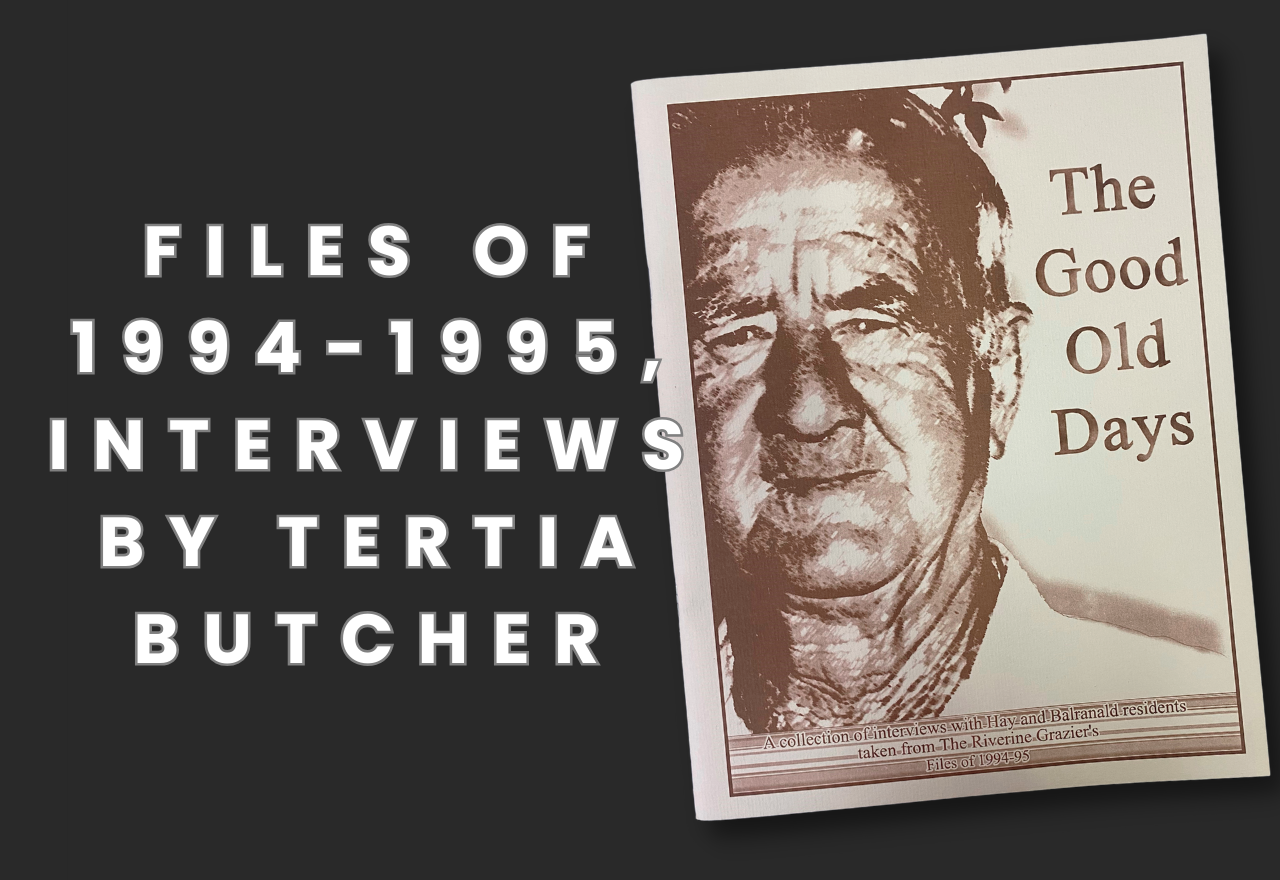
When Mary Bunyan thinks back to the good old days, she thinks of a better Hay.
"Hay has gone backwards in my opinion," 84 year old Mary says. "It used to be a much better and more progressive place. "We had six passenger trains a week plus an extra one on Friday nights in summer. "There were up to five bakers at a time, we had our own butter factory which supplied excess cream to Narrandera, 15 men were employed at the Aerodrome to cope with the daily air traffic between Sydney and Broken Hill. "We had three tailors and shops had their own dressmakers. "Hay even had its own police magistrate, complete with his own driver. "There was a strong police force, both on foot and mounted. "We had two breweries. "Yes, I think we are going backwards.".
Mary was born in Hay, the daughter of Jack Jensen who worked as a carrier with his team of horses. When the Irrigation Area started in 1914, he was appointed water bailiff. "He held that job until 1921 when the irrigation was depleted and only the manager, Mr Timms and the man in charge of the engines, a Mr Jacka, were kept on. "Twenty of the men went to Griffith to start up the irrigation there. The others found work elsewhere. "In 1929 things reversed. "The irrigation was up and running again and the old staff were all re-employed. "Dad worked there until 1965 when he died. "Life on the ‘Irrigation’ was wonderful. "We even had our own girls’ cricket team. "And if someone had a birthday, everyone would turn up with a cake or sandwiches and we’d have a party. "No alcohol, just a cup of tea or coffee and plenty to eat.
"I also remember swimming at Madman’s Beach, the most popular beach in those days. "That was where all the fun was, where it all happened. "Summer time of course was water melon time, and Charlie Pearson’s garden was just up the river from the beach. "It was nothing to see eight or nine people crawling up to Charlie’s garden to grab a water melon or rockmelon, and then float it back to Madman’s Beach. "This could happen in day time or at night time. "Another popular place was at Jacka’s Pumping Station on the Irrigation Area. "We were not allowed to swim in the channel, but the offshoots of the main canal used to feed the Headons’ orchards. "And they had very nice stone fruit. "Unfortunately the Headon boys were our school friends, and they knew what tricks we could get up to. "They were very handy with the shotgun. "Billy and George Headon thought nothing of shooting over the area where the fruit thieves were. "They never shot at us, just over us and no one ever got hurt. "The Headons were the most wonderful family I’d known. "A young boy had the job of taking orders from hotels in time for their breakfast. "People used to buy from carts in those days too. I loved swimming carnivals at Alma Beach and Orson Beach. Alma Beach always held a big day on Boxing Day and Orson Beach on Australia Day. "I loved them. These days I have to be content with playing bowls."
In 1932 she married her first husband, Alex Crawford, a shearer. He died in 1969 and 11 years later she married Gordon Bunyan of Hay. Mary has always been a keen photographer and over the years has built up a comprehensive photographic history of Hay. She captured on film the Boxing Day 1927 air crash of ‘Satin Bird’ on the old Aerodrome, photographed flood, fire and famine and recorded life in Hay in the earlier days. "Where I live now (Edward Street) used to be an old Chinese Camp, all the way through to Maidens Lane," she said. Mary was instrumental in forming St Mary’s School Parents and Friends Association. "It all started when I visited the school one day while my daughter was there. "I found the teachers were using pre-war world maps, because they didn’t have new ones. "I gathered up six mothers and we formed the P&F to raise money for the school." She was secretary for 25 years and past noble grand of the former Rebekah Lodge which closed down in Hay in the 1960’s. The Lodge started in Hay in 1908 and met on a monthly basis, in rooms in Lachlan Street, on the site now occupied by Hay Shire Council Chambers. In later years meetings were held in the CWA rooms. And when the first wireless was built in Hay, she was there to share in the excitement. "A gentleman from Sydney came down to Hay to build a wireless which could be used locally.
NEWS


SPORT
RURAL
COMMUNITY