From Cooktown champion to Hay's newest star: The remarkable Corinne Stallan
Kimberly Grabham
09 January 2026, 4:00 AM
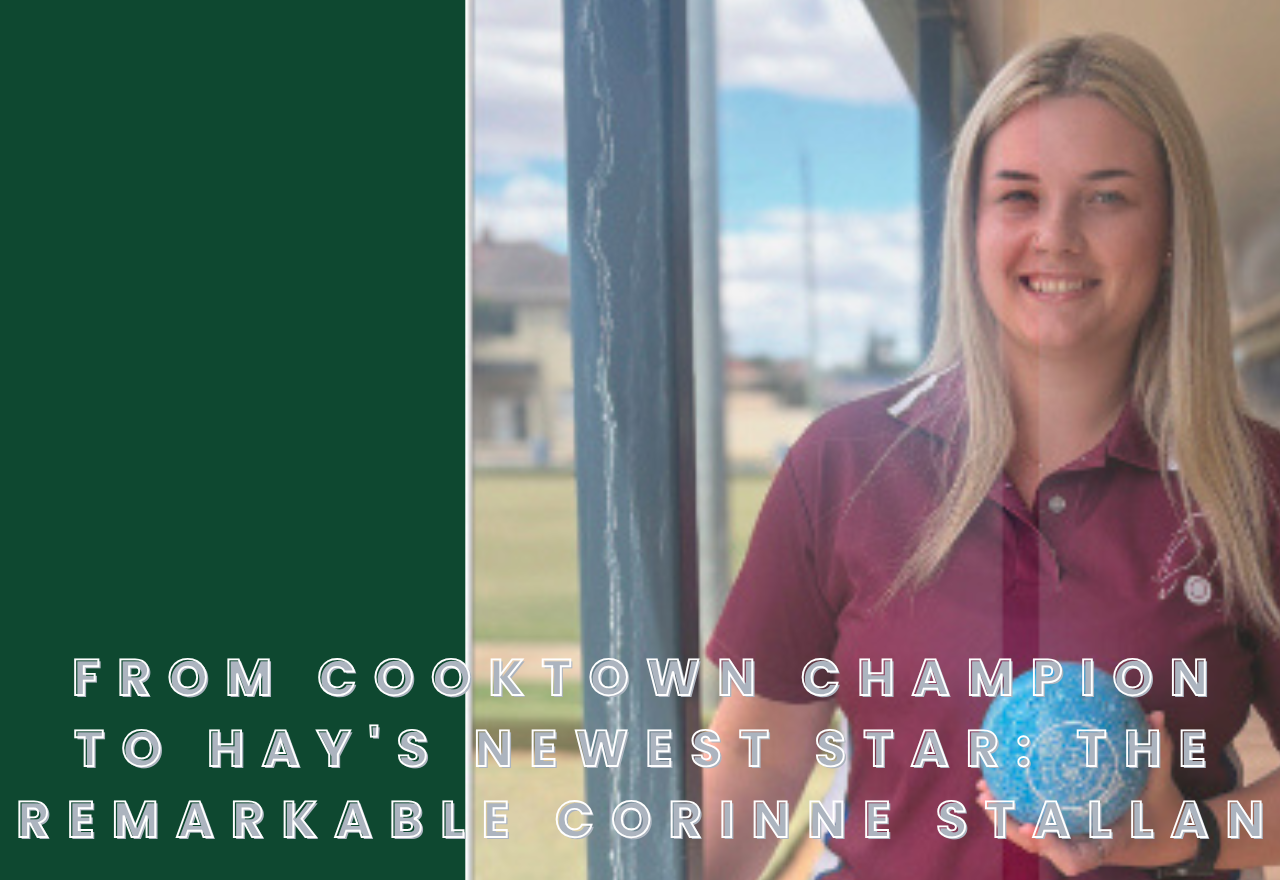
At just 20 years old, Corinne Stallan has already achieved what many bowlers spend a lifetime chasing; state titles, national gold medals and representative honours for Queensland.
Now, she’s making her mark in the Riverina, bringing championship pedigree to the greens of Hay.
Sitting at the Hay Bowling Club on a typical spring afternoon, Corinne reflected on a journey that began with watching her mum Katrina bowl every Sunday in Cooktown when she was just a teenager.
“I just ran along. I used to watch her every Sunday at bowls and then a coach picked me up in Cooktown one day,” Corinne recalled.
“He wanted to take me under his wing and coach me because he saw potential.”
That coach’s instinct proved remarkably accurate.
Within a year of starting at age 13, Corinne was selected for the Queensland under-18 team, an almost unheard-of achievement for a first-year competitor.
“Everyone was a bit upset because you don’t usually get picked in the first year you're there,” she said with a modest smile. “Everyone was like, that’s crazy. How did you get picked?”
What followed was a stellar junior career that saw her represent Queensland for three consecutive years in the under-18 championships.
In 2022, at just 16 years old, she won gold in the fours at the Australian under-18 championships on the Gold Coast, becoming the first junior from Far North Queensland to play in a Queensland versus New South Wales match.
“I came home with three medals, a gold in fours, a silver in triples, gold for Queensland and we also got the overall girls’ trophy and overall winners of the national competition,” Corinne said.
But success at that level came with serious commitment.
Training three times a week wasn’t optional, it was mandatory, with drills tracked on spreadsheets and emailed to the Queensland CEO.
“They were very hard drills too,” Corinne remembered.
“Like 40-bowl drills and grouping drills, just to prove that you are practising and how consistent you are."
The dedication paid off, but by late 2024, Corinne and her mum Katrina were ready for a change.
They packed up their lives in Far North Queensland and headed south to Hay, arriving at the end of October last year.
For Corinne, the move was challenging in ways her bowling career had never been.
“It was very challenging for Corinne because I was born here,” Katrina explained.
“And it’s such a different town from where she grew up. It was very hard to make friends when you’re not in school.”
But the Hay bowling community quickly embraced their newest member.
The warm welcome contrasted sharply with the more serious competitive atmosphere Corinne had experienced in Queensland.
“It’s more relaxed and more fun,” Corinne says.
“They take it a bit more seriously up where we're from. Like, they frown upon you if you have a beer while you're bowling.
“All the people in Hay, the bowlers in Hay, are just so good. They’ve taken me under their wing.”
The adjustment has been worth it.
Since arriving in Hay, Corinne has already made history at her new club, becoming the first female and youngest player ever to win the major singles championship.
She’s also found employment at Hay Shire Council in customer service and is building a life with her boyfriend, Tyson.
“I think it was one of the best moves we ever made,” Katrina reflected.
“She’s got a good job, she’s got a good boyfriend.
“Hay’s just been so good for her.”
At the club, Corinne has become a mentor figure herself, despite being one of only three or four women who regularly play. She’s patient with newcomers, eager to share the knowledge her early coaches instilled in her.
“Everyone in Hay, they’re willing to teach you,” she said.
“They’re willing to stop playing to teach new people. The club just needs new people.”
For those curious about trying the sport, Corinne emphasised getting started is easier than many people think.
Lawn bowls has been described as “the game that takes a second to learn, but a lifetime to master”.
The basic premise is simple.
Take your bowls as near as possible to a smaller white ball called the jack.
Most clubs have various sized sets of bowls to lend to new recruits while they learn, so there’s no need to invest in equipment immediately.
The game can be played as singles, pairs, triples or fours.
In singles, each player uses four bowls, while in pairs competitions, each team member also has four bowls.
In triples, players have three bowls each, and in fours, each player uses two bowls.
The scoring is straightforward, the player who has their bowl closest to the jack scores a point, with points awarded for each bowl closest to the jack until the opposing player has the next bowl closest.
What makes the sport challenging, and fascinating, is that lawn bowls are not perfectly round in shape and are shaved on one side, which creates a bias.
This means the bowl will curve as it slows down, adding complexity to each delivery.
“It’s one of those games you want to perfect,” Corinne said.
“You can’t pick up a bowl and expect to be good at it. It’s a game of consistency.”
She’s quick to dispel any notion that bowls is simple.
The sport demands consideration of countless variables; wind, weather, grass conditions, weight, line and strategy. Moving from synthetic greens in Queensland to grass in Hay presented its own learning curve.
“The grass is affected by the weather and the sun,” she explained.
“It beats up and stands up and sits down. So it's a bit more of a challenge.
“Whereas synthetic just stays at one speed and pace.”
For Corinne, bowls is ultimately about reading your opposition, adapting your strategy and maintaining consistency, skills that translate well beyond the green.
Recently, she represented Hay at the under-25 state championships, skipping a team that included two beginners.
Despite the challenge of mentoring newcomers while competing at a high level, her team won the under-25 shield.
“They thought she was more than capable of taking them under her wing,” Katrina said proudly.
“She’s so young herself.”
Looking ahead, Corinne is settling into her new life while continuing to bowl competitively.
She’s currently in the pairs final with club stalwart Wes Moorhouse, and has her sights set on converting her Queensland representative experience into New South Wales selection.
“It’s just so hard to start from scratch when you don't have your teams down here,” she said. “You’ve just got to get your name out there.”
With more than 2,000 affiliated bowling clubs and approximately 250,000 club members playing the game across Australia, lawn bowls has a strong community presence.
The sport is particularly accessible because it doesn’t require high levels of fitness and can be enjoyed by people of all ages and abilities.
For young people considering the sport, Corinne's advice is simple; just give it a go. Head to your local club, where experienced players are always willing to teach newcomers.
“It doesn't matter what level of fitness you have, you can participate in bowls,” she says.
“And the enjoyment of playing it, meeting new people, that’s what makes it special.”
As Hay continues to grow on her, Corinne Stallan represents the future of lawn bowls; young, talented and passionate about sharing the sport with the next generation. From national champion to local mentor, her journey is just beginning.
And for those wondering about the ‘Roll the Kate’ competition at the Hay club?
That’s the weekly jackpot game where members try to roll an old bowl across a mat to hit the jack (nicknamed Kate by bowlers) while staying within a small square.
The jackpot is growing, and everyone’s determined to win it, including Corinne, who brings her championship precision to every roll.
NEWS


SPORT
RURAL
COMMUNITY