From boom port to ghost town: Wilcannia's rise and fall on the Darling River

Kimberly Grabham
24 December 2025, 4:00 AM
The remarkable story of NSW's forgotten inland port that once rivalled major cities
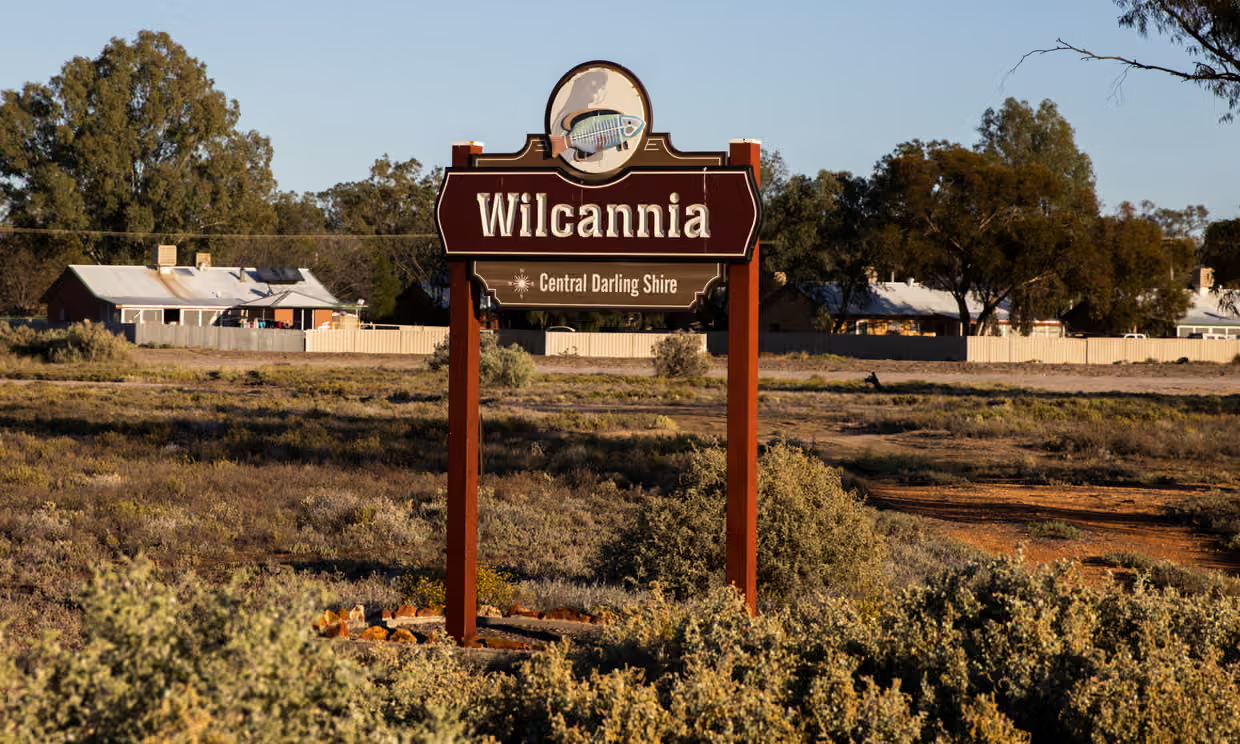
In the 1880s, when Australia was still finding its feet as a federated nation, the remote town of Wilcannia on the Darling River was one of the continent's most important inland centres. Paddlesteamers crowded its wharves, their smokestacks darkening the outback sky as they loaded wool and wheat bound for Adelaide and international markets beyond. At this time Wilcannia was the 3rd largest port in NSW after Sydney and Morpeth (near Newcastle) and was known as "Queen City of the West".
Today, with a population of just over 700, it's hard to imagine this dusty outback town ever holding such prominence. Yet Wilcannia's rise and fall tells one of the most dramatic stories of boom and bust in Australian colonial history – a tale of ambition, prosperity, and the cruel realities of geography and technological change that shaped the destiny of countless inland communities.
The area lies in the traditional lands of the Barkindji people, who call the river "Baaka". For thousands of years before European arrival, the Barkindji had lived along the river, understanding its moods and seasons, developing sophisticated methods of fishing and food gathering that sustained their communities through drought and flood. The arrival of Europeans in the 1860s would transform this ancient landscape beyond recognition.
The town was officially proclaimed in June 1866 and incorporated as a municipality in 1881, but its importance as a trading centre had been established several years earlier. The discovery of silver at nearby Broken Hill in 1883 would later boost the town's fortunes, but it was the wool trade that initially made Wilcannia's reputation and fortune.
The key to Wilcannia's early success lay in its position on the Darling River system. From 1859 the river was plied by paddlesteamers who went as far up as Bourke. In 1890 there were reported to be around 90 steamers using the river. The Darling River was navigable for over 1,600 kilometres, connecting the vast pastoral districts of western NSW and southern Queensland to the Murray River system and from there to the port of Adelaide.
The scale of river traffic at Wilcannia's peak was extraordinary. A copy of a black and white photograph taken in 1902 shows 8 paddle steamers and 4 barges under a bridge over the Darling River near Wilcannia in N.S.W. Cargo is being unloaded onto the left bank. Two barges are also tied up on the right bank. This single photograph captures the intensity of commercial activity that made Wilcannia one of Australia's busiest inland ports.
The paddlesteamers were marvels of 19th-century engineering, specifically designed for the shallow, winding rivers of the Murray-Darling system. Stern-wheelers were not uncommon on the Murray, but unsuited to the bends of the Darling. The vessels that plied the Darling were typically side-wheelers, their broad, flat-bottomed hulls able to navigate in as little as two feet of water when fully loaded.
These river boats carried much more than cargo. They were the lifelines that connected isolated communities to the outside world, bringing news, mail, passengers, and manufactured goods to settlements that could be hundreds of kilometres from the nearest road. The arrival of a steamer was a major event, drawing people from surrounding stations and settlements to collect supplies, send mail, and catch up on news from the outside world.
Wilcannia's boom years were marked by remarkable confidence and ambition. The town's main street was lined with two-storey stone buildings that wouldn't have looked out of place in Adelaide or Melbourne. The Athenaeum Theatre hosted touring companies and local productions. Multiple hotels catered to travellers, drovers, and commercial agents. Banks established branches to handle the substantial sums generated by the wool trade.
The Red Lion brewery built in 1879 was the first brewery that the famous beer writer visited, highlighting Wilcannia's cultural as well as commercial significance. The establishment of a local brewery indicated not just economic prosperity but also the town's confidence in its future growth and importance.
The municipal incorporation in 1881 reflected the town's civic pride and political aspirations. Wilcannia had its own mayor, town council, and local government services that rivalled those of much larger centres. The town boasted street lighting, a hospital, schools, and other infrastructure that demonstrated its residents' belief that they were building a permanent centre of regional importance.
The wool industry that drove Wilcannia's prosperity was built on the vast pastoral stations that spread across western NSW. These stations, some covering hundreds of thousands of acres, ran millions of sheep whose wool was among the finest in the world. The wool clip from stations across the region was brought to Wilcannia by bullock dray and horse team, where it was baled and loaded onto steamers for transport to Adelaide.
The seasonal rhythm of the wool industry dominated Wilcannia's calendar. Shearing season brought an influx of workers, contractors, and wool buyers to the town. The wharves would be stacked high with wool bales waiting for transport, and the hotels would be full of shearers, station managers, and commercial travellers. The successful completion of the wool season meant prosperity for the entire community.
However, the very factors that made Wilcannia successful also made it vulnerable. The town's prosperity depended entirely on river transport, which was subject to the vagaries of rainfall and river levels. During drought years, the Darling River could become too shallow for navigation, stranding cargo and isolating communities. Flood years could be equally disruptive, making river transport dangerous and unpredictable.
The arrival of railways in other parts of NSW began to change the economics of transport and trade. Rail transport was faster, more reliable, and less dependent on weather conditions than river transport. Towns with railway connections gained significant advantages over those dependent on steamers. When the railway reached Broken Hill in 1888, it provided an alternative route for much of the cargo that had previously travelled via Wilcannia and the river system.
The decline of Wilcannia was not immediate but rather a gradual erosion of its economic base. As railway networks expanded across NSW, more and more cargo moved by rail rather than river. The number of steamers operating on the Darling began to decline, and the frequency of services to Wilcannia decreased accordingly.
The wool industry itself was also changing. Improved roads and motor transport made it possible to take wool directly from stations to railway terminals, bypassing river ports altogether. The flexibility and convenience of road transport increasingly outweighed the cost advantages of river transport, especially as the road network expanded and vehicle technology improved.
World War I marked a turning point for many of Wilcannia's young men, who enlisted in the Australian Imperial Force and never returned to the river trade. The war years saw significant changes in Australian society and economy, and the old patterns of river trade seemed increasingly anachronistic in a modernising nation.
By the 1920s, Wilcannia's role as a major transport hub had largely ended. The last regular cargo service on the Darling River ceased in the 1930s, though some vessels continued to operate sporadically into the 1940s. The town's population began to decline as businesses closed and families moved to centres with better opportunities.
The Great Depression of the 1930s hit Wilcannia particularly hard. With no significant economic base beyond the declining river trade, the town struggled to maintain its infrastructure and services. Many of the grand buildings of the boom years began to show their age, and some were demolished or fell into disrepair.
Yet Wilcannia's decline also preserved something valuable. Unlike towns that were completely transformed by later development, Wilcannia retained much of its 19th-century character. The stone buildings that had been built to last during the boom years survived as reminders of the town's former importance.
Today, Wilcannia is recognised as one of NSW's most significant heritage towns. Its collection of 19th-century commercial and public buildings provides an unparalleled glimpse into the era of river trade and inland prosperity. The former wharf area, though no longer used for commercial shipping, remains as evidence of the town's former role as a major inland port.
The story of Wilcannia serves as a powerful reminder of how quickly fortunes can change in rural Australia. Geographic advantages that seem permanent can be overcome by technological change, and communities that appear solidly established can find themselves left behind by economic shifts beyond their control.
Contemporary Wilcannia faces different challenges from those of its boom years, but the town's residents continue to work to preserve its heritage and find new sources of economic activity. Tourism, particularly heritage tourism, provides some employment and helps to maintain the town's historic buildings. The story of the "Queen City of the West" continues to fascinate visitors who come to see where paddlesteamers once crowded the wharves and wool bales filled the warehouses.
Wilcannia's legacy extends beyond its own boundaries. The town's experience was repeated in dozens of river ports across the Murray-Darling system, each of which faced similar challenges as transport technology changed and economic patterns shifted. The rise and fall of river trade shaped the development of inland Australia and influenced the location and growth of contemporary cities and towns.
For historians and heritage enthusiasts, Wilcannia represents an almost perfectly preserved example of a 19th-century Australian river port. The town's buildings, streetscape, and even its decline tell the story of an entire era of Australian development – an era when rivers rather than roads or railways were the highways of inland Australia, and when towns like Wilcannia were the gateways between the pastoral interior and the markets of the world.
NEWS


SPORT


COMMUNITY