A life well lived: the story of Ray Eade

Kimberly Grabham
05 January 2026, 4:00 AM
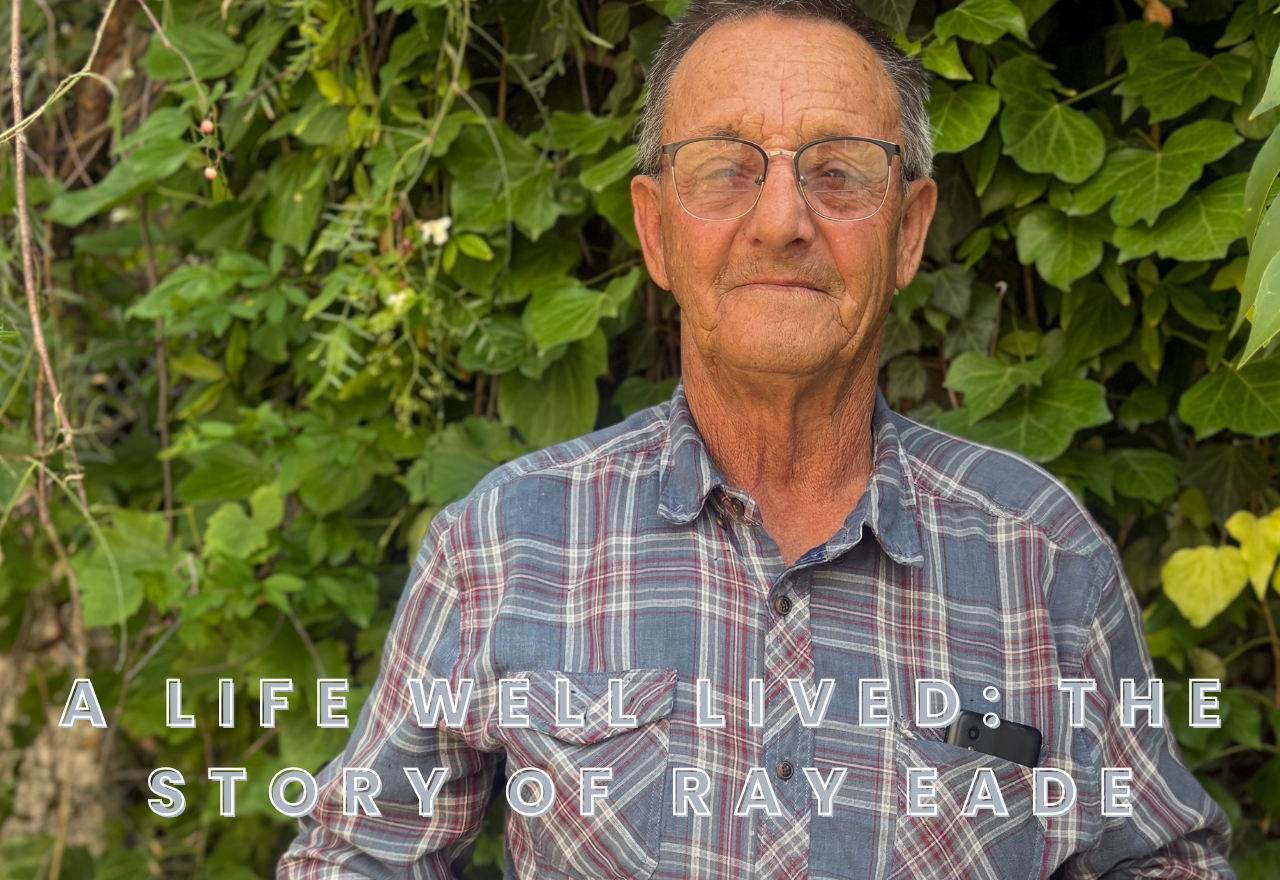
When Ray Charles Eade walked into the office, there was something familiar about his face. It wasn't until he mentioned his sister Dawn Matthews that the pieces fell into place.
The youngest of 11 children, Ray carries the unmistakable features of his family, particularly resembling his mother and his sister Dawn.
At 75 years old, Ray has plenty of stories to tell, and he’s generous with them.
His life began in rather dramatic fashion, born on a sulky travelling to the maternity home in Lachlan Street in June 1950. His mother couldn't wait any longer, and Ray made his entrance to the world on the buckboard of the horse-drawn carriage. It's the kind of beginning that seems to have set the tone for an adventurous life. Growing up as the baby of such a large family had its challenges.
By the time Ray came along, his mother had run out of names. In a wonderfully practical solution, she named him after household appliances; Ray from the Rayburn wood stove and Charles from the Charles Hope fridge. It’s an origin story Ray shares with good humour and warmth. The Eade family lived at Willow Tree Farm on the Thorne Road, about four or five kilometres out of Hay.
Life on the farm was busy, particularly for Ray's father, who had three mail runs throughout the district from the early 60s until 1970.
The Gunbar run, the West Burrabogie or Balranald run, and the Jerilderie run kept his father occupied five days a week. Young Ray often helped on these runs, particularly around the Gunbar route, which featured an exhausting 168 gates. He joked that he never wants to see another gate in his life. The family moved in 1965 when Ray’s father sold Willow Tree Farm and purchased a property on the Booligal Road. Ray was about 15 at the time.
His first job came with Hay Shire, earning forty dollars a week, or one dollar an hour.
With his wages, he bought his first car from Harold Wilder's Motors, a 1958 Morris 1000 for one hundred dollars.
That little car served him well for years, delivering an impressive fifty miles to the gallon.
At seventeen, in 1967, Ray headed north to Daisy Plains, about eighty miles from Hay and thirty miles north of Booligal. He worked there for three years until tragedy struck when his brother Neville had a significant accident with a slasher in early 1970. Ray was pulled from his job at Daisy Plains to help run the family farm in the irrigation area.
He never received a cent for his work, and later that year, in October, his father died of a heart attack at age 61. Ray was just 20 years old.
After his father’s death, the family farm was sold. Ray and his brother Robin briefly ran the Undercut Butchery in Hay, purchased from Jeff and Betty Pocock.
But butchery wasn’t Ray’s calling. He wanted to travel, and soon found work at Dunlop Station at Louth on the Darling River.
Dunlop Station was enormous; one million acres with 91 stands in the shearing shed and up to 60,000 sheep. Ray became the main contract musterer for the entire property.
Some paddocks were 30,000 acres, and Ray would head out with five horses, five dogs, a truck and a horse float to his camp in the middle of the property, where he’d sleep in the horse float. He worked alone, never wearing a watch, relying instead on landmarks and the position of the sun. His dogs were specially trained to jump up on the back of his horse and to respond to different whistle commands rather than voice. It was demanding, isolated work, but Ray loved it. It was at Louth that Ray met the love of his life.
Among three eligible young women in town, he chose one who would become his wife.
They married and shared 42 wonderful years together before she died ten and a half years ago. The loss devastated him. Even now, Ray visits the cemetery every month, taking flowers to her grave. The couple had three children, Robert, now 51, Lesley, 45, and Susan, 41.
After marrying, they moved to Narrabri, where Ray worked for Auscott, the cotton company, for seven or eight years. They lived in Narrabri for 18 years before moving to Wellington, where Ray has now been for 34 years. Throughout this time, he worked for various farmers, doing cattle work, sheep work and tractor work. Ray’s mother Alice lived to the grand age of 97 and a half, passing away in 2016. Whenever Ray and his wife visited, she would have cakes and biscuits freshly baked, delighted that her baby was coming home with the grandchildren. Ray still misses both his parents deeply. Music runs through the Eade family. Ray’s father was talented on the banjo and button accordion, whilst his mother played piano. Ray inherited this gift and still plays multiple instruments today, all by ear without reading music.
The family gatherings at Christmas were f illed with music and laughter, with sometimes 50 people at the farm. Ray’s father also served in the Second World War, joining up twice.
After being injured the first time and recovering at the Wagga base, he rejoined and served in the 16th garrison at the prisoner of war camp in Hay as a sergeant cook. Like many of his generation, Ray’s father didn’t talk much about his wartime experiences. The Eade family has deep roots in the district.
Ray’s great great grandparents, George and Maryanne, walked thousands of kilometres from their property at Lilydale, north of Booligal, after migrating from England. There’s a harrowing story in the family history about one desperately hungry night when George, devastated but thinking of the only perceived option in a very hard time, suggested leaving their eldest child under a bush to die. Maryanne couldn’t bear it and, whilst George slept, went back for the baby.
The next morning they milked their horse, an old mare that had lost its foal, to keep baby John alive.
That child was Ray’s grandfather.
The Eade name has a long history, with family crests dating back to 911.
The family held a major reunion in 1988 at the Hay Showground, where 600 people with the Eade name, or married to an Eade, attended. Ray’s daughter Susan, just a few months old at the time, was one of the youngest there.
Growing up in Hay, Ray attended school from the age of four, though his first day didn’t go well. Overwhelmed by the attention, he ran away and hid in berry bushes near the showground for two or three hours before his older sister Barbara found him.
His father gave him a good belting for that escapade. Life in the irrigation area was different then.
The giggle hall, a big community hall for irrigation area families, was a social hub where families would gather for cups of tea whilst children ran around the floor. Ray remembers catching yabbies in the irrigation channels for two shillings a bucket, which fishermen from town would collect.
The channels are all gone now, replaced by underground pipelines, and Ray joked that you can’t go yabbying anymore.
School days included getting two shillings to spend. Ray would buy a shilling’s worth of chips “Lately I keep being drawn back to Hay, thinking about coming home.
“There’s something about Hay which always calls me; it is always home to me.” had a wonderful time.
His children encourage him to return to Hay, to revisit his roots. from the Garden of Roses Cafe, a bottle of drink for sixpence, return the bottle for threepence back, and after school, spend the remaining threepence on a big single ice cream from Hill’s Corner.
The Eade and Baird families, both living on Baird’s Lane, had an unspoken rule; no one in Hay was allowed to speak badly about the other family. If anyone did, they faced consequences. It was a mark of respect and community solidarity that Ray remembers fondly. Ray grew up playing with the Baird boys - Mervyn, Brian, Graham, Ray and Robin.
Ray’s father was highly respected in the community, achieving the rank of Grand Primo in the Buffalo Lodge and receiving the chain of honour, the highest award possible.
Ray now has this chain, which must be passed down through male descendants with the surname Eade.
Though the family scattered after his father's death in 1970, with that glue that held them together gone, Ray maintains that he had a good childhood and no regrets.
When asked if he enjoyed growing up in Hay, his answer is immediate and enthusiastic, immensely.
Despite spending much of his working life elsewhere, from the vast paddocks of Dunlop Station to his decades in Wellington, Hay remains the place where it all began. And judging by the warmth and detail with which he recounts his stories, it’s clear that those early years on the farm, with his 10 siblings, hardworking parents, and tight knit community, shaped the man he became; resilient, good-humoured, and full of stories worth telling.
NEWS


SPORT

RURAL
COMMUNITY