$25 Billion hospital boost: what it actually means for remote NSW

Kimberly Grabham
05 February 2026, 7:00 PM
In Short:
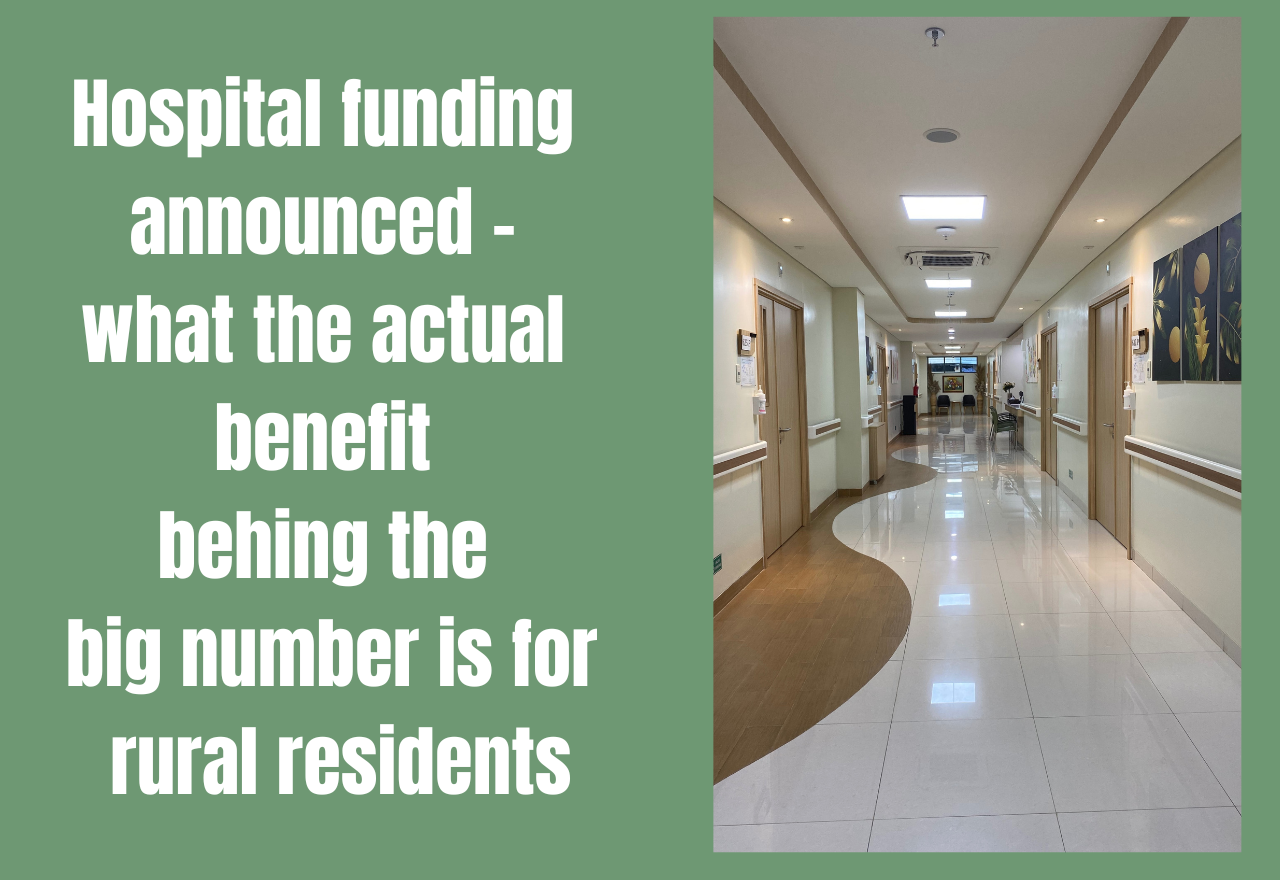
- Federal government's $25 billion hospital funding deal announced 31 January includes $8.6 billion for NSW regional health, but distribution to remote areas like Hay, Balranald and the Far West remains unclear with no detail on how money will reach smallest hospitals.
- Independent MPs Roy Butler and Helen Dalton are fighting to split massive health districts, arguing 20 year old amalgamations have failed rural communities, with parliamentary inquiries underway and findings expected late 2025 or early 2026.
- Rural Australians die up to 13 years earlier than city residents, with an $8.35 billion funding gap between rural and urban health spending, while GP shortages and hospital service closures continue to erode local healthcare access.
When Prime Minister Anthony Albanese stood before the cameras on 31 January to announce a $25 billion boost for public hospitals, the figure was staggering enough to make headlines across the country. Triple the funding of the previous agreement. More than $219 billion over five years. The kind of money that should, in theory, fix everything.
But if you're in Hay waiting weeks to see a GP, or driving from Balranald to Griffith for basic specialist care, or watching services disappear from your local hospital, you might be forgiven for wondering: what does this actually mean for us?
The question has become especially urgent as regional MPs push for radical change. Just weeks before the funding announcement, Member for Barwon Roy Butler introduced a private member's bill to split the Hunter New England Local Health District.
"Two decades after the amalgamation that formed the Hunter New England Local Health District, it is clear it is a failed experiment in having a metropolitan based administration run medical services in rural and remote areas," Butler told NSW Parliament on 20 February 2025.
Helen Dalton, the Independent Member for Murray which covers Hay and Balranald, has been fighting a parallel battle to split the Murrumbidgee Local Health District, with her bill also referred to parliamentary inquiry.
During Regional Health Minister Ryan Park's visit to her electorate, Dalton didn't mince words: "We have had to sit back and watch our health services erode away to the point where our life expectancy is five years less than our mates in the city. It just not good enough."
Their message from the local members is clear: throwing money at a broken system won't fix it if the system itself is fundamentally flawed.
Around seven million Australians live in rural and remote areas, that's more than a quarter of the population. In NSW alone, nine local health districts serve regional and rural communities. For residents of Hay, Balranald, Carrathool and the Central Darling, healthcare means navigating the vast distances and limited services of the Far West and Murrumbidgee health districts.
The 2025 Rural Health in Australia Snapshot painted a stark picture: men in rural areas die up to 13.6 years earlier than those in cities, women up to 12.7 years earlier. Nearly 18,500 people nationwide live without access to essential primary healthcare services within an hour's drive. In remote areas like the Central Darling, that hour's drive might not even get you to the nearest town with a hospital.
The National Rural Health Alliance's analysis revealed an $8.35 billion funding shortfall between rural and urban health spending in 2023-24, about $1,090 less per person, per year. And that gap has widened by $1.8 billion since 2020-21.
These aren't just statistics. They're real people in our communities who can't get their chest pain checked because the nearest GP isn't taking new patients. They're elderly residents waiting six weeks for a follow up appointment after hospital discharge when doctors recommended five days. They're young families driving hours for prenatal care because local hospitals no longer offer maternity services.
The $25 billion federal commitment, matched by state contributions, will see NSW receive $8.6 billion for regional health in 2025-26, a 4.1% increase on the previous year. An additional $3.5 billion over four years has been earmarked for regional and rural health infrastructure, including projects in Dubbo, Forbes, and Maitland.
The deal includes $2 billion specifically to help manage elderly patients stuck in hospitals waiting for aged care beds, a problem that clogs emergency departments and surgical wards in both city and country hospitals. There's also the Thriving Kids program, aiming to ease pressure on the National Disability Insurance Scheme by providing early intervention support.
But here's where optimism meets reality. The Australian Medical Association, while welcoming the announcement, cautioned that "the new deal alone will not be enough to stem the decline in hospital performance without further reform." Their modelling suggests that even with this injection of funds, patients will still wait too long for emergency and essential surgery.
The funding announcement doesn't specify how much will flow to the smallest rural and remote hospitals versus metropolitan facilities or larger regional centres. It doesn't explain how hospitals in places like Hay, Balranald or Wilcannia will be protected from closure or downgrading. It doesn't address whether states will reach the agreed upon Commonwealth funding share of 42.5% by 2030 or whether growth caps will be removed.
While federal and state governments negotiated dollars, Butler and Dalton were fighting a different battle: restructuring how rural health is actually governed.
On 20 February 2025, Butler stood in NSW Parliament and delivered a blunt assessment of the Hunter New England amalgamation. His bill to split the district gained immediate traction. The chamber was packed with regional MPs, "a rare sight," as Butler noted. Within weeks, it was referred to the Committee on Community Services for inquiry, with support from Tamworth MP Kevin Anderson, Northern Tablelands MP Brendan Moylan, and Lismore MP Janelle Saffin.
The catalyst? Wee Waa Hospital. The closure of services there became a symbol of what happens when a massive health bureaucracy tries to manage dozens of rural communities from a metropolitan base. Butler's argument was simple: let country communities look after their own.
In February 2025, Dalton introduced the Health Services Amendment (Splitting of the Murrumbidgee Local Health District) Bill. Her proposal would divide the sprawling MLHD into two districts, allowing more localised, responsive care. The Murrumbidgee district currently stretches from the Riverina through to areas including Hay, covering vast distances and diverse communities with vastly different needs.
The Murrumbidgee Local Health District opposed the split, arguing it would cost more, deliver less, and fragment the workforce. But Dalton, who won the 2025 Uniting Political Courage Award for her advocacy on rural health and gambling reform, wasn't backing down.
Regional Health Minister Ryan Park welcomed the inquiries but stopped short of supporting the splits.
"I don't think dismantling the health district is the best way," he said. "The current model has advantages of funding and efficiency and importantly, access to specialist care and services. I am concerned splitting the authority in two would be detrimental to regional communities and risk exacerbating staffing challenges."
It's a familiar tension: centralisation promises efficiency and resource sharing; decentralisation promises local accountability and responsiveness. The inquiries will test which matters more to communities watching their hospitals decline.
Dr Lexi Campbell, speaking about the Rural Health Snapshot's release, captured the problem with brutal clarity: "Patients leaving hospital inform me they won't get into their GP for six weeks. Ideally, I'd like them to be seen by another doctor within five days."
The shortage of general practitioners in rural areas has reached crisis levels. Medicare data from 2023-24 shows that GP visit rates are lowest in remote communities. When people can't access preventative care, they end up sicker, requiring more intensive and expensive hospital interventions.
This is where the funding announcement becomes frustratingly vague. How will the money address the GP shortage, which is fundamentally a federal responsibility? How will it prevent the ongoing erosion of services in smaller hospitals? How will it stop the centralisation of care that sees communities left behind?
A 2024 review of NSW's Small Rural Hospitals Funding Model found that more than 100 small public hospitals across seven regional local health districts face "growing financial challenges due to rising costs of providing healthcare and declining rural and remote populations." The review delivered nine recommendations, but implementation requires both money and political will.
There are bright spots worth celebrating. The NSW Government's Rural Health Workforce Incentive Scheme offers up to $20,000 in financial packages for health workers relocating to hard to fill positions in remote areas. Midwives moving from metro NSW or interstate receive a $20,000 sign on bonus.
The Rural Generalist Single Employer Pathway is training doctors specifically for regional work, keeping them employed by a regional Local Health District for up to four years while they complete training in both general practice and hospital settings. This addresses the old problem of doctors ping ponging between employers, creating instability for both workers and communities.
The Isolated Patients Travel and Accommodation Assistance Scheme helps people who must travel more than 100 kilometres one way for specialist treatment, easing the financial burden of distance. For Hay residents travelling to Griffith, Wagga Wagga or further afield, this assistance can make the difference between getting treatment and going without.
And there are innovations happening on the ground. Hospital in the Home programs are expanding, allowing patients to receive hospital level care at home, particularly valuable for elderly rural residents who would otherwise need to travel or relocate for treatment.
But for every solution, there are a dozen unanswered questions. Peter Breadon from the Grattan Institute pointed out that details on how the new deal will actually shift stranded patients out of hospitals and into appropriate care remain "scant." There's no clear reform agenda to deal with ever rising costs or the mounting demands on the system.
Most critically, it doesn't solve the workforce crisis. You can pour billions into hospital infrastructure, but if there aren't enough doctors, nurses, allied health workers, or specialists willing to work in rural areas, those shiny new facilities will stand half empty, and patients will still drive hours for care.
The convergence of federal funding and structural reform creates a rare moment of possibility and peril. On one hand, there's $25 billion in new federal money flowing to states, with NSW receiving $8.6 billion for regional health in 2025-26. On the other, there are parliamentary inquiries examining whether the very structure of rural health governance needs to be dismantled and rebuilt.
Butler put it plainly when he spoke about the increasing number of regional independents and crossbenchers: with more regional MPs now holding the balance of power, government must "really start paying attention to this issue to counter the disparity between rural and metropolitan health."
He's right that pressure is mounting. Rural voices are getting louder. The evidence is stacking higher. The inequity is becoming impossible to ignore.
But attention isn't the same as action, and action isn't the same as transformation.
The inquiries into splitting the Hunter New England and Murrumbidgee health districts are expected to deliver findings in early 2026. The federal funding starts flowing in July 2026. Somewhere in the intersection of these timelines, rural NSW will discover whether this moment leads to genuine change or just another headline.
Will the $25 billion be distributed equitably, or will it flow disproportionately to larger regional centres? Will the district split proposals reveal a path forward, or confirm the status quo? Will workforce incentives be enough to attract and retain the doctors and nurses rural communities desperately need? Will small hospitals in Hay, Balranald, and across the Far West be protected, or will they continue to lose services year by year?
Will someone in a remote town be able to get the care they need, when they need it, without driving for hours or waiting for weeks?
These are the questions that matter. And until they're answered, not with promises, but with real, measurable change, rural Australians will continue to wait, to travel, and to die younger than they should.
The money is there now. The inquiries are underway. Regional MPs are pushing harder than ever. What we do with this convergence of opportunities will write the next chapter of rural health in NSW.
NEWS



SPORT

RURAL