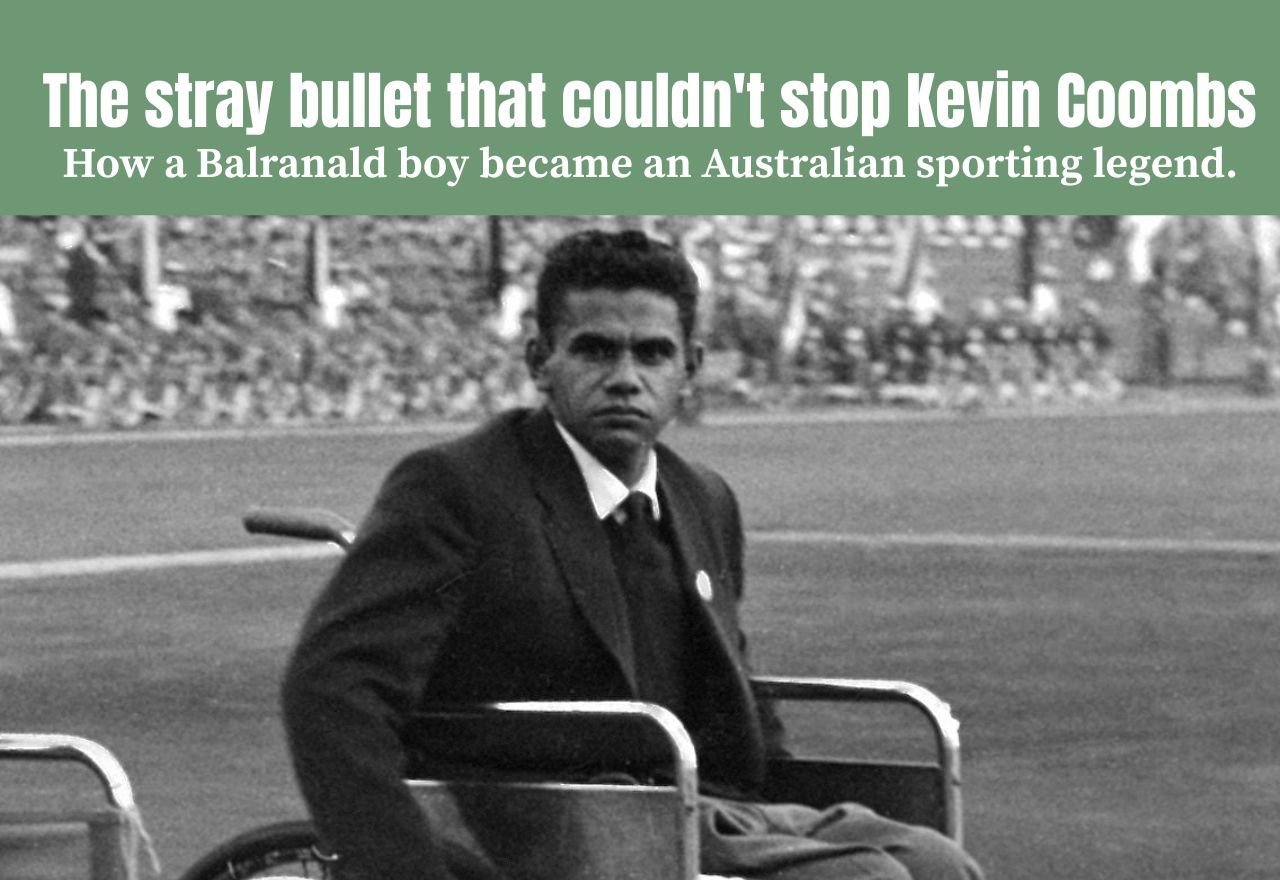
The stray bullet that couldn't stop Kevin Coombs: How a Balranald boy became an Australian sporting legend.
Krista Schade
24 February 2026, 7:00 PM
In Short
- A Life-Changing Moment: In 1953, a freak rabbiting accident on Canally Station left 12-year-old Kevin Coombs a paraplegic, setting him on an unexpected path toward sporting history.
- A Global Pioneer: Despite not being recognised as a citizen at the time, Coombs became Australia’s first Indigenous Paralympian, competing in Rome in 1960 with a 40kg everyday wheelchair.
- An Enduring Legacy: Beyond five Paralympic Games, Uncle Kevin became a revered Elder and advocate, becoming the first Paralympian in the world to receive the PLY post-nominal title.
On a Friday afternoon in September 1953, a split-second accident on Canally Station near Balranald changed the course of Australian sporting history.
Twelve-year-old Kevin Coombs was out rabbitting with friends. He was enjoying a typical afternoon for a young boy growing up on the Balranald Aboriginal Reserve, when a .22 rifle, carried by a seven-year-old playmate, accidentally discharged after the younger boy slipped.
Kevin was struck by the stray bullet.
The local headlines at the time were grim. The Sydney Truth reported the young "Coombes" was on the "danger list," and the Daily News in Perth listed him in serious condition. After a frantic car trip that ended in a breakdown two miles from the Balranald hospital, he underwent emergency surgery. After he was then rushed to Swan Hill for further surgery, Kevin survived.
But the accident left him a paraplegic.
He spent time at the Royal Austin Rehabilitation Hospital in Melbourne where he was introduced to sport as part of his rehabilitation program.One of the sports that he competed in was wheelchair basketball.
What the newspapers couldn't have known then was that this young boy from the Wotjobaluk nation would go on to become a global pioneer: the first Aboriginal Paralympian, a passionate supporter of Australian sport and athletes with disabilities and an advocate of First Nation people.
Kevin Coombs was born on 30 May 1941 in the Victorian town of Swan Hill, to Cecil Coombs and Rosie Clayton. After losing his mother at age five, he and his four siblings moved to live with relatives in the NSW town of Balranald.
When Kevin Coombs traveled to Rome for the inaugural Paralympic Games in 1960, he wasn’t just competing against the world’s best wheelchair basketballers; he was navigating a country and a society that didn't officially recognise him as a citizen.
Because the 1967 Referendum was still seven years away, Indigenous Australians were not yet counted in the census.
On 27 May 1967, Australians voted to change the Constitution so that like all other Australians, Aboriginal and Torres Strait Islander peoples would be counted as part of the population and the Commonwealth would be able to make laws for them.
A resounding 90.77 per cent said ‘Yes’ and every single state had a majority result for the ‘Yes’ vote. It was one of the most successful national campaigns in Australia’s history.
But Kevin’s appearance at the very first Paralympics in Rome in 1960 ment, to represent his country, Kevin had to carry an honorary British passport rather than an Australian one.
Those games in Rome were the ninth iteration of the Stoke Mandeville Games, the predecessor to the Paralympics, held since 1948, yet no identified Indigenous athletes participated in those earlier events.
Kevin arrived in Rome with a single wheelchair - the same 40kg (88lb) heavy-duty chair he used for his daily life. Despite the lack of high-tech equipment, Kevin’s talent was undeniable.
He went on to represent Australia at five Paralympic Games between 1960 and 1984, captaining the men’s basketball team twice and serving as the captain of the entire Australian Paralympic delegation in 1980.
His trophy cabinet boasted gold medals from the Far East and South Pacific Games and a silver from the Commonwealth Paraplegic Games, but it is said that Kevin’s greatest impact was off the court.
As an Elder, after his sporting career, Kevin spent his professional life dedicated to his community. He established the Koori Hospital Liaison Officer program and managed the Koori Health Unit for the Victorian Department of Human Services.
His contribution to the spirit of the Games was so profound that in 2016, Paralympics Australia created the Uncle Kevin Coombs Medal. In 2023, he became the first Paralympian in the world to be officially honored with the initials PLY after his name—a post-nominal signifying his status as a pioneer of the movement.
Post-nominal letters, such as PhD or MD, are placed after a person’s name to indicate that they hold a position, honour, or is a member of a fraternity. As such, PLY can be added alongside the Paralympians’ name on official documentation, social media, cv, business cards, presentations, email signature or anywhere else their name may be used.
Uncle Kevin Coombs passed away on October 5, 2023, at the age of 82. There remains an avenue named in his honor at Sydney Olympic Park - the boy from Balranald who took on the world.
NEWS


SPORT
RURAL

COMMUNITY