The River Kings: Cramsie, Bowden & Co. and the golden age of Riverina trade

Contributor
27 December 2025, 1:00 AM
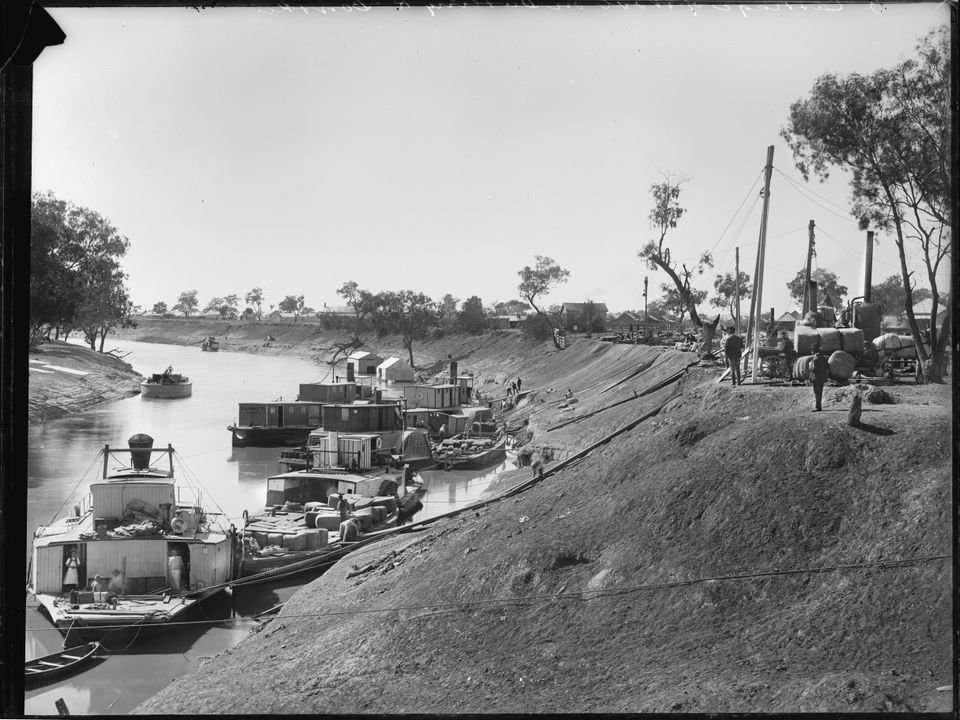 A later image of paddle-steamers at Bourke, probably captured in 1893. One of these is the “Rodney” which in 1877 was operated by Cramsie Bowden and Company, predecessor to the firm that Tomas Wakefield Chambers joined in 1881. Image: https://geoffsvenson.com/thomas-wakefield-chambers/
This article was made with information taken from a Blast From the Past written by the late Rod McCully.
Long before highways and freight trains connected the inland to the coast, the lifeblood of commerce in the Riverina flowed along the rivers themselves. During the golden age of river trade in the late 1800s, one company dominated the waterways like no other. At its peak, Cramsie, Bowden & Co. employed 700 workers during wool season and operated a fleet of paddle steamers and barges that carried the wealth of the inland to markets in Melbourne and beyond.
The story begins with an Irish immigrant named John Cramsie, born in 1832 in Ballymoney, County Antrim, Northern Ireland. He arrived in Australia around 1858 with little more than ambition and a willingness to work hard. Cramsie made his way to Swan Hill in Victoria where he found employment with Sparks, Perkins & Co., a store specialising in station supplies. It was there that he learned the business that would make his fortune.
Within a year, Cramsie had become a partner with T. H. Sparks and together they established a similar business at Balranald in 1859, trading as Sparks, Cramsie & Co. The timing was perfect. The inland was opening up, pastoral stations were expanding, and the river trade was beginning its spectacular boom. The new company quickly established itself as a vital link in the supply chain that kept the stations running.
An intriguing footnote to Australian exploration connects to the company's early days. In 1860, the famous Burke and Wills expedition left surplus equipment with Sparks, Cramsie & Co. for auction. One can only imagine the bustle at the Balranald store as curious locals examined the gear from one of the most ambitious expeditions ever mounted in Australia, little knowing the tragedy that would soon befall the explorers.
The partnership changed in 1868 when Sparks died, but Cramsie's business acumen only grew stronger. In 1870, he took on Maurice Aron from Euston and Louis Gerstman as partners in what became John Cramsie & Co. This partnership lasted only a few years before dissolving in 1873, but it led to the most significant collaboration of Cramsie's career. That year, John Clark Bowden became his partner, and together they would build an empire on the rivers.
John Clark Bowden brought his own remarkable story to the partnership. Born in Geelong in 1844, he came from a family steeped in Australian colonial history. His grandfather, chief surgeon Matthew Bowden, had accompanied Lieutenant Governor David Collins aboard the sailing ship Ocean in 1803 to found a settlement at Port Phillip. That expedition ultimately moved on to establish Hobart after deciding Port Phillip lacked sufficient timber and fresh water. During their brief time exploring the area, a convict named William Buckley escaped and lived with local Aboriginal people for 32 years, becoming part of Australian folklore.
John's father, William Henry Bowden, married Catherine Clark in 1835 and moved to Port Phillip in 1842, establishing a flour mill on the Barwon River at Geelong and a farm at Mount Duneed. Catherine came from Newton, Wick in Caithness, Scotland, which may explain why the family's later business dealings often involved the Waugh company. William and Catherine raised 10 children, and young John received his education at Geelong.
The young Bowden began his working life with the shipping company Holmes, White & Co., agents for the famous Loch line of clippers that connected Australia to the world. Around 1870, he joined Cramsie and Aron in Wentworth before moving to Balranald. In 1873, he bought out Aron and became Cramsie's partner in what would become one of the most successful trading operations in the Riverina.
The scale of Cramsie, Bowden & Co.'s operations was staggering for its time. The company established branches at Hay, Euston, Wentworth, Wilcannia, Milparinka, Mount Browne, Tibooburra, Echuca, Melbourne and Sydney. This network of stores ensured that pastoral stations across the vast inland could source their supplies, no matter how remote their location. The Hay branch was particularly important, managed by Hugh 'Huie' N. Bowden, John's brother, who oversaw operations on the Murrumbidgee.
But it was on the rivers themselves that the company truly dominated. Cramsie and Bowden operated an impressive fleet of paddle steamers and barges on the Murrumbidgee, Edward, Murray and Darling rivers. The steamers included the Barwon, Goldsborough, Kelpie, Pearl and the ill-fated Rodney, which would later be burned by striking shearers in 1894. The company's barges bore names like Confidence, Horace, Jessie, Namoi, Nelson, Paroo, Pimpampa, Sprite, White Rose and Woorooma. The paddle steamer Lancashire Lass is often associated with the company and may have been leased, while another steamer called Kilfera, mentioned in company reports from 1881, appears to have operated with the barge Jessie.
These vessels were the trucks and trains of their era, carrying wool from the stations to markets and bringing supplies back to the inland. The rivers were highways of commerce, and Cramsie, Bowden & Co. commanded those highways like few others. During wool season at the height of the river trade, the company reputedly employed 700 hands, a workforce that speaks to the enormous scale of their operations.
The company's premises on Court Street in Balranald became a hub of activity, running what was described as a most extensive wholesale and retail business. The partnership wasn't just about commerce, though. John Cramsie entered politics, serving as Member for Balranald in the NSW Legislative Assembly between 1880 and 1887. He also invested in well-known pastoral properties including Kilfera, Tibbereenah, Glendon and Strathdarr in Queensland. His son, John Boyd Cramsie, managed Strathdarr between 1891 and 1896.
In 1884, the partnership underwent a significant change when Bowden took over the business, establishing John C. Bowden & Co. Four years later, in 1888, Bowden sold the fleet of steamers and barges to Permewan, Wright & Co. The age of river transport was beginning its slow decline as railways started to penetrate the inland, though the rivers would remain important for several more decades.
The Hay operation was sold to Meakes & Wheeler in 1890, ending the direct Bowden family involvement in that branch. In Balranald, Bowden's former bookkeeper, H. L. Harben, took over the business at the end of the decade, continuing operations in the premises that had been the company's headquarters for so many years.
John Bowden extended his business interests to Melbourne, where he conducted an extensive ironmongery business with his son, specialising in aluminium goods. He became well known in Melbourne as a racing man, a passion that began during his time in Balranald in 1883 when he ventured into horse racing with the late Alexander Lawrence.
The company managers who worked for Cramsie, Bowden & Co. often went on to establish their own successful businesses. William Bowring, who managed the Balranald branch in the early 1870s, later operated his own steamers. R. D. Murray managed the Balranald branch under John C. Bowden & Co. in 1887. These men learned their trade working for one of the most successful operations on the rivers and took that knowledge into their own ventures.
John Cramsie died in 1910, having built a commercial empire from humble beginnings as an Irish immigrant. John Clark Bowden lived until 1924, passing away at the age of 80. Together and separately, these men had shaped the commercial landscape of the Riverina during its most dynamic period of growth.
The story of Cramsie, Bowden & Co. is more than just business history. It's the story of how the inland was connected to the wider world, how wool from remote stations found its way to markets, how supplies reached places that seemed impossibly distant, and how entrepreneurial vision combined with hard work could build something lasting. The paddle steamers are long gone, their hulls rotted or burned, their names surviving only in historical records. The stores have changed hands many times. But the legacy remains in the towns they helped to build and the connections they helped to forge across the rivers and plains of inland Australia.