The first mail run between Deniliquin and Lang's Crossing

Kimberly Grabham
26 December 2025, 4:00 AM
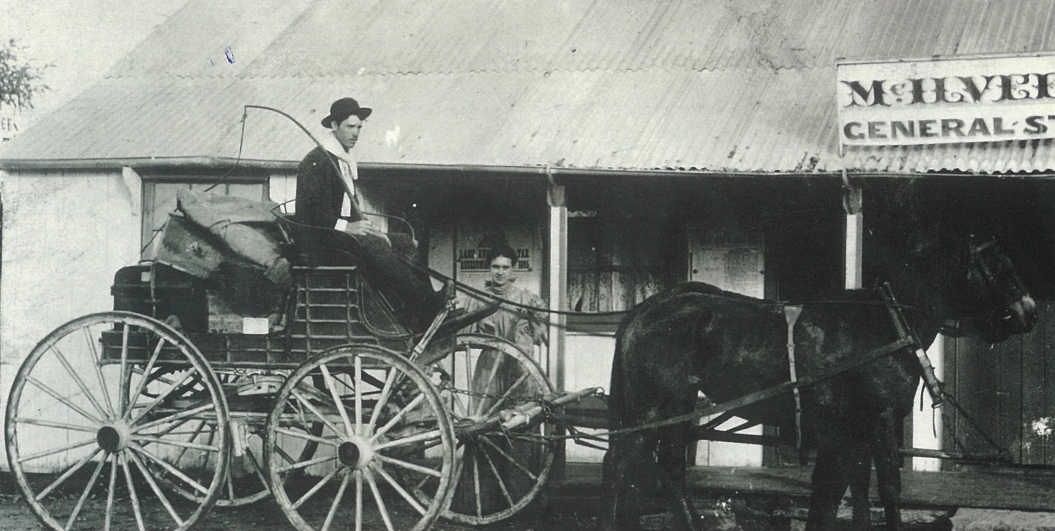 These are the times where mail was transported by horse and cart. Image: Auspost
The first mail between Deniliquin and Lang’s Crossing left for the Murrumbidgee on August 14, 1859.
The contractors were Marshall and Waring, storekeepers of Deniliquin.
Their rumble was a sort of cross between a bullock wagon and a spring cart, was an excellent set up, but proved equal to the requirements of the mail service even if it was a little rough on the occasional passenger who was compelled to use it.
Residents at Lang’s Crossing were overjoyed when the mail service first came into play.
The mail delivery had covered the distance in about 30 hours, impressive for the times. Previously, mail arrived weekly by horseback from Wagga. This was a significant advance, meaning that Lang’s Crossing could get communications to with Deniliquin twice a week, which in turn had communication with Melbourne twice weekly.
Marshall and Waring seem to have disposed of the mail contract to Richard Hill, who is recorded as running a conveyance to Hay.
On 12 October 1860, Thomas Grace placed a coach in opposition on the Hay and Lachlan run, starting at 5am every Monday, to which Hill replied by buying Bevan’s Deniliquin-Moama run and extending an improved new service to Hay.
In March 1862, Cobb bought Hill’s interests and maintained the line for the next 38 years.
Crossing the Murrumbidgee in 1859 was affected by means of Leonard’s punt, and it was not until March 1863 that a pontoon bridge was erected.
This was used for eleven years until a permanent bridge was opened on August 29 1874.
Hay was considered the Riverina headquarters of Cobb & Co in the 1860’s through its geographical position.
It radiated lines to Deniliquin, Narrandera, Wagga Wagga, Lake Cargelligo, Gunbar, Booligal. Hillston, Ivanhoe, Balranald, Wilcannia, Mossgiel and Moulamein.
For the 76-mile stretch between Deniliquin and Hay, apart from starting and stopping places, there were five changing stations, one every 17 miles.
These were located at Pretty Pine, Boree, the Black Swamp, Booroorban, and the 16-Mile Gums. When Cobb took the mail contract over from Richard Hill, their reputation made it a lot harder for themselves.
Hill had been given fourteen hours for the trip, but Cobb was immediately placed on a twelve-hour time limit, with heavy penalties for time overdue.
In the winter, Cobb protested that the roads were poor and the penalties were costing them £15 to £20 per week.
In poor weather it sometimes took sixteen to twenty hours for the trip. At one time Cobb had suspended running the coach altogether.
A local committee, comprising Henry Shiell, Thomas Darchy, and eighteen other gentlemen, wrote to Cobb insisting on the twelvehour limit and pointing out that the horses were regularly stable-fed and the run could be reduced to ten hours.
Autumn of 1878 was very wet, with Hay receiving upwards of seven inches of rain.
First Mail arrives at Lang’s Crossing
From the “Pastoral Times” Deniliquin, in a Cobb & Co Special Edition, 10 September 1963 Deniliquin, a raft had been constructed to ferry over the travellers.
A squatter residing forty miles north of Deniliquin, took two days to ride into our town from his station.
He left one horse (he was riding one and leading another) stuck in a bog, the water coming over the horse’s back, the rider being obliged to wade through the water which was chest high. Cobb’s coach between Deniliquin and Hay had for the present ceased to run.
One of Cobb’s vehicles was stuck on the Old Man Plain, where it remained until the waters subsided.
Deniliquin rainfall for February was 739 points, whilst a further 888 points in March gave a good start for a record 28 inches for that year.
Mail contracts for 1869 were announced as follows: Wagga Deniliquin 180 miles, four times weekly, horseback, £1195, R Powell and T Beveridge.
Moulamein Balranald via Wakool, 110 miles twice weekly, horseback, £400 – R Smith.
Hay-Deniliquin 80 miles, three times weekly, £1000 – Cobb & Co.
Deniliquin-Echuca, 50 miles, six times weekly, £1000 – Cobb & Co.
In 1914, the Hay mail contract was announced in November as follows:
“Mr Jas. Robinson, proprietor of the Finley, Jerilderie and Moulamein mail coaches, was the successful tenderer for the £1250 for the Hay-Deniliquin mail service for a period of five years.
The contract provides for a motor and coach service.”
In March 1914, a news item announced that James Robinson, mail contractor, had purchased a new chain-driven Fiat motor bus in Melbourne for use in connection with his mail service.
The new bus was to arrive in about a fortnight, and Mr Robinson would then have two motor cars (a Talbot and Flanders) and two motor buses (Commer and Fiat) besides coaches and horses available for his coach services and for hire.
Although the records state that the drought was the cause of the transition to motor transport in 1914, ‘oldtimers’ give the cause as shortage of manpower.
Bert Smith, of Hay, who was running the Deniliquin-Hay line at the time had to drive the coaches himself, and as some of the changing stations were unmanned, was obliged to roundup and harness the new horses himself.
It was usual, he stated, to run cars in the dry weather, but revert to horses in the winter. By 1916 the Model T Ford was being used on the Hay run.
Up to 1918 Bert Smith was operating from the Hay depot, and Gus Pollard from Deniliquin.
At this time Pollard won the contract from Smith Simpson and Smith retired as a driver. Cars did not finally supersede horses until 1918.’
The article is associated with this well-known (below) photograph from The Riverine Grazier archives, and has the following caption.
“The Hay mail coach in 1908. From left – Tom Skene (driver), Vic Heinz (gate opener), and standing, JC Smith (owner) and H Proctor (coach builder).”
The driver of the right-hand coach in the picture is Andrew “The Whip” Pedrana, grandfather of Lorraine Silvester, who returned to Hay with her husband to live in the old Pedrana home in Moppett Street, after her father, Bill, passed away.
Not only that, Lorraine identified the boy on the coach next to her grandfather, as Hughie Cook, the gate-opener on that particular occasion.
Lorraine also reported that Andrew Pedrana, during a trip from White Cliffs to Wilcannia, was held up by a bike-riding bushranger!
MAIL COACH STUCK UP AND ROBBED A Bushranger on a Bicycle From the ‘Town and Country Journal’, September 1901.
A bushranger of up-to-date ideas stuck up a mail coach five miles from White Cliffs on Sunday night. His novelty consisted in the using a bicycle for his departure.
The robber stood at a gate on the road, and on Kanter, a photographer, beginning to open the gate, shot him through the arm. He then rifled mail, and opened the baskets containing opal, and made up a parcel, and rode away towards White Cliffs.
One bag, containing valuable opal, and one mail bag, containing a large amount of money for the savings bank, were missed by him, being in the boot of the coach.
There were two male passengers and a woman.
One passenger had £120, and the others smaller amounts, but they were not interfered with. The man wounded is not seriously hurt.
On the arrival of the coach at Wilcannia, the driver, Pedrana, and Mr Kanter were interviewed.
Andrew Pedrana, the driver, said, “We reached the Five-mile gate without incident.
Mr Kanter got down to open the gate. I heard a shot, and Mr Kanter called out, ‘My God, I’m shot.’
“A man in an overcoat, a cap, and a mask then came forward, presenting a revolver.
“I said, ‘Don’t shoot me’.
He said ‘I won’t shoot you, but I want the brass’. “I said, ‘I’m not going on’, and tied the reins to the brake, and got down.
“Miss Addy Ortloff, a passenger, was on the box seat beside me, and remained there all the time. Mr Rosanove got out, and stood next to Mr Kanter and me.
“I started cutting up tobacco, but the man quickly demanded my knife.
He then ripped open the bags and baskets, tearing open letters and packets, and strewing the contents on the road.
“This took more than an hour. He then made up a bag, and put in it some of the contents of the mail.
“This seemed pretty heavy, and, I think, contained a lot of packets of opal. Having done this, he said, ‘You can go now’.
“I said, ‘Can I take these things?’ He said, ‘Do as you like with them.’
He took his bike and started off in the direction of White Cliffs.
“The passengers resumed their places, and we drove on, leaving the mails and bags on the road.
We reached Tarella about half-past three, and informed the owner, Mr Edward Cato who undertook to communicate at once with the Police at the Cliffs and gather up the remnants of the mail.”
Mr Gustav Kanter, who is an assayer and photographer, at White Cliffs gave a similar account of the affair with fuller details as to the shooting, which he thus described – “When I got close to the gate I was fired at by a tall masked man who sprang from behind a gate post.
He gave no warning. The shot struck me in the right forearm.
“When shot I ran behind the leaders, calling out to the driver, ‘I am shot through the arm’, so as to warn him. “The man then went to the opposite side of the horses, and covered the driver with his revolver.” The robber is described as a strongly built man between 5’10” and 6’ high.”
The report in the Adelaide Chronicle of 2 September 1901, has more details.
“Calling at the Tarella homestead, the manager, Mr EP Quinn, was informed of the occurrence, and he thereupon rode back to White Cliffs, reaching that place at 4.30 this morning. Sergeant Nolan and Trooper Perry at once proceeded to the scene of the sticking-up, which is a spot lying between two low ranges and within half a mile of a large garden kept by a firm of Chinese. About 20 yards from the gate the ground was strewn with opened letters and packets, the contents of the crates.
About £4000 worth of crossed cheques was in transit to different banks. Numbers of these cheques were scattered in all directions.
Parcels were also flung away off the road, as if in disgust. The boot of the coach contained sealed and insured boxes of opal going home, but these the robber overlooked in his hurry.
When the Police received the first information of the crime, in going back over the road, discovered the tracks of a bicycle only recently ridden from the scene of the robbery.
A shower of rain falling through the night obscured all the former tracks, and it was therefore assumed that the highwayman came back to White Cliffs after perpetrating his daring crime. A man named Pyne, aged 20, has been arrested on suspicion of being concerned in the robbery. Pyne left White Cliffs, riding a bicycle, about 4pm on Sunday, and is said to have camped in the vicinity of the place where the robbery occurred, but went back again to the town. He was seen at White Cliffs at 8 o’clock, and returned later to his camp.
He missed his way, and arrived at the gates at the time when the highwayman had the coach bailed up. He was ordered to stand along with the others.
Pyne was taken on to Tarella with the others, and came back with Mr Quinn to the gate, remaining with the bags until the arrival of the Police. It is doubtful, therefore, if he was connected with the sticking up.
It is estimated that there was £8000 worth of treasure on the coach at the time of the robbery. It is not known how much opal was taken, but £1400 in notes was taken.
Many of the registered letters containing money were missed by the robber in his hurry. Amongst the articles stolen was a valuable opal brooch, intended as a wedding present, sent by an opal buyer.
The robber did not ask the passengers to turn out their pockets. Mr Kanter had £120 in a handbag. This he deftly hung on the names of the horse after being shot.
The townspeople of White Cliffs are not surprised at the robbery, as they have long marvelled that coaches carrying so much treasure were allowed to travel the long journey unmolested.
Sub-Inspector Hojel, with a posse of police and a black tracker, arrived in White Cliffs last night, and is acting in conjunction with Sergeant Nolan and the local police, in scouring the surrounding country in search of the highwayman.
Fred Pyne, the young man who was arrested, was brought before the court this morning and remanded for seven days.
It is expected that further arrests of a sensational nature will be made, but so far, no clue to the actual robber has been found, owing to his having successfully covered up his tracks by returning to the town.
Mr EP Quinn states that he followed the Bicycle track all the way from the gate to Opal Street. The tracks turned off in front of the Royal Hotel, went down Opal Lane, passed the Working Men’s Club and onto Miller and Byers’ veranda, where the rider got on dry ground, and evidently carried his bike to his camp and planted the spoil.
The shower of rain which fell soon after the robbery made the tracks distinct, and they were easily followed. FOLLOWING IN FATHER’S DUST. (from the Rockhampton Morning Bulletin December 1947) Where 60 years ago, a Cobb and Co driver, the late Andy Pedrana, was raising the dust on the Hay-Deniliquin Road, his son now drives the mail.
As driver of one of the famous Cobb and Co’s mail coaches, Andy’s timing was considered brilliant. It took seven changes of a six-horse team to get the coach over 80 miles in twelve hours. Today his son, Bill Pedrana, is carrying on the good work as mail coach driver, but six times faster.