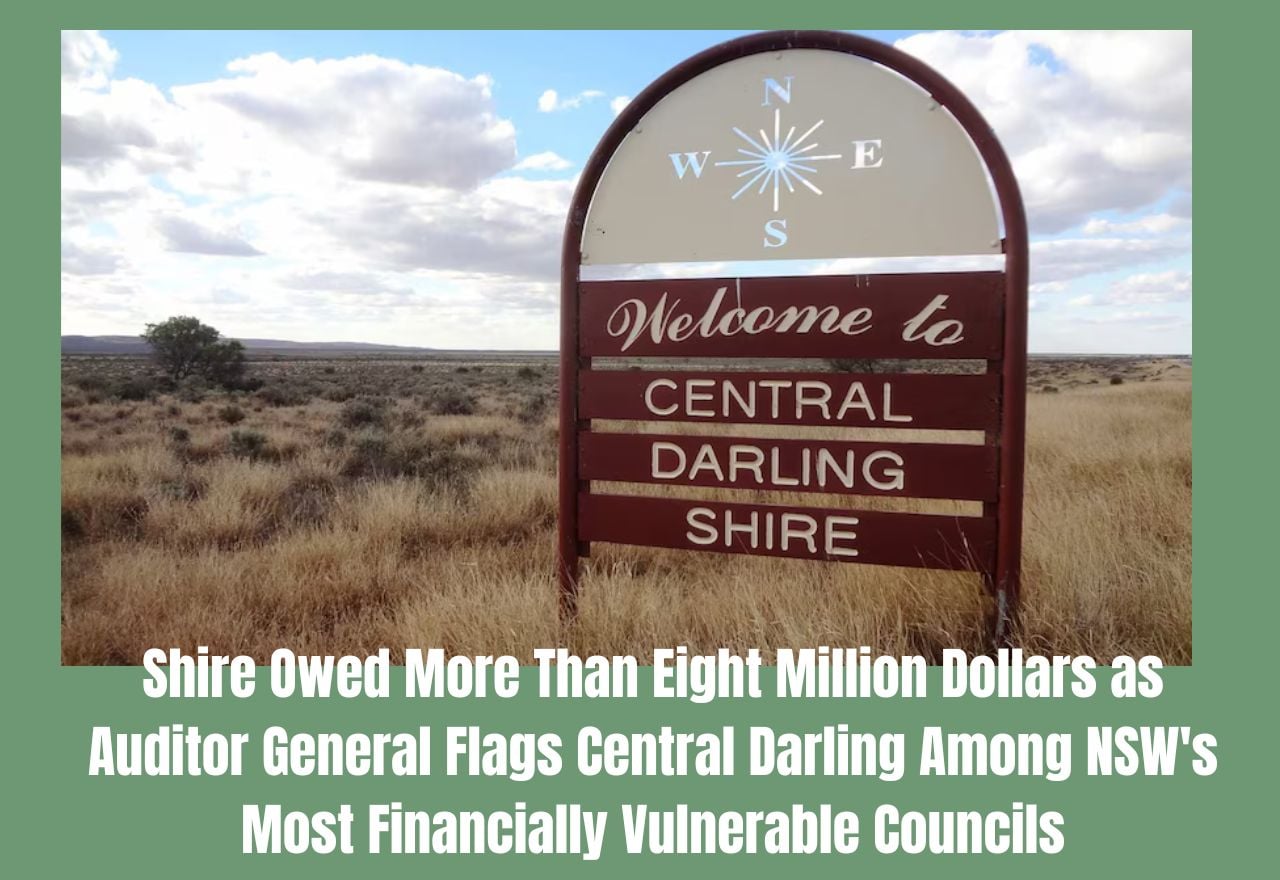
Shire Owed More Than Eight Million Dollars as Auditor General Flags Central Darling Among NSW's Most Financially Vulnerable Councils
Kimberly Grabham
21 February 2026, 7:00 PM
IN SHORT
The NSW Auditor General has identified Central Darling Shire as one of five councils in the state facing serious financial sustainability risks, citing low own-source revenue and high dependence on government grants.
The council holds a cash balance of approximately $1.979 million but is currently owed $8.828 million in outstanding grant reimbursements, because it must fund works upfront before claiming the money back.
Council is now calling on the state to establish a draw-down facility so rural shires can access grant funds as work is performed rather than after the fact.
Central Darling Shire Council (CDS) is carrying more than eight million dollars in debt, thanks to slow payment of grants by the NSW and Federal Governments. It is money that is owed but has not yet been received, forcing the council to operate like a bank for the state and federal governments it serves.
The February ordinary council meeting of CDS heard from the finance manager that the shire's cash balance sits at approximately $1.979 million at the end of January 2026.
But sitting behind it is a debt owed to the council of $8.828 million in outstanding grant reimbursements, money the shire has already spent delivering projects on behalf of state and federal funding programs but has not yet been paid back.
The problem is structural. Under the current system, councils must outlay funds to complete or progress capital works before they can submit a claim for reimbursement. For a large metropolitan council with a deep rates base and strong own-source revenue, that gap between spending and reimbursement is manageable. For a remote shire like Central Darling, which covers one of the largest and most sparsely populated areas in New South Wales, it is a chronic strain on operations.
The NSW Auditor General's 2025 report has identified Central Darling as one of just five councils across the entire state that are currently struggling with financial sustainability. The report points to low own-source revenue and heavy reliance on government grants as the primary risk factors. Those are not criticisms unique to Central Darling. They describe the structural reality facing most remote and rural local governments in Australia, where the rate base is simply too small and too dispersed to generate the income needed to fund services independently.
Council is projecting an end-of-year deficit of $830,000 for the current financial year. At the same time, it is overseeing more than nine million dollars in capital expenditure across roads, aerodromes, water treatment infrastructure and community facilities. The gap between what the shire earns and what it is required to deliver is significant.
In response, councillors have resolved to advocate for the establishment of a state-managed draw-down facility. The proposal would allow councils to access grant funding progressively as work is completed, rather than waiting weeks or months for reimbursement claims to be processed. It is a practical solution that would ease cash flow without changing the total amount of grant funding available.
If Central Darling can leverage its position on the Auditor General's watchlist into a genuine policy change on how grants are paid, the whole region benefits.
NEWS
SPORT

RURAL