Outback legends

Krista Schade
12 January 2026, 4:00 AM
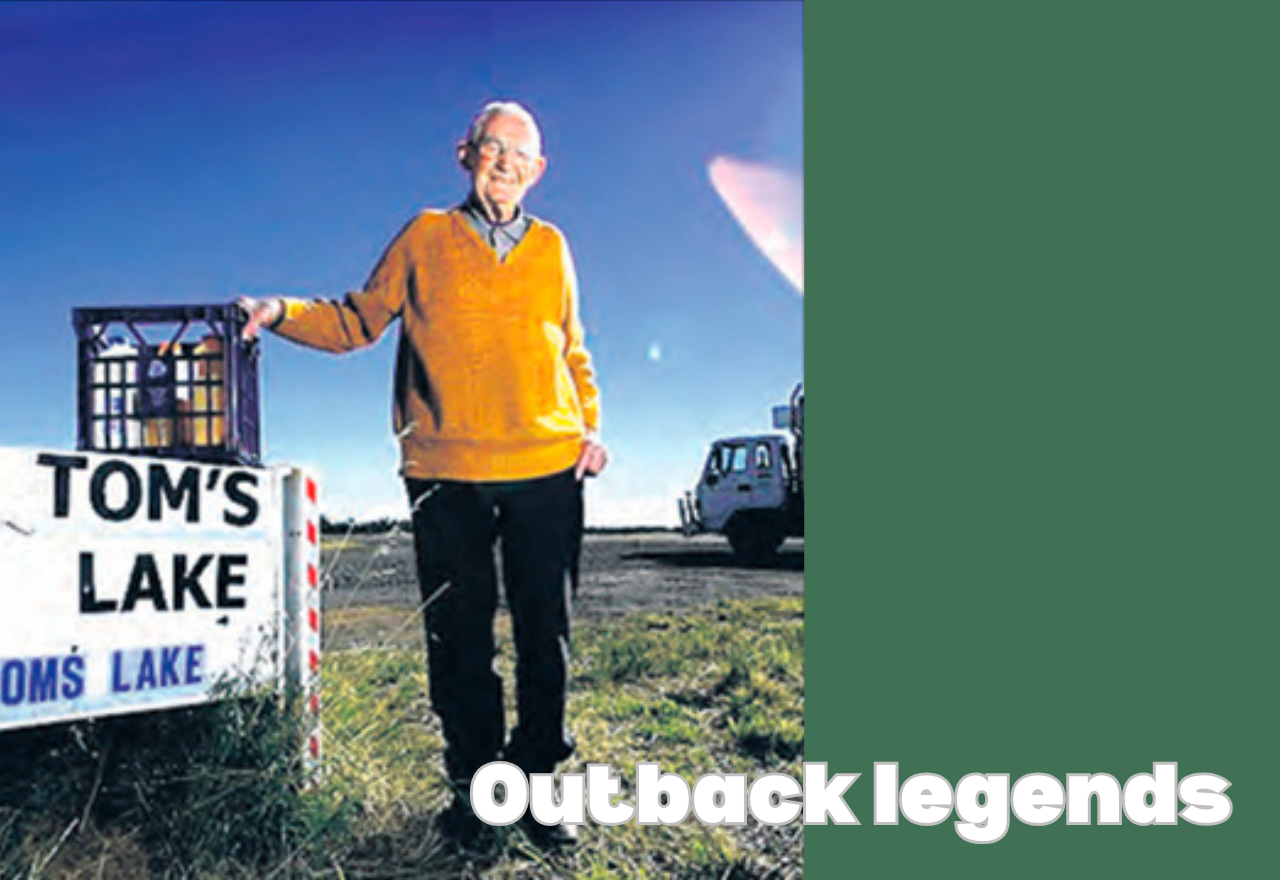
Blogger Kaye Matthews generously shared her work with The Riverine Grazier in 2021. This articles was published in 2009, when she and husband Nigel lived in Ivanhoe.
Nigel was stationed at the Police station for four years, before the family headed back to the coast for a spell, then to a posting in Cobar in 2018.
“My interest in old photos of Ivanhoe was sparked by a lovely lady called Olive Huntly, who showed me some photos of Ivanhoe dust storms over the years. When word of mouth spread and people discov ered that I had an interest in the town’s his tory, then suddenly everyone wanted to share photos and stories with me.
It was a rewarding and welcoming experience. Sadly, Olive has passed on but I wanted to share a story she told me about how a young girl from Victoria came to be raising a family in outback NSW. It seems that at 17, Olive was running late and missed her train.
While she was waiting for the next train, she noticed a newspaper on the bench where she was sit ting and started to read it. Her eyes were drawn to an ad for a gov erness in Mossgiel – a town that she, as a city girl, had never heard of. Olive successfully applied for the job, became a governess and eventually fell in love and married a station owner, settling down and raising a family on Barwonnie Station. Although she sometimes couldn’t help but wonder how different her life would have been if she hadn’t missed that train, there were no regrets. She loved the back country and never left. Perhaps we can all take something from Olive’s story.”
One of Ivanhoe’s best-loved charac ters is Mr Baird, who delivers groceries to the General Store in Ivanhoe as well as door-to-door deliveries of meat orders.
The fact that the locals refer to him as Mr Baird (never Bill) shows the respect that they have for this gentleman of the Bush. Mr Baird’s good friend, Loma Marshall lives up the road at Mossgiel where he would regularly stop for lunch on his way to Ivanhoe. Before the road was tarred, wet weather would see Loma running alongside Mr Baird’s truck so that he didn’t need to slow down (and get bogged) to get his lunch. I didn’t write these two articles but they tell their stories much better than I could. The articles were written by Sam Williams and published in the Daily Telegraph in January (2009) – photos by Nathan Edwards. Most 92-year-olds would be sitting down in front of the TV getting comfortable in their warm socks. But an agile Bill Baird puts on his boots at 5.30am every day to deliver mail, gro ceries and milk to properties between Hay and Ivanhoe – a 420km round trip on the Cobb Highway.
In his seventies, Mr Baird vowed he would retire from the job when he turned 80 – but that day came and passed and he still continues his run. “I keep doing it because it gives me something to get up for in the morning,” he said. While Mr Baird thinks his life’s been unremarkable, locals say he’s an icon and a great man who’s led a colourful life . . from his early milkman days when he gave away milk to those who couldn’t afford it because he believed kids should have milk, to being a POW of the Japanese.
Everyone has a story about him but those on the Cobb Highway said he was a lifeline to town.
Mr Baird grew up on a dairy farm at Hay and worked for his father Tom, who had the milk run. “I never went to school in the depression because you didn’t have to go so I carried the milk on foot and would sell it for tup pence (twopence) a pint,” he said. “I struck a lot of poverty, people would say, ‘Billy don’t call in again . . . I don’t have any money.” In 1940, aged 24, Mr Baird married Doris, who worked at one of the town’s cafes, just months before he joined the army. The following year, he was sent to Singapore where he became a prisoner of the Japanese.
As a POW he suffered from malaria, dengue fever and scabies and was flogged for stealing cans of sardines to feed comrades. He said: “You’d get up every morning vowing they wouldn’t break us.” He worked on the Thai railway and the day the atomic bomb was dropped on Hiroshima, he was 6km away digging for coal. He remembered: “When we came up everything was black . . . raining black soot and there was nothing left. We all got can cer,” he said. When he arrived home, he was ill and stick-thin – but determined to go back to his milk run. He has since driven through dust storms and floods so rural properties could get their mail and necessities. “I’ve seen kids grow up . . . towns come and go – but I wouldn’t change a thing,” he said. There was once a pub, a dozen shops, a racecourse, a hospital, a dance hall and a handful of homes. Now the only resident of Mossgiel is Loma Marshall, a retired drover who bought the old post office for $1500 in the 1970s. Mrs Marshall’s home, that sits on red dusty land at the edge of the Cobb Highway, is the only building that can be seen for kilometres. As she sits on a stool in her rustic kitchen flanked by four of her dogs, Mrs Marshall reflects on her life on the road as a drover.
“They tell me I’m 80 but I think I’m 79 – numbers don’t matter out here,” Mrs Marshall said. “Over the years I’ve seen a lot of good and a lot of bad. I’ve had happy campfires and I’ve had sad ones. “But out on the road is where I wanted to be. “It was a way to make a living. I didn’t like housework or cooking. I wanted to be free in a life with fresh air, adventure and cattle. As long as I wasn’t inside I was happy.”
She grew up on a farm but was too busy chasing wombats to go to school. At the age of 14 she earned money breaking in horses but not long after took to the life of droving with a horse and wagon, moving cattle from Victoria to NSW. “It’s history no one wants to know about,” she said. “It was a tough time where there wasn’t much around.” Daughter Leonee Wright, a saddler in the town of Hay, said her mother was a part of the great Australian pioneering spirit, driv ing livestock in floods and droughts. Mrs Wright said her mother worked as hard as any man in a 24-hour job while raising two children and cooking on a makeshift stove on her own after her hus band died in a truck crash.
“Mum never thought she did much in life, but she is wrong,” Mrs Wright said. “She had a terrible time back then because in those days the perception was that women should have been in the kitchen. But she never sooked when things went wrong or threw her hands up in the air or gave up – she just got on with the job.” While Mrs Marshall said she wasn’t handy in the kitchen, Mrs Wright said her mother could cook anything with such lim ited resources. “When we didn’t have much money mum would whip up an amazing feed from a pigeon or rabbit my brother Bill or I had caught that day,” she said. “We thought life on the road was magic with mum – and looking back I wouldn’t change a thing.” It is through writers such as Kaye that the legacy of legends such as Mrs Huntly, Mr Baird and Mrs Marshall live on. Kaye’s blog “Married to a Country Cop” is a cracking read – find it at mar riedtoacountrycop.com.