A Letter through time: Anthony Bradford’s journey from Hay to building an empire in mental health

Kimberly Grabham
22 December 2025, 4:00 AM
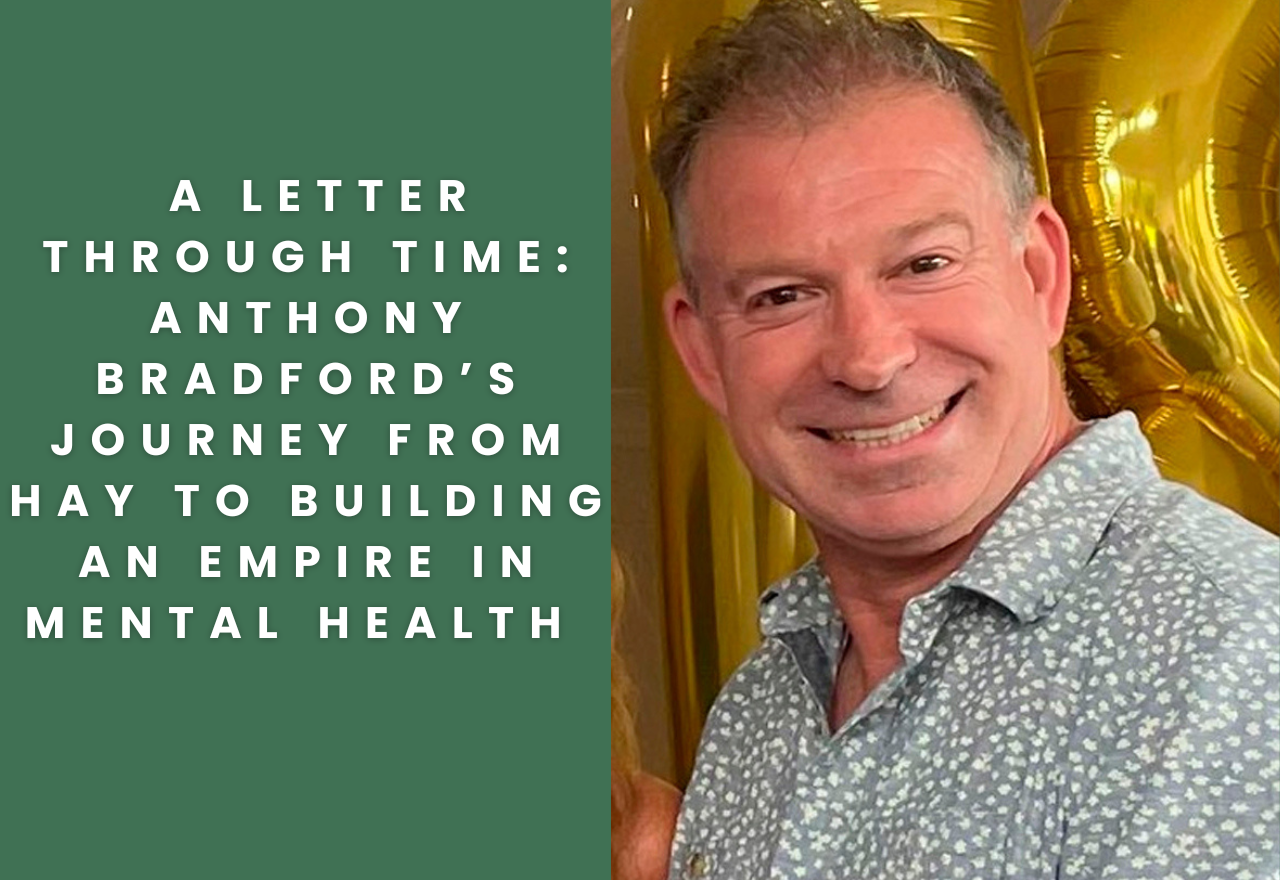
When the Anglican Church time capsule was cracked open, there was excitement in the air, and then dust, and then the first letter was drawn. It was addressed to the future children of Anthony Bradford. Anthony’s hands must have trembled slightly when they handed him the envelope.
Inside the year 2000-time capsule opened in Hay was a letter his grandfather, Jim Bradford Senior, had written to him back in 1972, a letter he’d completely forgotten about.
“I’ve got goosebumps talking about it,” Anthony said, the emotion still fresh despite the years that have passed.
But the story doesn’t end there. Inside that envelope were photographs of his father, Jim Bradford, as a child, images Anthony had never seen before.
So moved by this connection across generations, he made a decision that would create yet another bridge through time. He repurposed those precious photographs and the letter, adding them back into a new time capsule along with photographs of his own wife and messages for his two sons, who didn’t even exist yet when he sealed that capsule in 2000.
“I can't open that letter because it’s not addressed to me,” Anthony explained. “It’s addressed to my two boys.” Now those boys are grown. Eldest son Finn, 22, has just returned from Europe and finished his degree in politics, philosophy and economics at university in Canberra. Sam, turning 19 in January, has just completed first year psychology at ANU, following in his mother Rachel’s footsteps. Anthony is waiting for the right moment to bring them both together to finally open that letter and see what wisdom their father captured for them a quarter century ago. “I’m scratching my head trying to think what it might've been,” he laughed. “I’m a bit scared actually. I’m a bit worried that I haven’t written things like ‘this is the sort of parent that I want to be’ and I hope I’ve actually delivered.” Given what Anthony has achieved since leaving Hay on January 22 1988 at just 17 years old, it seems likely he’s exceeded any expectations he set for himself. The young man who left Hay that day, one of the youngest in his year 12 class, not turning 18 until April, had dreams of exploring the world. Growing up in a family that wasn’t wealthy and didn’t travel much beyond visiting relatives in Wodonga, Anthony saw the defence force as his ticket to adventure. He studied hard, got the marks, and was accepted into the Defence Academy in Canberra. For eight years, he served as a navigator, driving ships and patrol boats around Darwin and Perth before moving to head office in Canberra. But the world he would ultimately explore wasn't mapped in nautical charts, it was the complex landscape of the human mind. After leaving the Navy, Anthony pursued further studies and moved into private consulting.
Then, in 1999, just before he wrote that letter to his future children, he and Rachel started their own business in corporate psychology, specialising in workplace stress. “We had no idea when we started out what our world would become and what we’d end up doing,” Anthony reflected.
“It wasn’t even a grand plan really. It just sort of evolved.” Evolved it certainly did. Over 26 years, they grew that business to employ over 100 psychologists across the country before selling it last year, a life achievement that Anthony suspects featured prominently in the advice he wrote to his sons.
“One of the themes I feel I would’ve written about was when we started our business, you know, the world’s your oyster, have a crack, what’s the worst that can happen? “Believe and succeed, motivational stuff,” he said. all that “Because we specialised in workplace stress, I probably wrote stuff around don’t take life too seriously, enjoy life, seize the day, look after yourself; resilience, mental health, all that sort of stuff.
That’s what our business was all about.” Now, semi-retired and contemplating his next chapter, Anthony has strong views on the mental health crisis facing Australian youth, views shaped by decades of expertise and, no doubt, by watching his own sons navigate modern life. “One in three girls under the age of 16 now has a clinically diagnosed anxiety condition in this country,” he said sombrely, the statistics clearly troubling him.
“Which is outrageous. It is absolutely outrageous.”
The problem, as Anthony sees it, lies in a fundamental misunderstanding of what builds resilience. He speaks passionately about the difference between self-esteem and self efficacy; a distinction most people don’t know exists, but which he believes is crucial to understanding youth mental health. “We’ve focused way too much on self esteem in our society, in our families, in our schools,” he explained.
“Don't upset little Johnny’s feelings, you know, that’s not nice.
“We don’t want to upset anybody. But what's more important is self-efficacy, which is the belief that you can do things. That’s an inner confidence.” Self-efficacy, Anthony explained, is what allows someone who fails an exam or gets rejected from a job interview to think, “Never mind, I’ll be right. I know what I can do. I can try again.”
But developing that confidence requires something modern parenting often denies children, the opportunity to fail and recover.
“You build self-efficacy from having a go, falling off the horse, getting back on,” he said.
“Unfortunately, we see way too often now in the cities where kids aren’t allowed to even get on a horse to start with, let alone risk falling off and hurting themselves.
“That in itself is a really big problem in our society.”
The irony, he said, is that parents have become hyper-focused on protecting children from physical dangers while neglecting the far greater psychological dangers of unlimited internet access. “We focus so much on protecting our children from the outside world in terms of physical danger that we’ve neglected the non-physical danger such as the online space,” he said.
“We just let our kids spend 10 hours a day on the internet in their bedrooms. “We stopped them going out and doing crazy things, riding bikes and climbing trees because they might get hurt, stranger danger and all that. “But online seems to be fine. In fact, it’s the opposite. It’s online that is the most danger, not riding your bike around the river and jumping out of a tree like I used to do.” He’s equally forthright about parenting styles. “You have too much peer parenting. Parents want to be best friends with their kids rather than be parents.
“The old days of tough love, holding people accountable and setting standards, that’s not child abuse, but people confuse it.
“They think saying no to a kid or punishing them, grounding them, taking away pocket money because they didn’t do what they said they were going to do is child abuse. “We can’t hurt their feelings because we’re so desperate for them to be our best friend, to love us, and all that stuff is at the expense of being a parent and holding standards and maintaining accountability.” Its perspective born from both professional expertise, his wife Rachel is “We focus so much on protecting our children from the outside world in terms of physical danger that we’ve neglected the non-physical danger such as the online space.” one of Australia’s leading experts in workplace stress, and personal experience. Anthony looks back fondly on his simple Hay childhood, even as he acknowledges there were parts he didn’t enjoy.
That simplicity, that freedom to explore and take risks, shaped who he became. He still returns to Hay at least once a year, and usually for the Bradford-Harvey family reunion held every five years at Easter. People come from all around the world now for these gatherings, booking out the Hay South Caravan Park, though fewer Bradfords remain in town these days. His younger sister Veronica, is now a humanitarian worker based in Oman, working on Palestinian refugee projects after spending two years in Ukraine. His sister Gaylene is somewhere in between them.
Only a couple of cousins remain in Hay itself. Not this past Anzac Day, but the one before, Anthony gave the commemorative address at the dawn service, a homecoming of sorts for the boy who left at 17 with dreams of seeing the world and ended up building an empire in understanding the human mind. When he finally sits down with Finn and Sam to open that letter from their father’s younger self, Anthony might be surprised by what he reads.
Or perhaps he’ll find that the themes he suspects are there; resilience, self-efficacy, having a go at life, looking after yourself, are exactly the values he’s lived and passed on to his sons through example rather than words. After all, he took his own advice. He had a crack. He believed. He succeeded. And now, one letter from his grandfather and one to his sons bookend a remarkable journey from Hay to the heights of Australian corporate psychology.
This journey started with a simple desire to see the world and ended with helping thousands of Australians navigate the most important landscape of all; their own mental health. The world may have been his oyster, but Anthony Bradford proved that sometimes the greatest adventures aren’t about the places you go, but the lives you touch along the way.
Occasions such as the opening of the time capsule illuminate the fact of what people from Hay who are now spread far and wide around the world have done, and are doing amazing things, and still hold Hay dearly in their hearts.
NEWS

SPORT
RURAL
COMMUNITY

LOCAL WEATHER

FOR SALE


COMMERCIAL PROPERTY